

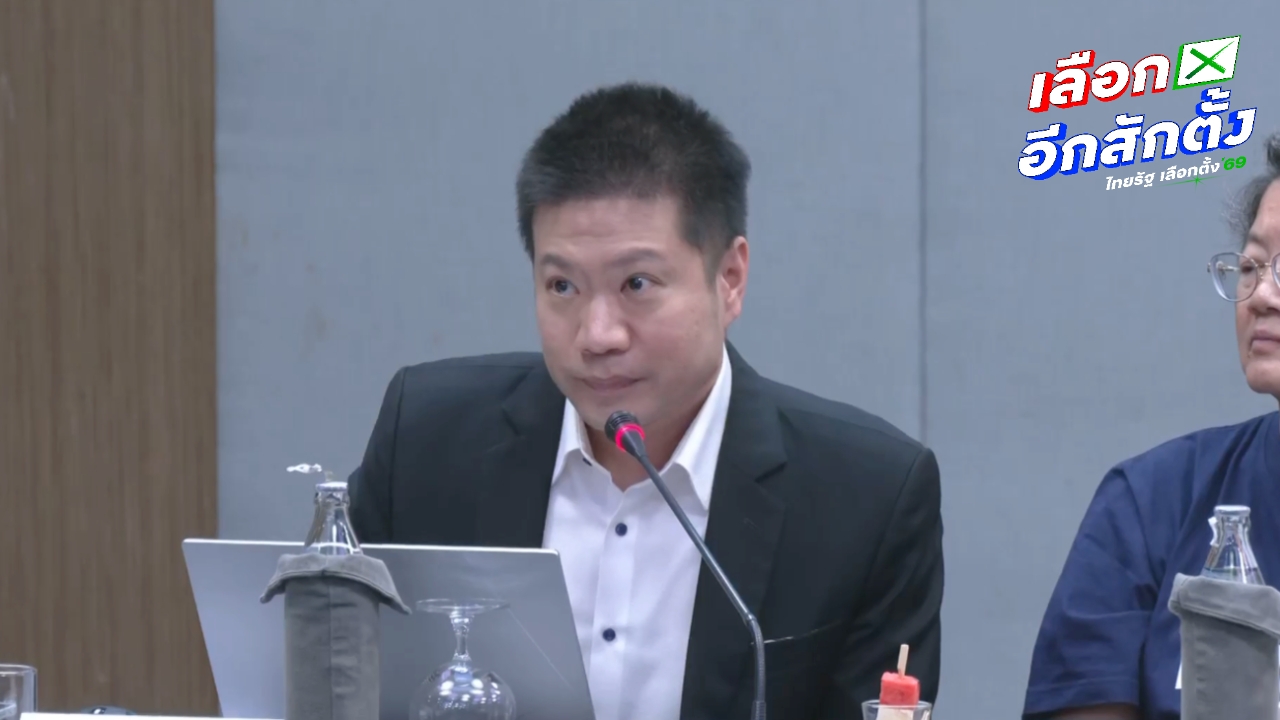
"Dr. Airplane" confirmed that barcodes can trace ballot sequences, raising concerns that those aware of this vulnerability might use the data as Big Data for political planning in the future. Meanwhile, "Somchai" is preparing a simulated election to decode the barcodes and plans to invite diplomats as witnesses.
On 25 February 2026 at Novotel Bangkok Hotel, the Committee for Campaigning for Democracy held a meeting with democratic organizations, academics, and civil society networks to examine election fraud in the 2026 election. They also set strategies to monitor election fraud, scrutinize the Election Commission, propose reforms, and discuss constitutional amendments to reform independent agencies.

Mr. Thamthee Sukchotirat, or Dr. Airplane, director of D-Vote at Sripatum University, explained the method to verify ballots with barcodes that can trace back to the voter. He said that by setting up cameras to record images throughout election day in Bangkok on 22 February, then using AI to estimate voters' choices during the counting phase by analyzing photos of every green and pink ballot, it is possible to match the sequence of voters signing in at the start with the barcode order. This allows identification of which ballot belongs to which voter in the sequence.
Therefore, the design of this process means those intending to commit election fraud can verify whether vote-buying was successful, even if the accuracy isn't 100%. If authorities obtain this data, they could instruct officials in independent agencies and government bodies to build Big Data to strategically ensure political success in the future.

Mr. Thamthee also believes that the next election likely won't use barcodes or QR codes. But since they exist now, and the Election Commission claims they are used to detect counterfeit or altered ballots, a nationwide recount today would reveal the extent of any vote discrepancies.
Meanwhile, Mr. Somchai Srisutthiyakorn, former Election Commissioner, observed that the green ballots with QR codes reflect the ballot book, each containing 20 ballots sharing the same QR code. If this is true, it should not pose a problem for revealing individual voters' choices—unless it is proven that on 8 February the QR codes corresponded not to the ballot book but to individual ballots.

Meanwhile, the pink ballots have a barcode at the bottom that can be scanned by mobile phones, linking to a unique nine-digit code for each ballot. This proves it is unnecessary to have three special items—ballot, stub, and voter list—to identify votes. Simply observing at the polling station is enough, and this is very easy. This issue is not theoretical but demonstrable.
On Wednesday, 4 March 2026, at 13:30, a simulated election will be held using mock ballots resembling those of the Election Commission. Ten media representatives will cast votes in booths and photograph their ballots privately. After voting, five expert teams and five citizen teams—including university students, high school students, elementary students, and general public members—will attempt to decode the ballots within 30 minutes to identify which journalist cast each ballot. This aims to show Thais that ballot designs with barcodes, regardless of stubs, can reveal voter choices. The Parliamentary Committee on Political Development, Public Participation, Human Rights, Freedoms, and Consumer Protection of the Senate will invite foreign ambassadors and academics to comment on the secrecy of the 8 February election and witness the simulation.
Mr. Somchai said the purpose of the simulated election is to prove that ballot designs with barcodes and QR codes are flawed, regardless of any court rulings if this issue is brought to trial.