

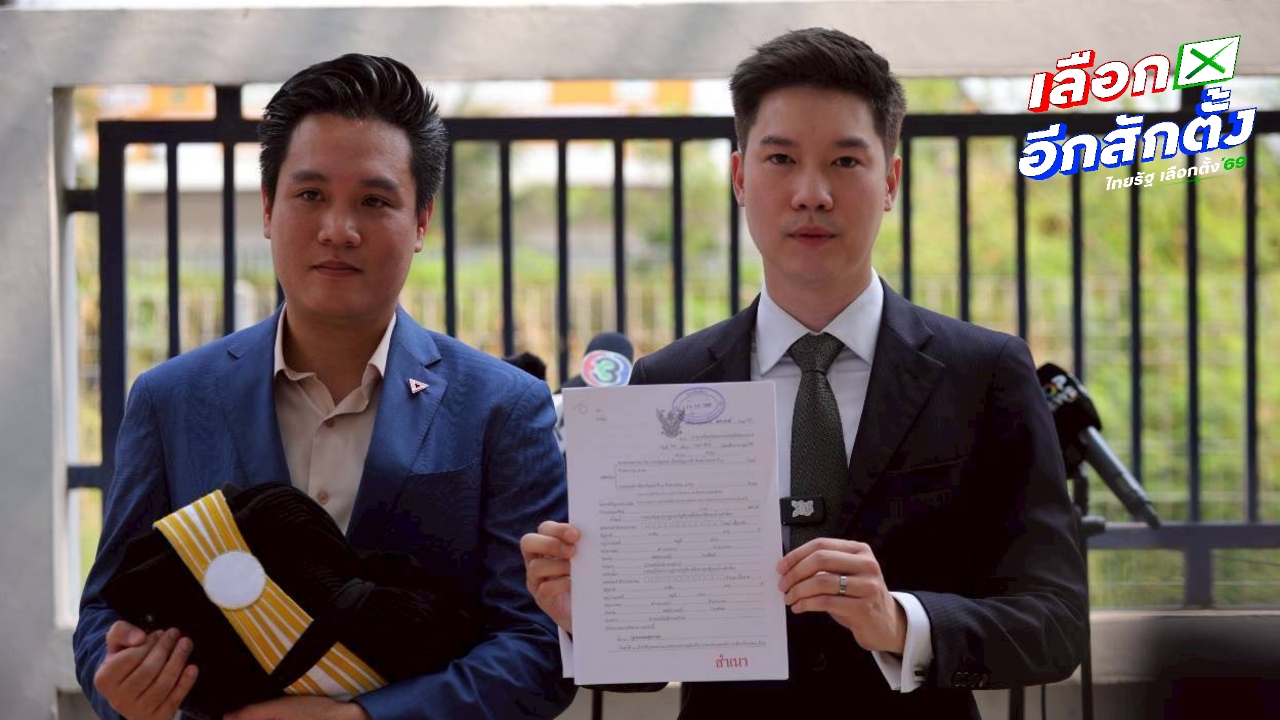
The People's Party dispatched Dr. Vayo to file a criminal complaint against the Election Commission (EC), charging violation of Section 157 combined with the Election Commission Act and the Election Act regarding the addition of barcodes on ballots. They intend to use the EC's lawsuits against citizens marking ballots as part of their case.
On 26 Feb 2026 at the Central Criminal Court for Corruption and Misconduct Cases, Dr. Vayo Asawarungroj, deputy leader of the People's Party, along with legal counsel, filed a criminal case against the Election Commission (EC). The complaint cites Section 157 of the Criminal Code for officials performing duties improperly or neglecting duties to cause harm, as well as the Election Commission Act Section 69 for officials neglecting or improperly performing duties, and the Election of Members of the House of Representatives Act Sections 96 and 164 concerning making identifiable marks on ballots, which is punishable under Section 164.

The case has been officially registered, and a decision is awaited within 30 days on whether to order amendments to the complaint, accept it for trial, or dismiss it. If accepted, a preliminary hearing will be scheduled, likely within 45-60 days from 24 March 2026.
Dr. Vayo stated that many facts have emerged, and there is a precedent case involving Wasana Permlap from 2006, with a Supreme Court ruling issued in 2015. He and his team have studied this case thoroughly and found it quite applicable. That case was judged under the Election Commission Act Section 24 combined with Section 42, comparable to the current Section 69 cited in their complaint. He expects this case will undergo a lengthy legal process through appeals, likely taking around ten years, similar to the Wasana case.
He acknowledged concerns about Section 157 being special; beyond general intent, the plaintiff must prove the defendant had a hidden specific intent to cause harm, which is difficult. The 2015 precedent did not rule under Section 157, so filing under the Election Commission Act Section 69 as well is necessary and likely sufficient to cover the charges.

Dr. Vayo explained differences between this lawsuit and other filings. Complaints to the Ombudsman lead to the Constitutional Court, which lacks jurisdiction over criminal cases but handles position-related matters or election annulments. Administrative courts address administrative orders like election calls or recounts, including ballot printing issues. Their case at the Central Criminal Court for Corruption and Misconduct is criminal. Whether cases are consolidated depends on the court's discretion but is not duplicate filing since different plaintiffs are involved.

He noted that it is generally difficult for citizens to file criminal cases, especially corruption cases against state officials, as evidence procedures differ from typical criminal cases. However, all eligible voters are considered victims with a legitimate right to sue the EC. Citing a 2016 precedent, the court ruled that elections must be fair and honest, and any acts widely affecting voters' rights make all voters legal victims. This is rooted in the constitutional and legal protections of privacy and the direct, secret nature of elections.
Dr. Vayo added that as a political party, there are concerns about election integrity and economic damages. Since political parties are established under the Political Parties Act to nominate representatives, propose policies, and serve the people, the economic costs and activities involved mean that unfair, inaccurate, or non-secret elections cause harm to parties as well.

When asked about the EC in Bangkok suing citizens, Dr. Vayo said the EC claimed it must sue citizens or face Section 157 penalties, asserting it acts within its duties. However, he argued that the EC’s action risks violating Section 157 more, as the EC has discretion over whom to sue and is not legally mandated to sue in every circumstance. The EC should evaluate if suing benefits the public interest.
He plans to amend their complaint within 15 days to include that the EC’s actions constitute discriminatory enforcement and improper performance of duties causing harm. The EC suing citizens who expose irregularities while failing to form investigative committees under their authority shows selective enforcement, consistent with facts from 2006.
Dr. Vayo concluded that it remains very difficult for citizens to take action against independent organizations' officials. This case clearly shows the power and duties of independent bodies, highlighting their disconnect from the public and the lack of mechanisms for citizens to initiate opposition or removal of such organizations.