

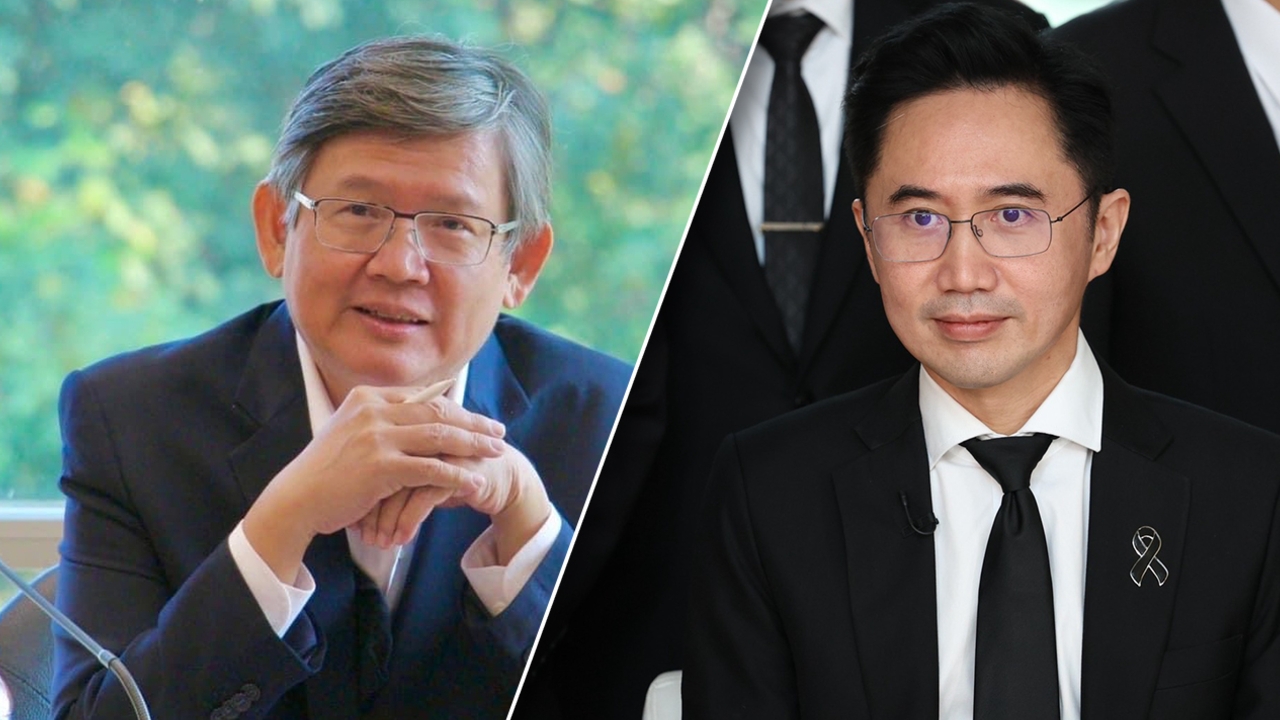
Suwit Mesentrii, former Minister of Higher Education, Science, Research and Innovation, explains why Yotsanan Wongsawat should be Minister of the same department, emphasizing the opportunity to concretely reset the nation's Technosphere direction.
On 28 Feb 2026 GMT+7, Mr. Suwit Mesentrii, former Minister of Higher Education, Science, Research and Innovation, posted on Facebook explaining why Mr. Yotsanan Wongsawat, a candidate for Prime Minister and future party-list MP for the Pheu Thai Party, is the leader Thailand needs to drive the Fourth Human Evolution through the Ministry of Higher Education, Science, Research and Innovation.
Mr. Suwit stated that humanity is approaching a pivotal transition—from agriculture to industry, to digital, and now to the Fourth Human Evolution era, where the Technosphere is no longer merely a "tool" but has become a "power structure" shaping the economy, society, and even the meaning of being human.
Technologies like AI, Neurotechnology, Bioengineering, Quantum Computing, and Data Infrastructure are systematically transforming thinking, decision-making, and the balance of power between the state and market. Thailand’s key question is not how to use technology but how to design its own Technosphere to preserve sovereignty and civilizational balance. Thus, the Ministry is not just a “research budget agency” but the country’s strategic core.
1. The Ministry is the nation's strategic lever within the Four Civilizational Layers framework (detailed in a prior article). It oversees the Technosphere, the fastest-growing domain with the deepest impact on the country.
Today’s Technosphere defines
• The digital economic structure,
• Competitive capabilities,
• Cybersecurity,
• Information systems,
• Social power balance.
Without leadership that comprehends the Technosphere system, growth will be directionless and inevitably clash with the Biosphere, Sociosphere, and Ecosphere.
2. Why Professor Yotsanan is suitable: 1) A systems thinker rather than just an administrator. As former Vice President for Research at Mahidol University, he oversaw research strategies encompassing quality, international standards, funding allocation, academic integrity, and linking research to industry. The country needs a policy integrator who understands connections between
• AI and labor,
• Research and real economy,
• Universities and security,
• Technology and ethics.
In this civilizational shift, an integrator is needed more than a bureaucrat.
2) Architectural tech literacy. Governing AI and deep tech requires profound structural understanding, not superficial policy knowledge. His background in Brain Engineering and Neurotechnology — connecting Brain–Computer Interface, Neuro-modulation, and AI — clarifies that technology touches the very core of humanity. The minister must be able to
• Engage with advanced researchers,
• Understand the data ecosystem,
• Perceive the impact of algorithmic governance.
This architectural knowledge is the minimum requirement for leading the Technosphere.
3) Moral framing of technology. Thailand should avoid extremes between Silicon Valley’s laissez-faire and authoritarian tech models. It needs a tech-moral path that embraces technological power alongside ethical principles. A leader who understands AI as not just a productivity tool but as a power structure is best suited to establish the country’s tech-moral discipline framework.
3. Strategic agenda requiring leadership: To advance its own version of the Fourth Human Evolution, the Minister must act as the chief architect of Thailand’s tech-moral civilization.
Urgent agendas include:
1. Developing the Thailand Tech-Moral Framework,
2. Establishing AI oversight architecture,
3. Shifting university KPIs from paper-based to impact-based,
4. Allocating research budgets according to the Four Civilizational Layers,
5. Building a human augmentation economy instead of an AI displacement economy.
These agendas are not incremental reforms but a re-architecting of the entire system.
4. Thailand’s window of opportunity: The country faces three major risks:
• High dependence on foreign technology,
• Universities disconnected from the real economy,
• Delayed AI governance.
If the ministry functions merely as a funding agency, the country risks losing another decade. But if it is seen as a strategic lever, Thailand can reposition itself as ASEAN’s tech-moral hub.
5. Beyond the minister — toward civilizational leadership: Ordinary ministers manage budgets, but ministers at civilizational crossroads manage the “direction of the system.” Professor Yotsanan’s role should extend beyond administration to designing Technosphere balance aligned with
• The Biosphere (basic security)
• The Sociosphere (justice)
• The Ecosphere (sustainability)
to establish a principled, sustainable technological civilization foundation.
Mr. Suwit concluded that in this century, sovereignty is measured not only by military power but by the ability to govern AI and deep tech. The Minister of Higher Education, Science, Research and Innovation is the chief architect of Thailand’s Technosphere. The question is not who can manage it but who can design its future. If Professor Yotsanan Wongsawat is entrusted with this role, it represents not merely a personnel change but a concrete opportunity to reset the nation’s Technosphere direction.