

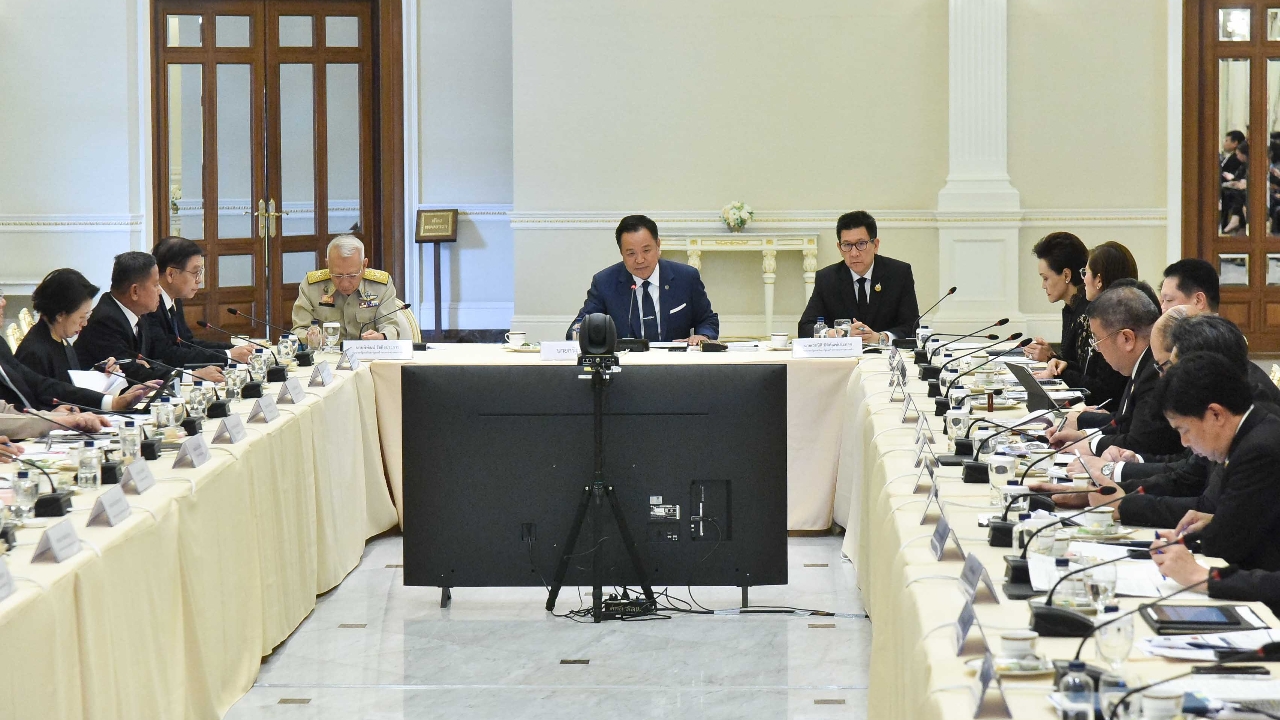
The Prime Minister acknowledged that the conflict in the Middle East impacts Thailand and called a meeting with economic agencies to assess the situation, limit damage, and ease the hardship for the public as much as possible.
At 13:30 on 2 Mar 2026 at Government House, a meeting was held to assess the impact of the Middle East conflict. The meeting was chaired by Prime Minister and Minister of Interior Anutin Charnvirakul, joined by Deputy Prime Minister and Minister of Transport Phiphat Ratchakitprakarn, Deputy Prime Minister and Minister of Finance Anek Laothamatas, Minister of Foreign Affairs Sihasak Phuangketkaew, Minister of Commerce Supachai Sutthumpun, Minister of Labour Treenuch Thienthong, Secretary-General of the Council of State Pakorn Nilprapunt, Secretary-General of the National Economic and Social Development Council Danucha Pichayanan, along with permanent secretaries and relevant officials.
Additionally, Energy Minister Atthapol Rerkpiboon joined the meeting via video conference due to being on an overseas assignment.
Prime Minister Anutin opened the meeting by noting the intense military conflict in the Middle East since 28 February. The attacks remain focused on military targets, and Iran has retaliated by striking several countries in the region and targeting oil tankers in the Strait of Hormuz. Thailand will inevitably be affected to some extent. This meeting on 2 March 2026 aims to prepare measures to minimize potential damage to Thailand as much as possible.

Anutin added that a National Security Council meeting was held earlier that morning to address issues ensuring Thailand’s security and stability amid the situation. In the afternoon, discussions will continue focusing on economic and private sector measures to alleviate hardships for the Thai people as much as possible.
He also said that assistance is already underway for Thai citizens in the affected countries. Support will be provided in all forms. For those in Iran, efforts are being accelerated to repatriate them to Thailand as a priority. For other countries, coordination will continue to facilitate assistance for those wishing to return.
In today’s meeting, all attendees are urged to jointly assess possible future developments, keeping in mind the impact on Thai citizens and businesses abroad, especially regarding personal safety and property. The economic effects on Thailand, both direct and indirect, include energy prices, trade, investment, exports, tourism, and the cost of living. The meeting is open to clear, actionable proposals and responses to mitigate impacts on the private sector and public, enabling normal business operations to continue.