

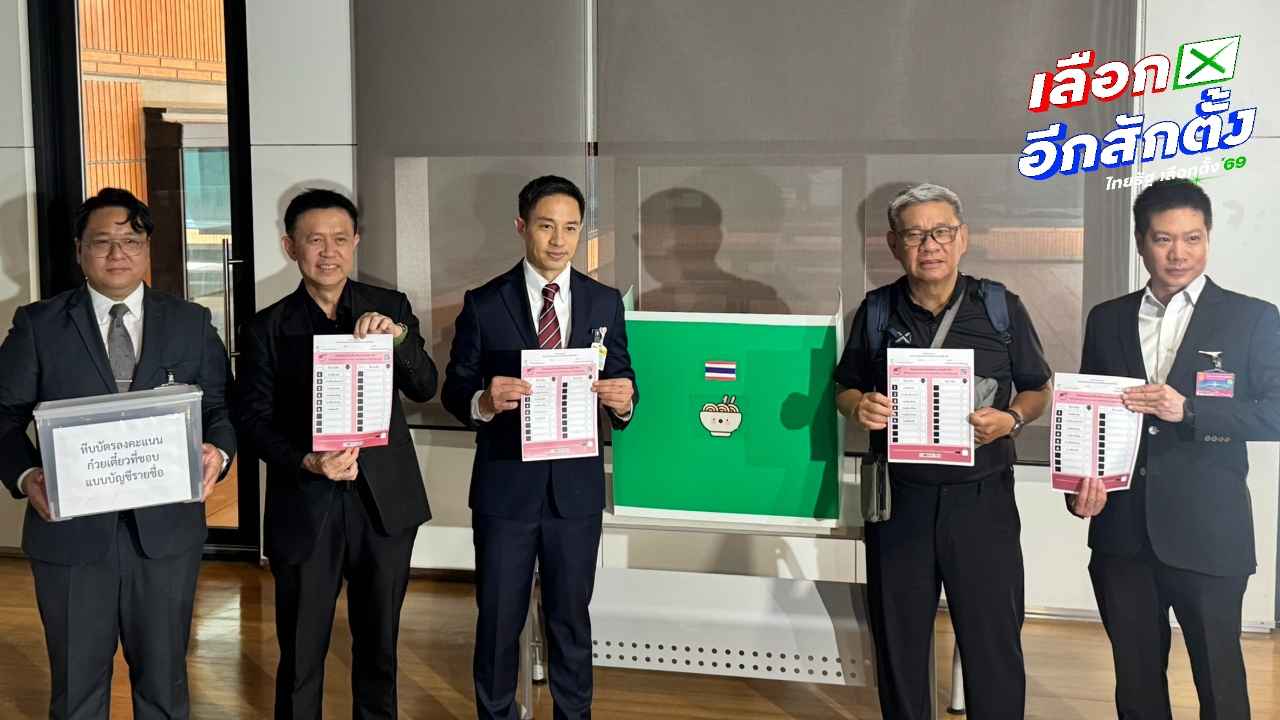
"Somchai and Dr. Reuban" inspect the simulated election site before meeting with the Senate Committee on Political Development.4 March.This to test pink ballots equipped withbarcodes to see if voters can be traced.Senator Naretchet confirms no political issues involved. All parties invited to observe, including Wisanu, Bowornsak, Charan, Jes, alongside "ambassadors from 7 countries."
On 2 March 2026 at 14:00 at the parliament, Mr. Somchai Srisutthiyakorn, academic and former Election Commissioner, along with Mr. Tamthee Sukchotirat, director of DeeVote at Sripatum University, and Mr. Thanarat Kuawatthanapan,,CEO of Domecloud and a blockchain technology software expert, who is among the six individualsnamed in the Election Commission's lawsuit for obstructing elections, visited parliament to survey the area in the Members' Reception Hall on the 2nd floor. They prepared for a simulated election on Wednesday, 4 March 2026 from 13:30 to 15:00 with Senator Naretchet Pratchyakorn, chairman of the Senate Committee on Political Development.At the venue, a proper election simulation was set up with staff arranging voting booths and ballot boxes.
Additionally, officials displayed the pink sample ballots featuring barcodes.These ballots included six choice options: number 1 boat noodles, number 2 yen ta fo noodles, number 3 tom yum noodles, number 4 stewed beef noodles, number 5 bitter melon chicken noodles,and number 6 duck noodles. For this election, a team of ten reporters was designated to vote.
Senator Naretchet said that on Wednesday, 4 March 2026 from 13:30 to 15:00, the Senate Committee on Political Development will meet and conduct a simulated election to verify whether ballots with barcodes, which have raised public concern, can be traced back to individual voters. This remains a debated issue in society, and the simulation aims to ensure transparency and gather opinions on how to handle such processes if tracing is possible.To ensure transparency, the committee coordinated with Mr. Somchai Srisutthiyakorn, academic and former Election Commissioner, to demonstrate the simulated election process on that day. Journalists have also been invited to observe this simulation.They will examine whether the barcodes on the ballots
can be hacked or not.
All parties are invited to observe, including Wisanu, Bowornsak, Charan, Jes, along with ambassadors from seven countries.Initially, the Committee on Political Development invited foreign observers, including ambassadors from Japan, the United States, Canada, Australia, and Norway, to participate in observation. They also invited academics who have commented on these issues, as well as citizenswho are being prosecuted by the Election Commission.
"The committee issued invitations to foreign observers, specifically ambassadors from seven countries such as Japan, the U.S., Canada, Australia, and Norway. They also invited scholars who have expressed opinions on these issues, including Mr. Wisanu Kreuangam, member of the Council of State; Mr. Charan Phakdithanakul, former Constitutional Court justice; Mr. Bowornsak Uwanno, Deputy Prime Minister for Legal Affairs; and Mr. Jes Tonawanik, a candidate for Prime Minister from the Rakchat Party. Additionally, groups prosecuted by the Election Commission and the entire central Election Commission, including the Secretary-General, were invited to observe and verify the facts. Our intention is to scientifically and academically prove whether the disputed barcode on the ballots really keeps voter secrecy. We encourage everyone to join the observation on the specified date and time," he said.This election simulation is free of any political issues and aims only to provide a platform to verify whether barcode ballots pose risks. If future elections continue to use barcodes, it may affect voters' decision-making freedom. The Election Commission will use the findings from this experiment to consider and improve future elections, inviting everyone to participate in decoding and observation," Senator Naretchet added.Additionally, the Committee on Political Development will send letters
inviting the Chairman and members of the Election Commission
to join the observation and fact verification of this event.
Senator Naretchet further revealed that the election simulation will be heldon Wednesday,4 March 2026 in the Members' Reception Hall, 2nd floor, preparing for the simulated election from 13:30 to 15:00. He emphasized that this simulationdoes not involve any political issues.Meanwhile, Mr. Somchai Srisutthiyakorn, former Election Commissioner, thanked the Senate President for providing the venue to prove the facts, stressing that the key issue is not about fault or election problems but rather the "design of the ballot" which features a barcode at the bottom. Each barcode is a unique, one-to-one serial number.
Mr. Somchai stated that such a design is "dangerous" because even without the stub, a voter list, or removing ballots during counting, it might still be possible to prove who voted for whom, especially in small areas like villages or polling stations where everyone knows each other, potentially compromising voter secrecy.To verify this concern, a simulation will have about ten representatives cast votes secretly. After voting, the ballot box will be sealed and counted following Election Commission procedures. Volunteers and media will analyze the barcode ballots to determine whether it is possible to identify who voted for whom.This process is open to journalists, senators, and even the Election Commission to observe and analyze collectively. The goal is that if decoding can link ballots to individuals, it will be a strong reason to discontinue such ballot designs in the future to protect the fundamental principles of secret and fair elections.


