

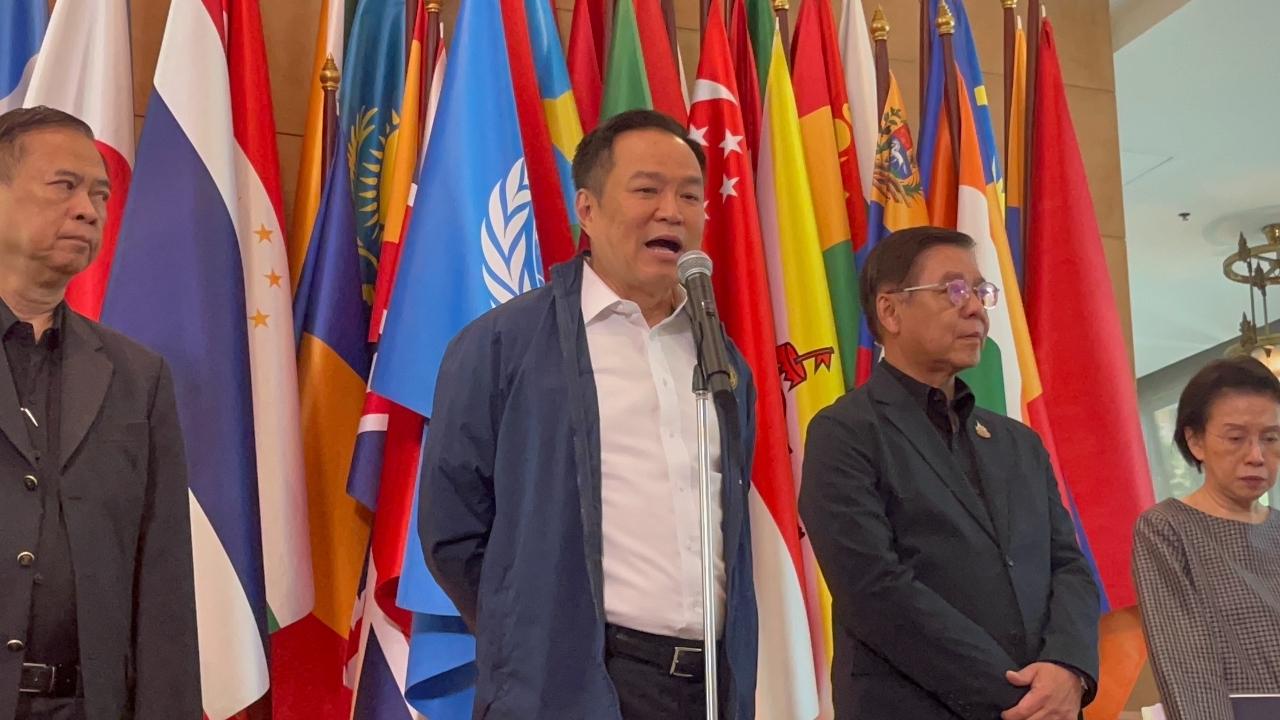
The Prime Minister has ordered urgent adjustments to expedite the evacuation of 300 Thais in Iran, confirming that oil reserves are sufficient and not at a crisis point. Tomorrow, he will call the Ministries of Energy and Commerce to discuss stabilizing prices as much as possible to handle a prolonged situation.
On 3 Mar 2026 GMT+7, Anutin Charnvirakul, the Prime Minister and Minister of Interior, along with Sihasak Puangketkaew, Minister of Foreign Affairs, held a press conference after a meeting with ambassadors and Foreign Ministry offices in Middle Eastern countries to hear updates on the situation in each country, proposals, and preparations to facilitate Thai citizens residing there.
Anutin stated that the government listens to all problems, but overall, morale remains good. Regarding advice for Thais to protect themselves from attacks, embassies in each country have coordinated, and the Thai government has identified Iran as the most dangerous area. They will expedite the evacuation of about 300 Thais, including government officials, to withdraw and regroup by leaving Iran first and returning to Thailand.
"We are not exceeding 300 people. It's fortunate that we can manage the movement of these individuals within our available capacity," Anutin said.
He added that coordination will happen as quickly as possible. Thailand is fully prepared to bring its citizens home, with remaining tasks involving embassy coordination for exit visas, not just entry visas. They cannot wait for everyone to have complete documents because the public service system in Iran is currently not functioning normally, so all possible measures must be taken.
When asked about his main concerns, Anutin said the greatest worry is the safety of Thais. Most have been advised on how to behave, and the countries involved have security systems, especially those with strong economies. Nevertheless, Thailand remains concerned and has instructed ambassadors to provide full facilitation. Those wishing to return to Thailand must receive all possible assistance. Currently, he praised the spirit of Thais, noting that less than 25% have returned, showing confidence in their ability to live in the area.
Regarding how many Thais in Israel wish to return, Anutin said there are over 60,000 Thais living there, with only about 20 expressing a desire to return. This number may increase if circumstances change. He noted his past close work with the Ministry of Interior and Deputy Prime Minister roles, coordinating with the embassy. Most Thais working there are in agriculture and live in safe areas, though some are in Gaza Strip areas from which evacuation is necessary. He also met with the Thai ambassador to Israel, who reported that Thais there remain confident and able to care for themselves.
When asked about 1,000 Thais in the United Arab Emirates wishing to return, Anutin said that according to earlier data, many wish to return. The UAE is a travel hub with many options for normal travel home. However, the government has prepared plans in case people cannot leave one country; the embassy will arrange transfers to another city with open airspace to enable return to their hometowns.
Regarding the closure of the Strait of Hormuz, Anutin said the government has oil management measures. Though some have said Thai oil is in private hands, this refers to PTT, a private company with a majority state shareholding. The government has legal authority to prohibit oil exports if necessary for national security. Currently, Thailand bans oil exports except to Laos due to close relations and economic ties. Thailand still relies on electricity from Laos and sends 7 million liters of refined oil daily to Laos, with the rest exported elsewhere.
"Regarding the remaining 30 million liters that generate income from exports, if the situation worsens, we will reconsider. We export out of neighborly relations and because we rely on electricity imports from Laos, which uses mostly hydroelectric power. If necessary, we have domestic power production capacity to use. If we fix prices now, when we need Laos, it may cause problems. We are not at that point yet," Anutin said.
When asked if a price review is needed after recent oil price increases, Anutin said prices must be managed, but market mechanisms apply. Thailand still aims to stabilize prices as much as possible. Yesterday, the government assessed the situation, and tomorrow they will meet with the Ministries of Commerce and Energy to discuss price controls on goods affected by living costs.
Regarding public panic buying of fuel, the Prime Minister said people are alert, which is acceptable, but assured that the situation is not yet critical. Oil reserves are sufficient and usable beyond just 60 days. Even if no crude oil comes in, Thailand imports from regions beyond the Middle East. Although global production has declined, market mechanisms affect oil prices, such as gas prices, which require consideration on how to address.
When asked if additional oil sources are needed, the Prime Minister said Thailand's daily consumption remains sufficient according to the latest information. He has instructed the Ministry of Energy and PTT to communicate clearly to reassure the public. The Commerce Ministry Permanent Secretary, who chairs PTT, has been told to provide explanations to build confidence.
Asked about concerns over a potentially prolonged one-month situation, Anutin said even one day is worrying because this is a war with destruction. Thailand’s approach is: "Don't let the rain falling over there make it cold here." They must prioritize Thai safety, control living costs, stabilize product prices to prevent exploitation, and manage fuel reserves, which are essential for domestic use. The situation changes daily, so no definite end is predicted, but they hope nothing affects Thailand. The government’s priority is to minimize impact on Thailand and its people.
Additionally, the Foreign Minister and Permanent Secretary have been instructed to set up a press center to provide continuous updates. The public is urged to follow daily press briefings.
When asked about confidence in ensuring tourism safety, the Prime Minister said safety concerns extend beyond tourism to include residents from the countries involved living in Thailand. He has instructed security agencies and the Royal Police Commissioner to acknowledge the urgent need for measures. Yesterday’s National Security Council meeting assigned responsibilities accordingly.
On whether a new government formation is urgent for unified problem-solving, the Prime Minister said he hopes the MPs’ certification occurs soon. Meanwhile, the current government continues to administer the country, especially during crises. He is ready to fully use all networks to protect Thai interests, regardless of caretaker status. After the election, the government is prohibited from binding future budgets, so budget discussions are not timely now. Senior civil service appointments are not in the transfer season, so those issues are also set aside. Apart from that, the government can operate normally, regardless of the cabinet. Thailand must always have a functioning government.
Today, priority is the rapid evacuation of about 270 to 300 Thais from Iran, as conditions allow. One plane can bring them back, either a charter or a Thai government flight. All options are open. The Thai ambassador to Iran is fully prepared.