

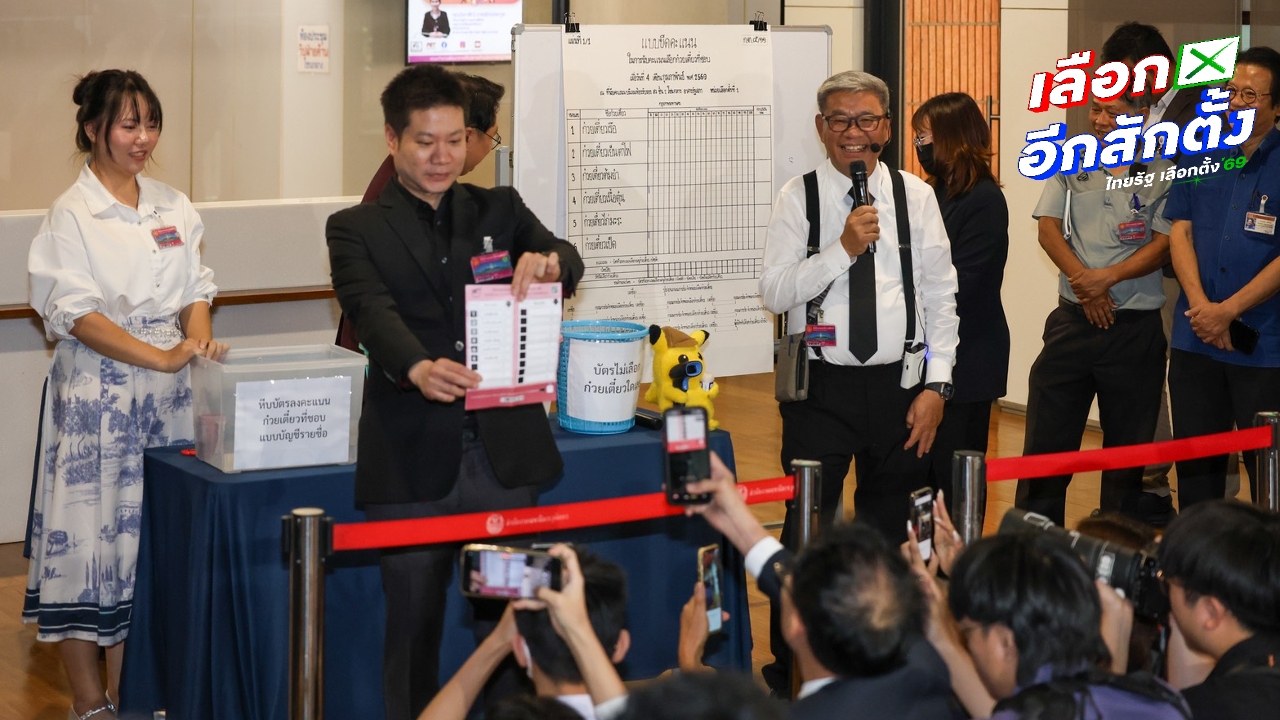
A mock election test involving volunteers investigating barcode data on ballots revealed startling findings: it is possible to know exactly who voted for whom without needing original ballot stubs. The chairman of the Senate Political Development Committee affirmed the objective was to uncover academic truths about the issue.
On 4 Mar 2026 GMT+7, at the Parliament, the Senate Political Development Committee collaborated with citizen volunteers to conduct a mock election testing barcode ballots, aiming to trace their origin. They invited Somchai Srisuthiyakorn, former Election Commission member and academic; Thamthee Sukchotirat, director of DeeVote at Sripatum University; and Thanarat Kuwattanapan, CEO of Domecloud and blockchain technology expert, to participate in the voting test.
The event included election observers, citizen volunteers acting as investigators, and members of the media, such as Associate Professor Prinya Thewanaruemitkul, academic; Somboon Boonngam-anong; Dr. Jest Tonawanik, prime ministerial candidate from the Pheu Chart Party; and other scholars.

Noraset Prachayakorn, chairman of the Senate Political Development Committee, stated that prior coordination acknowledged risks associated with the barcode data, which many found concerning. He noted it would be beneficial to provide clear information and create a space for academic study. The committee could open this platform to prove whether barcodes on ballots allow retrospective identification of individual voters and assess the risks involved.
He further explained the committee's intent was purely academic—to study and report the findings to relevant agencies. He emphasized that the test would be scientific and hoped everyone would learn from the process. The conclusions would not interpret legal issues concerning constitutionality or liability. The committee’s scope was limited to proving the risk related solely to the presence of barcodes on ballots.
Somchai explained the rules: ten citizen volunteers would identify themselves to receive ballots, enter voting booths, and mark their preferred noodle dish on the party-list ballots, completing the full process before revealing results. The test aimed to see if the investigators could determine how each of the ten voted. Each volunteer would identify themselves individually and sign for their ballot. The investigator teams could collect all data during the voting demonstration. After the ten volunteers voted and the ballot box was opened, Somchai allowed the ten investigator volunteers to begin tracing information from the noodle-choice ballots.
The test results showed one team correctly guessed all ten volunteer votes on the noodle-choice ballots, while other teams achieved 70% and 40% accuracy. Those who erred admitted to negligence and errors in collecting video clips from ballots, where barcode images were unclear, causing mistakes.
The team with perfect results revealed their method: they photographed the QR codes and initially used general QR code scanning apps but found LINE’s QR code scanner easier and more effective. Using LINE’s live QR code scanning, they obtained highly accurate data. They also shared that as long as the QR code is clearly captured, the correct information can be retrieved immediately.
Somboon stated the key question is the true intent behind this: whether the process aims to keep elections confidential. He warned that silencing the public over this issue is serious and could potentially undermine future elections. If this method continues to be used, elections will no longer be secret.


