

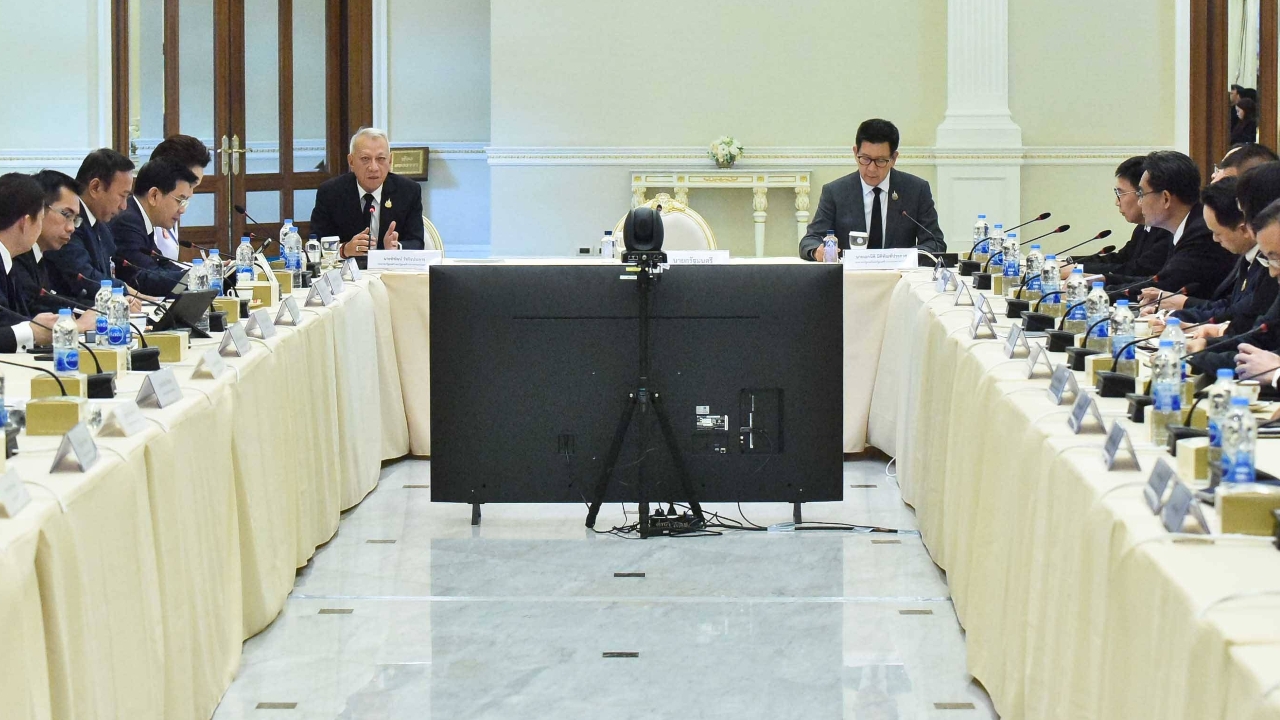
The Prime Minister assigned Phiphat and Aekniti as joint chairmen to discuss responses to the Middle East war situation, planning measures to increase the country's oil reserves, and invited the Securities and Exchange Commission (SEC), Stock Exchange of Thailand (SET), and the Bank of Thailand to assess impacts from all dimensions.
At 16:30 on 4 Mar 2026 GMT+7, at Phakdi Bodin Building, Government House, Deputy Prime Minister and Minister of Transport Phiphat Ratchakitprakarn and Deputy Prime Minister and Minister of Finance Aekniti Nitithanprapas co-chaired the second meeting of 2026 to assess the ongoing conflict in the Middle East, as assigned by Prime Minister and Minister of Interior Anutin Charnvirakul. Also present were Commerce Minister Supachai Sutthammanoon, Permanent Secretary of Commerce Wutikrai Leewiraphan, Secretary-General of the Council of State Pakorn Nilprapan, Deputy Permanent Secretary of Energy Sompop Patnariyangkul, Director-General of the Energy Business Department Sarawut Kaewtatip, representatives from the Thai Chamber of Commerce, and other relevant agencies. Energy Minister Atthapol Rerkpiboon attended via videoconference due to overseas commitments.

At the start of the meeting, Phiphat said the situation in the Middle East directly impacts Thailand, especially oil prices. When oil prices fluctuate, the government must discuss with various agencies about product prices, transport costs, and fuel prices at service stations, as well as how to manage the situation. The Ministry of Energy estimates domestic oil reserves sufficient for 60 days but believes this period can be extended by suspending some nonessential activities. For example, they are considering halting exports of surplus oil stored on floating storage vessels without prior contracts to retain this oil domestically. They must evaluate where to store this oil and consult with all operators about available tank capacity and cooperative storage if volumes exceed storage limits. This requires discussions with all operators to manage the situation effectively.
Regarding gasoline and diesel, if a further supply shock occurs, it may be necessary to adjust the fuel blending formulas for retail sales. Currently, diesel B5 contains 5% biodiesel (B100); they are considering whether to increase this to B7 or B10. For gasohol, they may increase the alcohol blend ratio. Multiple options will be discussed to develop measures to address this situation.

Deputy Prime Minister Aekniti said he discussed the situation with the Prime Minister earlier today. They have invited private sector representatives, including the joint public-private committee of three institutions, to ensure consistent information sharing. The Prime Minister has assigned the Ministry of Foreign Affairs as the central agency to coordinate and gather information, liaising with spokespersons of various ministries. The Ministry of Foreign Affairs will update the situation from the front lines to provide accurate information. This process helps determine which news is true or false to prevent panic. Regular updates will enable the war room to assess economic, trade, and investment impacts comprehensively.
Key issues to monitor include:
1. Oil-related matters, overseen by the Ministry of Energy.
2. Transportation issues, managed by the Ministry of Transport.
3. Product prices, monitored by the Ministry of Commerce.


Meanwhile, today the Stock Exchange of Thailand (SET) management and the Securities and Exchange Commission (SEC) were invited to the meeting to assess capital market conditions. The Governor of the Bank of Thailand assigned a deputy governor to attend, focusing on currency impacts. This comprehensive assessment aims to formulate necessary measures. Following the meeting, the Prime Minister will summarize and announce the measures to manage the situation.

