

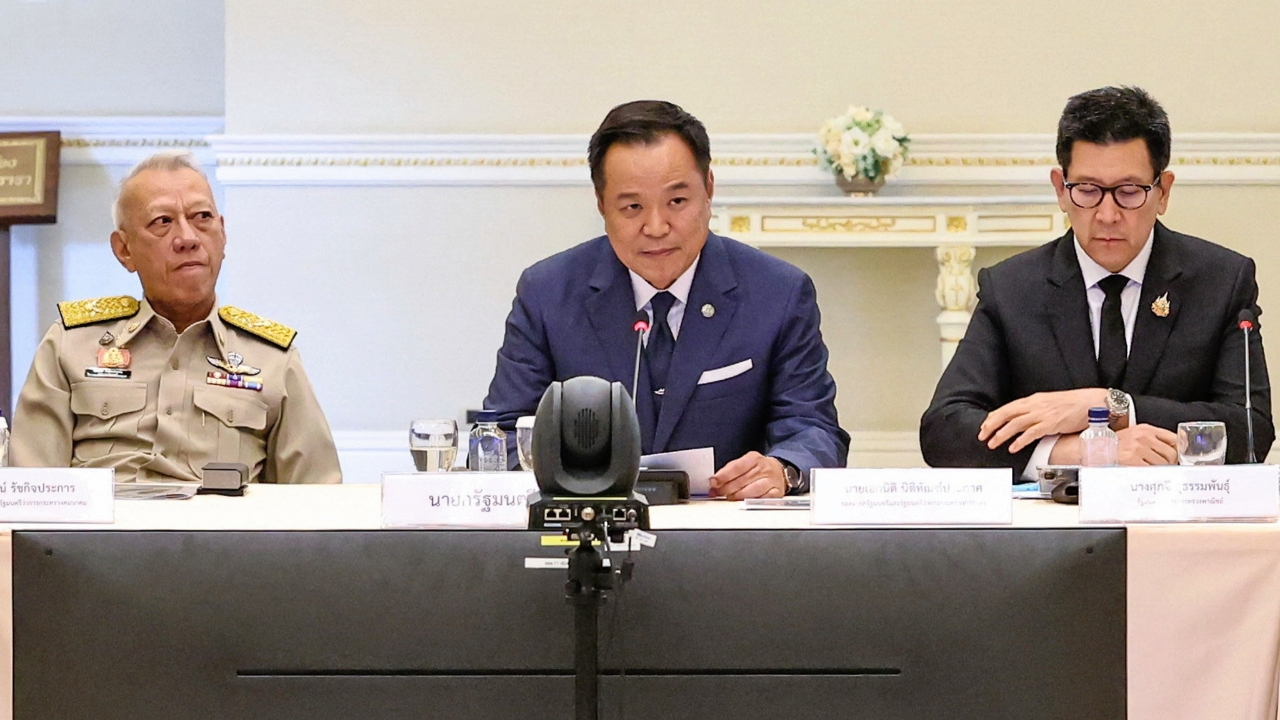
Prime Minister Anutin signed an order to establish a center to manage and monitor the conflict situation in the Middle East region, appointing Phiphat, Deputy Prime Minister and Minister of Transport, as director of the center.
On 6 March 2026 GMT+7, Prime Minister Anutin Charnvirakul issued Prime Minister's Office Order No. 53/2569 establishing the Center for Managing and Monitoring the Conflict Situation in the Middle East (CEMC) to ensure effective and orderly resolution of issues arising from the conflict in the Middle East region.
Under the authority granted by Sections 11 (6) and (9) of the Government Administration Act B.E. 2534 (1991), the center is hereby established. The center is officially named the Center for Managing and Monitoring the Conflict Situation in the Middle East, abbreviated as "CEMC." The center’s composition, duties, and powers are as follows:
1.1 The Prime Minister serves as the center’s advisor.
1.2 The Deputy Prime Minister and Minister of Transport serves as the center’s director.
1.3 The Deputy Prime Minister and Minister of Finance serves as deputy director.
Members include:
1.4 The Minister of Defence.
1.5 The Minister of Foreign Affairs.
1.6 The Minister of Energy.
1.7 The Minister of Commerce.
1.8 The Minister of Labour.
1.9 The Permanent Secretary of the Prime Minister’s Office.
1.10 The Permanent Secretary of the Ministry of Defence.
1.11 The Permanent Secretary of the Ministry of Finance.
1.12 The Permanent Secretary of the Ministry of Foreign Affairs.
1.13 The Permanent Secretary of the Ministry of Tourism and Sports.
1.14 The Permanent Secretary of the Ministry of Transport.
1.15 The Permanent Secretary of the Ministry of Energy.
1.16 The Permanent Secretary of the Ministry of Commerce.
1.17 The Permanent Secretary of the Ministry of Interior.
1.18 The Permanent Secretary of the Ministry of Labour.
1.19 The Secretary-General of the National Economic and Social Development Council.
1.20 The Secretary-General of the National Security Council.
1.21 The Secretary-General of the Office of the Council of State.
1.22 The Director-General of the Public Relations Department.
1.23 The Director-General of the Department of Energy Business.
1.24 The Director-General of the Excise Department.
1.25 The Director-General of the Customs Department.
1.26 The Director of the Fiscal Policy Office.
1.27 The Governor of the Tourism Authority of Thailand.
1.28 The Secretary-General of the Securities and Exchange Commission.
1.29 The Governor of the Bank of Thailand.
1.30 The Board Member and Managing Director of the Stock Exchange of Thailand.
1.31 The CEO and Managing Director of PTT Public Company Limited.
1.32 The Chairman of the Federation of Thai Industries.
1.33 The Chairman of the Board of the Thai Chamber of Commerce.
1.34 The Chairman of the Board of the Thai Bankers' Association.
Members and secretary:
1.35 The Director-General of the Information Department.
Members and assistant secretary:
1.36 The Deputy Secretary-General of the National Economic and Social Development Council as assigned.
1.37 The Deputy Secretary-General to the Prime Minister for Administration (Ms. Chanida Kasemsuk).
2.1 To direct, manage, and monitor the conflict situation in the Middle East region.
2.2 To propose guidelines and measures to resolve problems and mitigate impacts arising from the Middle East conflict.
2.3 To order government agencies, state entities, and state enterprises to integrate and perform duties within their legal authority.
2.4 To proactively disseminate accurate information to the public, building trust between the government and citizens.
2.5 To summon relevant government agencies, officials, or state officers to attend meetings, provide explanations, submit documents, or undertake any necessary actions.
2.6 To appoint working groups or experts to support operations as needed.
2.7 To perform other duties as assigned by the Prime Minister or the Cabinet.
This order is effective immediately.
Ordered on 6 March 2026 GMT+7.
Signed by Anutin Charnvirakul, Prime Minister.


