

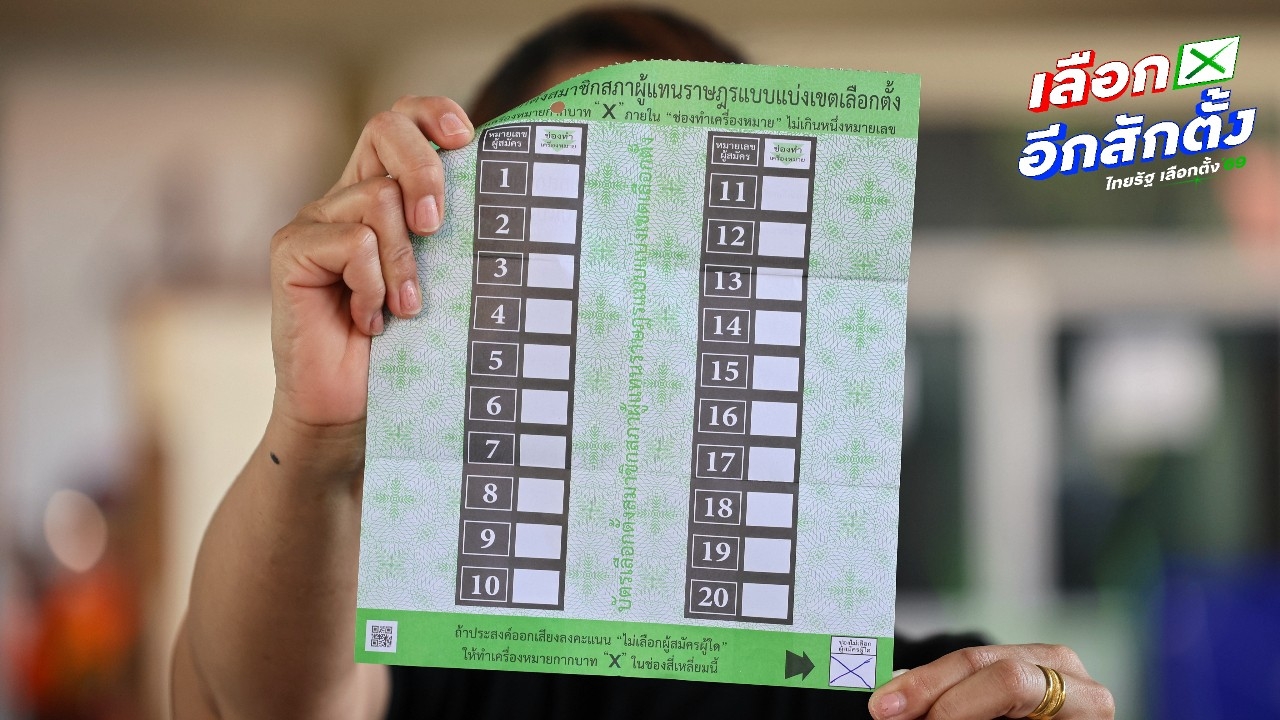
The NIDA Poll revealed that the public believes the QR code and barcode issue should not rush the formation of a new government. They recommend waiting until the court issues a ruling but trust this will not cause any political unrest and are not concerned about the secrecy of the 8 February election.
On 8 March 2026, the Public Opinion Survey Center “NIDA Poll” at the National Institute of Development Administration (NIDA) released results of a survey titled “New Government Formation vs. Ballot Issues.” Conducted from 2-4 March 2026, it surveyed 1,310 Thai citizens aged 18 and over across all regions, education levels, occupations, and income brackets nationwide. The survey explored public opinions on new government formation and ballot issues following the election. Sampling was done probabilistically using the Master Sample database of NIDA Poll, employing multi-stage sampling. Data collection was by telephone interviews with a margin of error not exceeding 0.05 at a 97.0% confidence level.
The survey asked public opinion on new government formation and the court case concerning QR and barcodes on ballots. It found that 44.81% stated the new government formation should not be rushed but should wait for the court’s ruling on the QR and barcode issue. Next, 41.68% said the government should be formed quickly to allow the country to move forward. Meanwhile, 13.20% were indifferent, and 0.31% did not respond or were uninterested.
When asked whether the QR and barcode issue on ballots would cause a new round of political unrest, 36.56% responded that it would not lead to any political turmoil./Next, 34.20% said it would cause new political unrest but that the government would be able to control it./28.55% said it would lead to political unrest that the government could not control./And 0.69% did not respond or were uninterested./Regarding public concern about the secrecy of voting in the 8 February election, 47.64% said they were not worried at all. Following that, 19.08% were somewhat worried, 18.55% were very worried, 14.27% were not very worried, and 0.46% did not respond or were uninterested.
