

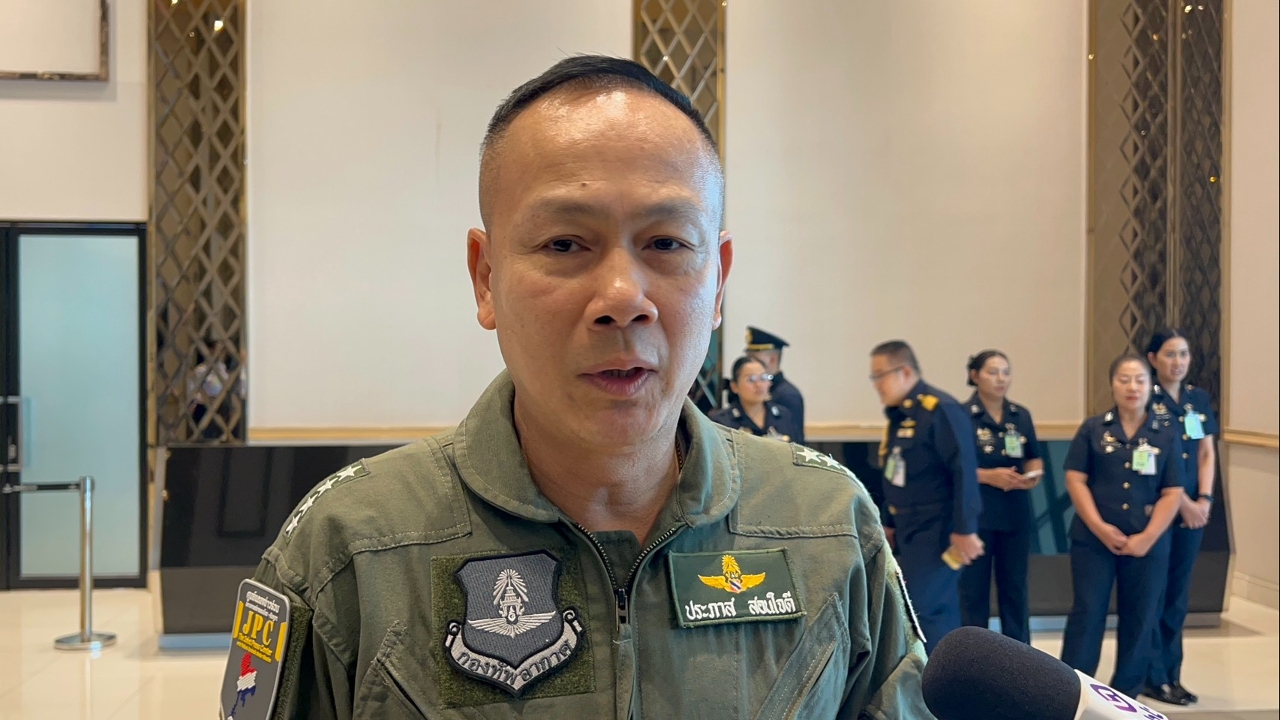
The Air Force Commander has ordered fuel reserves to prepare for emergencies, protect sovereignty and the nation, and to proceed with the Cope Tiger exercise with the United States. He expressed confidence that the international community understands the situation and emphasized strict security screening, with postponement or cancellation if any warning signs arise.
At 10:00 a.m. on 9 March 2026, at Building 2, Wing 6 Airbase, Air Chief Marshal Praphas Sonjaidee, Deputy Commander of the Royal Thai Air Force, disclosed the energy-saving policy of Air Chief Marshal Seksan Kantha, Air Force Commander. This follows Defense Minister Natthapol Nakpanich’s directive amid the Middle East crisis causing a spike in oil prices. The Air Force reviewed its priorities, categorizing fuel use: ground support operations are to be conducted with economy and caution, using only what is necessary, whereas critical operational missions will be fully supported.
Regarding aviation fuel, the Air Force has prepared two main portions: normal flight operations and continuous training missions, along with a reserve war fuel stockpile for emergency missions. He assured the public that the Air Force will manage these resources adequately and, in the event of any situation, will utilize them for assigned duties to defend the country and sovereignty during emergencies.
In terms of general energy use, a shift in mindset is necessary to raise awareness among personnel and the public that the abnormal situation caused by the Middle East conflict impacts Thai people. Although alternative oil sources have been secured, the duration of the crisis is uncertain. The National Security Council estimates a prolonged situation lasting four weeks based on facts. Sometimes the real impact on the ground is unclear. He urged trust in official assessments and cautioned against being alarmed by media images, some generated by AI. Certain groups exploit the circumstances for their own interests, but prolonged conflict harms citizens and the global community. Peace negotiations would minimize impact; if violence escalates, losses would be regrettable and peace difficult to achieve.
When asked about whether the United States would participate in the Cope Tiger joint exercise, Air Chief Marshal Praphas said there would be no impact. The training will continue as planned, but with intensified security measures, including police support within the Air Force area. He expressed confidence in the vigilance and protection provided, and urged the public to be alert for suspicious activities that could pose danger, recalling that such incidents have occurred before in areas with foreign adversaries, advising prompt reporting to authorities.
He confirmed that the Air Force’s training will proceed continuously but with enhanced security oversight. He reminded participants that abnormal situations can arise at any time, potentially involving asymmetric warfare, which remains uncertain. However, he assured that intelligence monitoring, surveillance, and coordination with civil authorities are in place to facilitate operations and hopes that unforeseen events do not occur.
The Cope Tiger exercise serves as a review and planning preparation for air power, with new pilots gaining experience and exchanging knowledge. It is a routine exercise with clear objectives and a focus on safety, relationship-building, and mutual learning among air forces. This fosters understanding for potential future joint operations. Concurrently, the Air Force applies lessons learned to improve and adapt practices suitable for Thailand. This highlights the benefits of the exercise.
Regarding concerns that adversarial countries might misunderstand the frequent joint exercises with the U.S., such as Cobra Gold, and fears Thailand might be drawn into conflicts, Air Chief Marshal Praphas said Thailand is a peace-loving country that does not use force to threaten or invade others. The exercises are routine, conducted for many years to maintain combat readiness. He believes the world understands why these exercises occur. Only if there is any sign of danger or insecurity would postponement or cancellation be considered, which he hopes will not happen.
The Royal Thai Air Force is preparing to host the major ASEAN regional joint air exercise “Cope Tiger 2026” with the U.S. Air Force and the Republic of Singapore Air Force from 15 to 27 March 2026. This aims to strengthen military cooperation and enhance the capability for joint air operations.
This exercise’s primary objective is to develop personnel skills and combat aviation equipment, as well as to improve coordination among allied nations for greater readiness and effectiveness, under the theme “Together We Fly, Stronger We Stand,” reflecting the unity and cooperation of the three air forces.
Additionally, Cope Tiger plays a significant role in fostering good relations and trust among partner air forces, facilitating the exchange of experience in tactical flying and modern military operations.
The training will take place across several key Royal Thai Air Force locations, including:
Wing 1, Nakhon Ratchasima Province
Wing 2, Lopburi Province
Chai Badan Weapons Training Range
Wing 23, Udon Thani Province
The Cope Tiger 2026 joint exercise is one of the region's major international air exercises, enhancing combat readiness, allied coordination, and elevating the Royal Thai Air Force’s capabilities in regional security cooperation.