

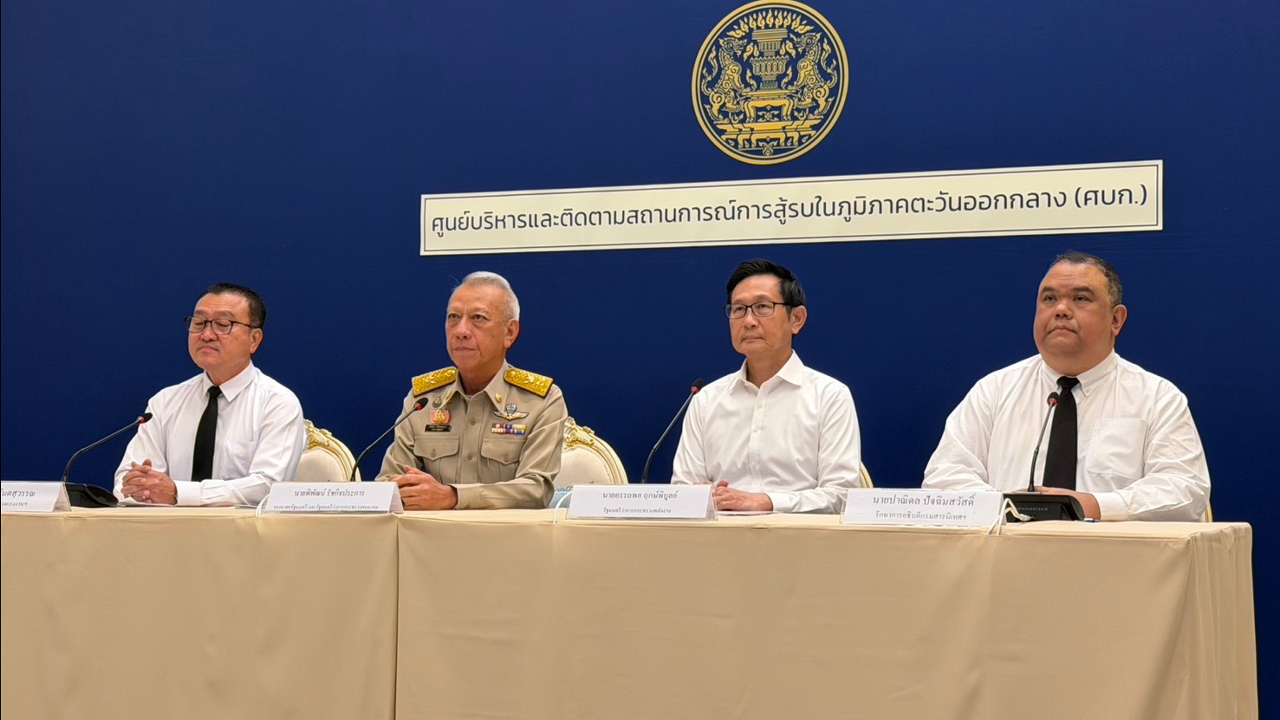
Attaphon is preparing to issue an emergency decree to borrow funds to compensate the oil fund after it went negative, responding to the Middle East war situation that caused prices to soar. He emphasized that after freezing diesel prices for 15 days, the situation will be reviewed, while gasoline prices will increase stepwise as well.
At 18:00 on 9 March 2026 at the Government House, Phiphat Ratchakitprakarn, Deputy Prime Minister and Minister of Transport, acting as chairman of the Center for Managing and Monitoring the Middle East Conflict Situation (CMO), reported that this morning he discussed with relevant agencies measures regarding fuel prices, including diesel, LPG, and LNG. The Thai public has been concerned since the Ministry of Energy announced three days ago that oil supplies can last 95 days. Today's meeting with the CMO, Ministry of Energy, and Prime Minister Anutin Charnvirakul concluded that they will seek additional oil supplies. If crude oil cannot be shipped through the Strait of Hormuz, alternative sources will be found, and the use of biodiesel or ethanol blends will be adjusted to extend supply duration. Currently blends are used, but in case of a greater crisis, they will consider increasing the percentage and implementing it gradually.
They also discussed price freezes. The Prime Minister announced on 28 February that diesel prices would be frozen for 15 days. About 9-10 days have passed, with 5-6 days remaining. For gasoline prices, which were not part of the price freeze, the Ministry of Energy has been using oil fund money to support prices without raising them. However, due to ongoing severe conflict and the current freeze only covering diesel, there might be announcements to adjust gasoline prices upward in steps, not a single increase, but gradually according to PTT's mechanism.

Attaphon Ruekpiboon, Minister of Energy, said that Thailand's refining capacity relies mostly on imported crude oil, with limited capacity for refined products from imported crude. Previously, exports were made, but the current measure is to suspend exports except to Laos and Myanmar. The suspension has been increased from a 1% reserve to 3%. By the end of March, oil reserves will increase to 1.5%, and by the end of April to 3%, which can be done within seven days.
After the Energy Policy Committee meeting, measures include increasing biodiesel B100 blend from 5% to 7% to reduce fossil diesel use by 2%, effective 14 March 2026, allowing oil traders time to prepare. This will reduce diesel consumption and promote domestic biodiesel use. Palm oil production is entering harvest season, so supply is sufficient. Simultaneously, studies will be conducted on promoting B10 and B20 blends, although some car manufacturers do not support these blends.
Diesel prices will be frozen for the full 15 days before being reconsidered. The government partially subsidizes diesel prices but not fully, since global prices remain high and adjustments are necessary. Coordination will ensure price increases are gradual, avoiding sudden spikes.
Immediately, the biodiesel blend will increase from B5 to B7. For gasoline, currently marketed as E10, E20, and E85 with ethanol blends, promotion will increase usage through price incentives. Currently, the price difference between E10 and E20 is about 2 baht; this will be increased to 3 baht.
Meanwhile, the Energy Policy Committee announced an extension of the LPG price freeze, originally set to expire in March, now extended for two more months until May. The public can be assured that LPG prices will not increase until then, after which the situation will be reassessed.
Regarding natural gas, a fuel for electricity generation, last week it was reported that of nearly 40 shipments in March and April, five are from Qatar; two have arrived, three have not. PTT has been instructed to seek alternative sources for the three pending shipments. Two alternative shipments have been confirmed, and one more is under confirmation from another supplier. LNG to replace Qatar gas during these two months will definitely arrive, and Qatar has not canceled shipments; if available, they will supplement supply.
In parallel, the Joint Development Area (JDA) gas field between Thailand and Malaysia will increase production. Malaysia confirmed it will supply more gas to Thailand. There are also discussions to buy more hydroelectric power from Laos and to increase coal-fired power generation capacity. Assurance is given that fuel shortages for power generation will be managed effectively.
However, to avoid negligence regarding energy-saving measures, a proposal will be submitted to the Cabinet on 10 March 2026. The Permanent Secretary of the Ministry of Energy has issued letters to government agencies to implement energy-saving measures such as setting air conditioner temperatures to 26-27 degrees Celsius, avoiding unnecessary receptions, relaxing dress codes (no ties or suits), conserving energy by turning off unnecessary lights, and promoting work from home and online meetings. Fuel retailers are encouraged to promote vehicle engine inspections and timely oil changes, which can significantly save fuel.
Energy-saving measures that are too restrictive could impact the economy by reducing circulation. If everyone worked from home 100%, travel and spending at shops near workplaces would decline, negatively affecting the economy.
Initially, energy-saving measures will be requests for cooperation. Strict actions like timed closures of gas stations could cause panic. Closing department stores at 9 p.m. would harm tourism and the economy. Therefore, each measure must be carefully considered from all perspectives.
Phiphat also stated that currently, there is significant consumer panic with many lining up at gas stations. He assured that there is no oil shortage and urged people to return to normal. He confirmed that oil supplies will not be interrupted. For industrial users who previously bought from jobbers, they should compile bills from the past two months to purchase oil at the prices announced by the parent oil companies; otherwise, they will have to buy at floating market prices.
Regarding the oil fund's status, Attaphon said it was positive by over two billion baht on the first day, then slightly negative afterward. He emphasized that it is the oil fund's role to manage volatile oil prices. The fund has previously been negative by up to 120 billion baht, but luckily was slightly positive before the current crisis. Currently, the fund is slightly negative.
On preparations for emergency borrowing via a royal decree and urgency, Attaphon confirmed the fund has its own capacity to go negative up to about 100 billion baht. Discussions with the Secretary-General of the Council of State have prepared measures. The Ministry of Finance has already guaranteed loans once. The committee responsible is fully prepared.
Assessing oil price trends, Attaphon said it depends on the war. Prices could go up or down; crude oil has risen to 100 dollars and refined products to 150 dollars, with diesel prices also high. On the positive side, countries with large oil reserves have begun to release stocks to stabilize price volatility. If the war continues, prices may remain high, but once the conflict ends, prices will certainly decline.
Asked whether Russia would be considered as a supplier if purchases become difficult, Attaphon said PTT's trading team is seeking sources from many countries including the US, Africa, Malaysia, and Australia. Russia is also a potential source but carries risks due to sanctions. Payment risks exist if funds are frozen. The US is beginning to ease some sanctions on Russia, but caution is needed to avoid such risks.
Asked about the possibility of oil prices soaring to 150 dollars per barrel, Attaphon said all scenarios are possible but such highs would not be permanent. Prices may spike temporarily and then fall. Oil prices and volumes directly depend on the war situation, which must be closely monitored hourly.
Wutthikrai Leewiraphan, Permanent Secretary of the Ministry of Commerce, said hoarding is punishable by up to seven years imprisonment, a fine of 140,000 baht, or both. He confirmed that there have been no price increases for controlled goods. Any price increase proposals must be submitted to the Ministry of Commerce with detailed price structure changes. Currently, no operators have applied to increase prices.