

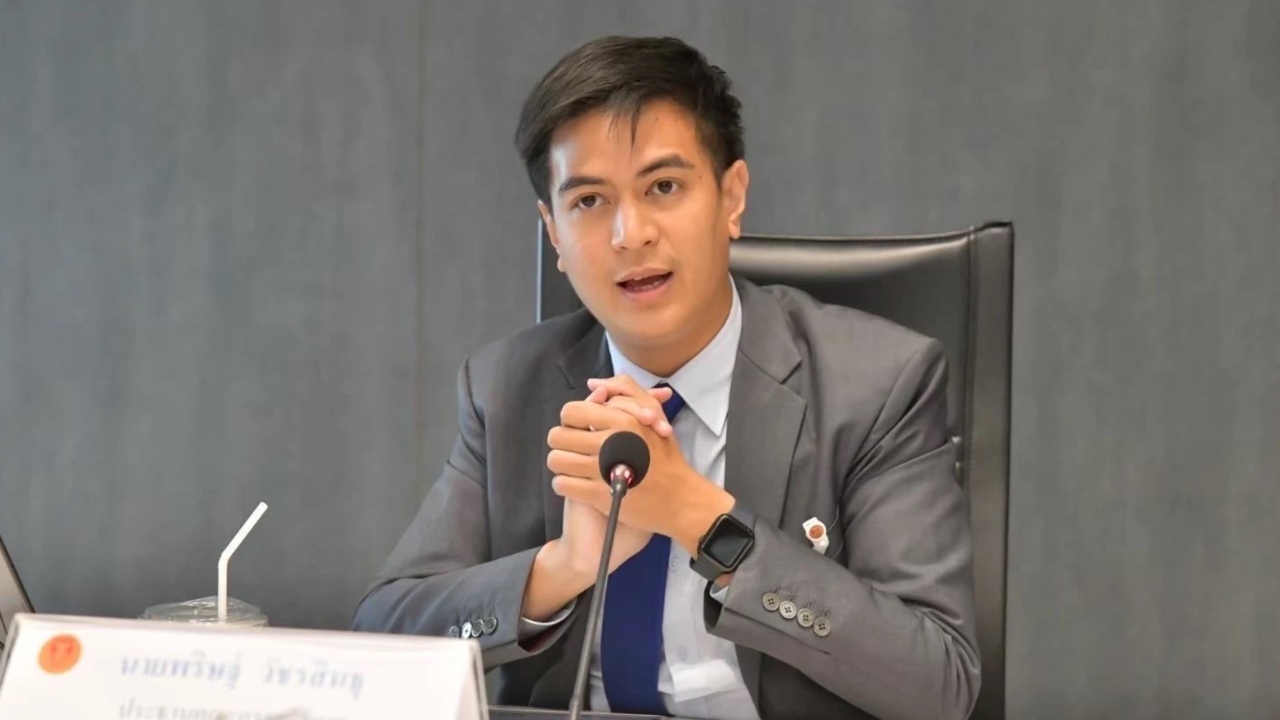
Parit raised questions about the decision of the Election Commission’s Subcommittee 36, which ruled that 229 senators were not guilty in the vote-rigging case, pointing out that this contradicts the investigation committee’s findings. He asked how much trust can be placed in the Election Commission’s final judgment when 4 of its 7 members were endorsed by the implicated senators.
13 Mar 2026 GMT+7 Parit Watjanasin, a party-list MP and spokesperson for the People's Party, commented on the case regarding the Election Commission’s Subcommittee 36 ruling, which contradicted the findings of Investigation and Inquiry Committee 26. (Read more:A 5-2 vote dismissed allegations against 229 senators for vote-rigging — DSI says it does not affect criminal charges of gang activity and money laundering.) He said that while society has yet to receive answers to many questions about the Election Commission’s investigation into the alleged vote fraud in the senatorial election,
Parit noted that although Investigation and Inquiry Committee 26 (a joint working group of the Election Commission and the Department of Special Investigation, DSI) had recommended prosecuting all 229 accused individuals (including 138 senators and 91 political party members and affiliates), yesterday’s news (12 Mar 2026) reported that the Election Commission’s Subcommittee 36 voted 5 to 2 to find no wrongdoing by any of the 229 accused, completely contradicting the investigation committee’s opinion.
If the report is accurate, this means that among the 138 accused senators, 5 subcommittee members ruled they were not guilty, while 2 believed most senators (134 of 138) were guilty. For the 91 accused party members and affiliates, all 7 subcommittee members unanimously found no wrongdoing.
The following questions arise: 1. Why does the Election Commission’s subcommittee hold a view completely opposite to that of the joint investigation committee from the Election Commission and DSI? How is it possible that all the evidence collected by the investigation committee—including vote analysis, meeting records, and financial trails—was deemed insufficient by the subcommittee to indicate any wrongdoing by the accused?
2. The Election Commission is responsible for deciding whether to follow the investigation committee’s recommendation to prosecute all 229 accused or the subcommittee’s view to dismiss the case. But since 4 of the 7 Election Commission members were endorsed by the accused senators, how can we trust that the Commission will handle the case fairly and without influence from those who helped secure their positions?
3. If it ultimately emerges that the Election Commission’s decisions on this case contradict facts and evidence and are made without legal accountability, can society conclude that independent agencies today are not truly independent from political interference but rather independent from the public?