

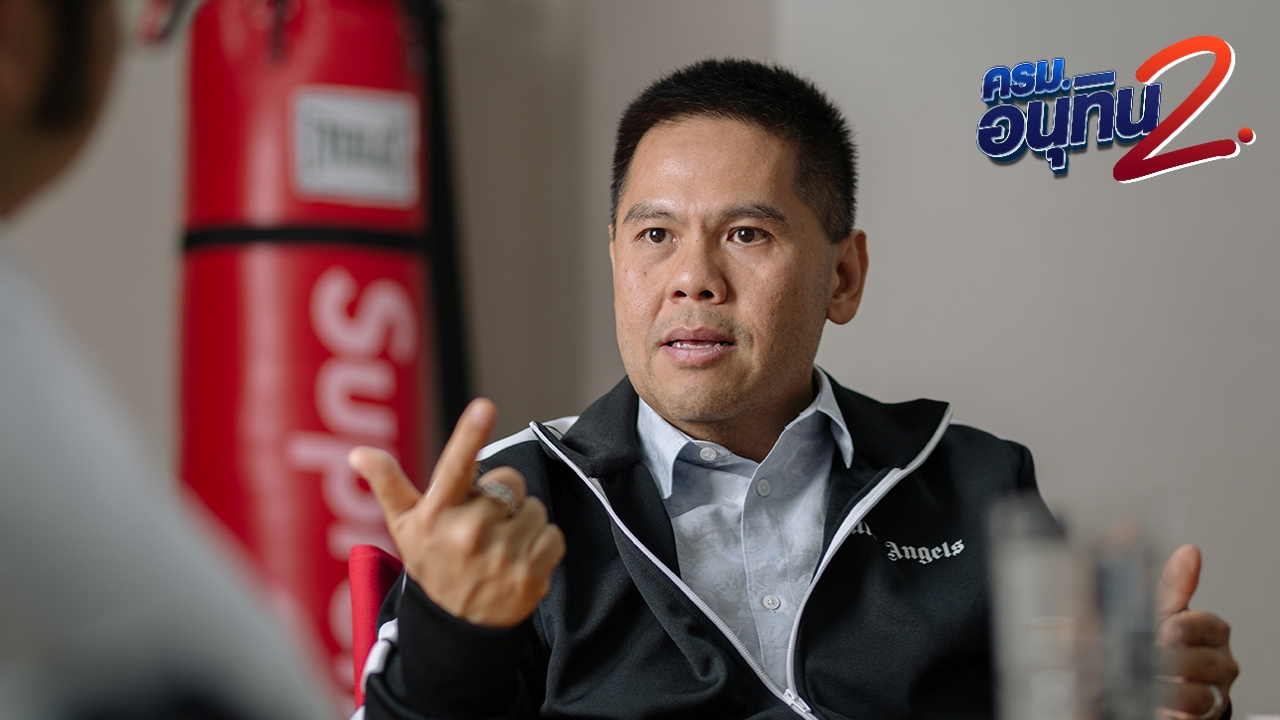
Tracing the journey of "Top's son," the progeny of "Suphan's Dragon," Banhan Silpa-archa, the late former Prime Minister, as he continues the legacy of the Silpa-archa family.
Warawut was born on 11 July 1973 as the youngest son of Mr. Banhan and Khun Ying Jamsai Silpa-archa. He began his education at Saint Gabriel's School before earning a Bachelor of Engineering from University College London (UCL) and an MBA in Finance from the University of Wisconsin-Madison, USA. His strong educational background made him a politician with global communication skills and systematic thinking.

His first step into politics followed in his father's footsteps, becoming MP for Suphanburi under the Chart Thai Party in 2001. He later served as Deputy Minister of Transport in Prime Minister Somchai Wongsawat’s government. Despite facing a political setback with a five-year ban due to the dissolution of the Chart Thai Party, he remained visible by chairing Suphanburi FC, helping to raise the local football club’s national profile.

Returning to politics with the Chart Thai Pattana Party, Warawut was appointed Minister of Natural Resources and Environment in General Prayut Chan-o-cha’s government. He is noted for leading campaigns to ban single-use plastics and tackling global warming issues on the international stage.

Later, under Prime Ministers Srettha Thavisin and Paetongtarn Shinawatra, he was assigned to oversee the Ministry of Social Development and Human Security, focusing on vulnerable groups including children, women, and the elderly—a challenging mission to strengthen social foundations.

In his personal life, Warawut is married to Suwana Silpa-archa, a key figure in Thailand’s ice skating sports community. They have three children, with their eldest daughter, "Nong Thames," following her mother’s path as a national figure skating athlete. This reflects a family balancing commitments to both public service and sports.

Warawut’s appointment as Minister of Industry in the "Anutin 2" cabinet is seen as a pivotal moment in Thailand’s economic transformation. He brings the image of a modern politician and a "connector" linking government policy with the private sector. His three main missions include spearheading Industrial Green Transformation, leveraging his experience in natural resources to move Thai industry toward Net Zero standards in response to strict international environmental trade measures.

He is also driving the EV Ecosystem & Hub initiative to accelerate electric vehicle industry development from upstream to downstream, aiming to establish Thailand as a regional hub for EV production and export. Additionally, he promotes SME Digitalization, reforming small businesses through innovation and digital technology to align with global market shifts and enhance competitiveness. Thus, his role extends beyond managing factories to positioning "sustainability" as a core engine in advancing the country’s high-value economy.