

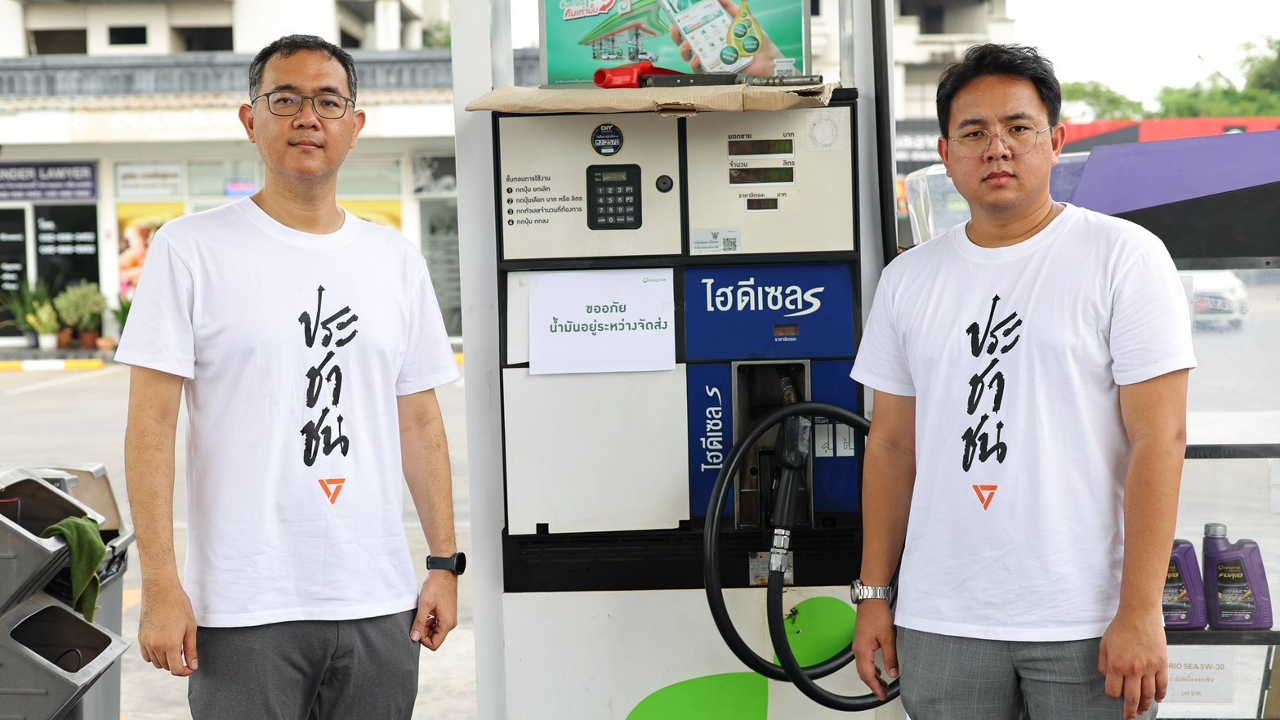
Isariya, a People's Party MP, recommends creating a government dashboard or central oil data system, enabling each gas station brand to present information about their affiliated stations through social media with daily updates to build public confidence.
On 16 March 2026, Isariya Pairipairit, a party-list MP, along with Supachot Chaisat, also a party-list MP of the People's Party, surveyed the situation at gas stations after many people lined up to buy fuel following the outbreak of conflict in the Middle East, which led to frozen oil prices.
Isariya stated that this morning he surveyed gas stations in outer Bangkok areas including Nong Chok, Min Buri, Khlong Sam Wa, and Bueng Kum with Supachot Chaisat, an energy policy expert and party-list MP of the People's Party. They found severe diesel shortages. At one station, oil arrived around 2:00 a.m., the station opened at 5:00 a.m., but by 8:30 a.m. diesel was completely sold out. To get more, customers had to come back the next morning. Similar reports were received from other stations in the area.
Investigating the causes of the oil shortage.
Isariya said that if outer Bangkok is already this affected, other provinces may be worse. He expressed serious concern and said if we trust the government's data that Thailand has sufficient oil reserves, "the largest in ASEAN," as the Prime Minister has stated, the shortage at gas stations likely results from two main factors:
1. Distribution This refers to transporting oil from storage depots to gas stations. Currently, quotas are being set for each station, where previously there were none (some brands limit daily quotas, others monthly). So it is unsurprising that when oil arrives at stations, it runs out faster than usual. He believes the government should clearly disclose the current status of oil transportation, how many transport vehicles are in the system, their usage rates, and how distribution to stations can be improved.
2. Information What the public most wants to know is information about whether the gas station near their home currently has diesel available, and if not, when it will be restocked. This would prevent people from aimlessly visiting multiple stations or waiting in long queues without knowing how long they must wait.

Recommending a central information system.
Isariya said that creating a government central oil data system or dashboard may not be timely, but if each gas station brand could simply present their network’s oil availability via social media with clear update cycles (e.g., every 6 or 8 hours), it would greatly benefit the public.
This is not difficult because stations already have this data. One station owner demonstrated reporting oil status across areas through the LINE app, showing it is routinely done. The only remaining step is to aggregate and publicly share this data via accessible channels.
Isariya concluded that while the global situation is beyond control, transportation, distribution, and transparency of oil information domestically are manageable. As an MP, he urges the government to adopt these measures to address the worsening hardship faced by the public.
