

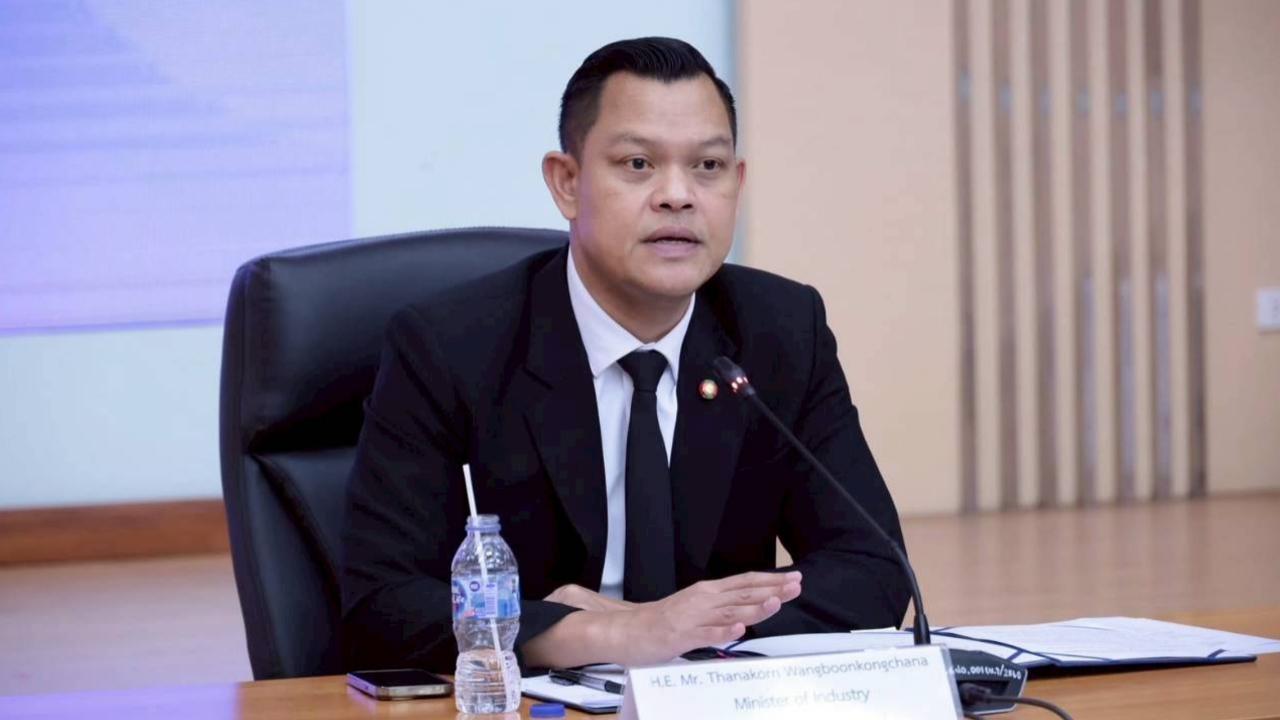
The Minister of Industry has instructed all agencies to sustain Thailand's industry in response to the Middle East crisis, following the Economic Situation Operation Center's policy. He emphasized the urgent advancement of measures to reduce burdens and facilitate entrepreneurs.
On 18 March 2026, Mr. Thanakorn Wangboonkongchana, Minister of Industry, revealed that the conflict in the Middle East between Israel, the United States, and Iran is likely to impact the global economy, especially the energy sector. Consequently, the government established the "Economic Problem Solving Operation Center for the Middle East Conflict Situation (ESOC)" to integrate relevant agencies' work in monitoring, analyzing, and urgently formulating measures to mitigate the impact.
Within the Ministry of Industry, the Industrial Economics Office was assigned to collect data from entrepreneurs, assess the impacts, and develop policy proposals to support high-risk industrial sectors, particularly regarding oil procurement issues. The government has directed the industry to return to using oil through the usual wholesale system. Entrepreneurs facing difficulties can present purchase records from the past two months to provincial governors or energy officials to continue oil procurement. Regarding the energy outlook after the diesel price cap at 30 baht per liter ends, the government, led by the Ministry of Energy, has consulted with oil traders and refinery operators to manage oil volume and distribution sufficiently, while planning gradual price adjustments of 50 satang to 1 baht per liter to lessen the impact on living costs.
"I have ordered agencies under the Ministry of Industry to act on three critical fronts: 1. Survey businesses affected or at risk due to higher energy costs and raw material shortages affecting supply chains, to develop targeted relief measures; 2. Campaign for businesses to reduce energy use, enhance energy efficiency, and support alternative energy use; and 3. Promote online services of the Ministry of Industry such as the Central Customer Registration system (I-Industry), online license applications (Digital License), and digital payment systems (Digital Payment) to reduce burdens and facilitate entrepreneurs," said Mr. Thanakorn.
Mr. Thanakorn added that the Ministry of Industry also advises entrepreneurs to adapt quickly to uncertainties by utilizing financial support measures like loans from the SME Development Fund under the Pracharath model and green loans. They should also diversify trade risks into new markets such as Latin America, Africa, and India, and employ risk management tools like war risk insurance and foreign exchange risk management. Additionally, the ministry promotes increased use of renewable energy in industry, such as biomass energy from agricultural waste (Biofuel) including rice husks, sugarcane leaves, bagasse, coconut shells, and palm fibers, development of Sustainable Aviation Fuel (SAF), and installation of solar rooftop systems on factories to reduce dependence on fossil fuels and enhance long-term energy security.
"The Ministry of Industry will closely monitor the situation and is ready to promptly introduce additional measures to support Thai entrepreneurs in continuing their businesses amid global economic volatility," Mr. Thanakorn said.