

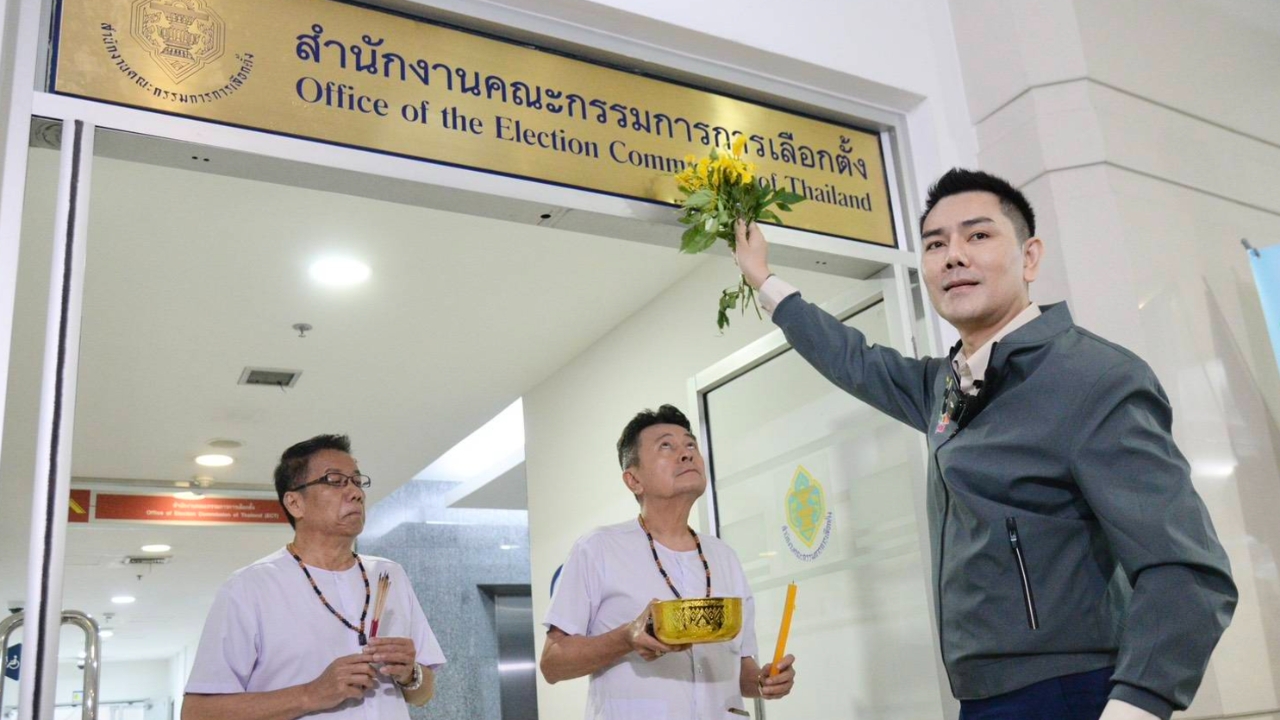
“Lawyer Aun” performed a Khmer exorcism ritual to cleanse the Election Commission (EC) office before presenting numerous documents to expose a scheme to cover up the Senate vote-rigging case. He claimed the evidence came from a secret informant and threatened to sue seven EC commissioners for conspiracy to dismiss the case.
At 11:00 a.m. on 18 March 2026, at the Election Commission (EC) office, Mr. Phattharaphong Supaksorn, known as Lawyer Aun from Buriram, led a group dressed as Brahmins to sprinkle holy water in front of the EC office to drive out Khmer black magic and urge the EC to perform its duties fairly in the Senate vote-rigging case. Afterwards, Phattharaphong presented copies of documents claimed to be evidence in the Senate vote-rigging case, compiled by the Department of Special Investigation (DSI) and Investigation Team 26, to the media. He demanded the EC disclose information about the 229 accused individuals and what evidence could refute the Investigation Team 26’s findings.


Phattharaphong stated that he personally believes the Senate vote-rigging case has been systematically dismissed. Since the DSI and Investigation Team 26 started working on the case, they have faced obstruction at every step, especially during witness examinations. Despite this, Team 26 worked hard and gathered evidence accusing 229 offenders, compiling over 70,000 pages of case files, which were submitted to the EC on 17 July 2025. However, the EC took no action and instead established the 36th Adjudication Committee in September 2025. This coincided with other cases, including Khao Kradong, Mr. Saksayam Chidchob’s case, and the Pak Chong airport runway case, all under independent organizations that were cleared. Now, the 36th Adjudication Committee ruled that the Senate vote-rigging case lacked merit and acquitted all 229 accused, despite the DSI’s sufficient financial trail evidence.


“I want to know what crucial evidence the 229 accused possess that can overturn the 70,000 pages of findings from Investigation Team 26. That evidence would have to be so convincing that the EC has no doubt at all. I question whether the EC trusts the evidence from the 229 accused more than the very Investigation Team 26 it established. The DSI has repeatedly tried to submit financial trail evidence to the EC, but the EC has rejected it. Why? Is there an agenda to dismiss the Senate vote-rigging case? This is my personal belief, based on reason, logic, and evidence.”
Phattharaphong further alleged that within Investigation Team 26, there is a person orchestrating the case, accepting assignments and appointing members to the 36th Adjudication Committee—one who kowtowed to Mr. Anutin, and another dismissed from a high-ranking government position. He asked whether these facts raise suspicions among Thai people and whether this is part of a scheme to dismiss the case. Everything remains secret within the EC, with no disclosure to the public. Importantly, the EC has exclusive authority to decide the case, and once it does, that is final. However, he believes there is no evidence, and he is confident the 229 accused cannot produce evidence to overturn the case. This is his personal belief.

When asked if the documents he presented today were the same used by Investigation Team 26, Phattharaphong said he believes so, as the EC has repeatedly refused to allow document copying. Several times he disclosed financial trail evidence, but no government official claimed the data was false. On the contrary, the EC dismissed one official and issued the first and only summons. Therefore, he believes the documents he brought today are genuine and obtained from a secret informant.
Regarding whether the EC’s dismissal of the DSI’s ongoing case would have consequences, Phattharaphong said if the petition is dismissed, it would be an improper exercise of prosecutorial discretion. He views the EC’s behavior as that of a “gang” and may soon file a lawsuit against the EC at the judiciary.