

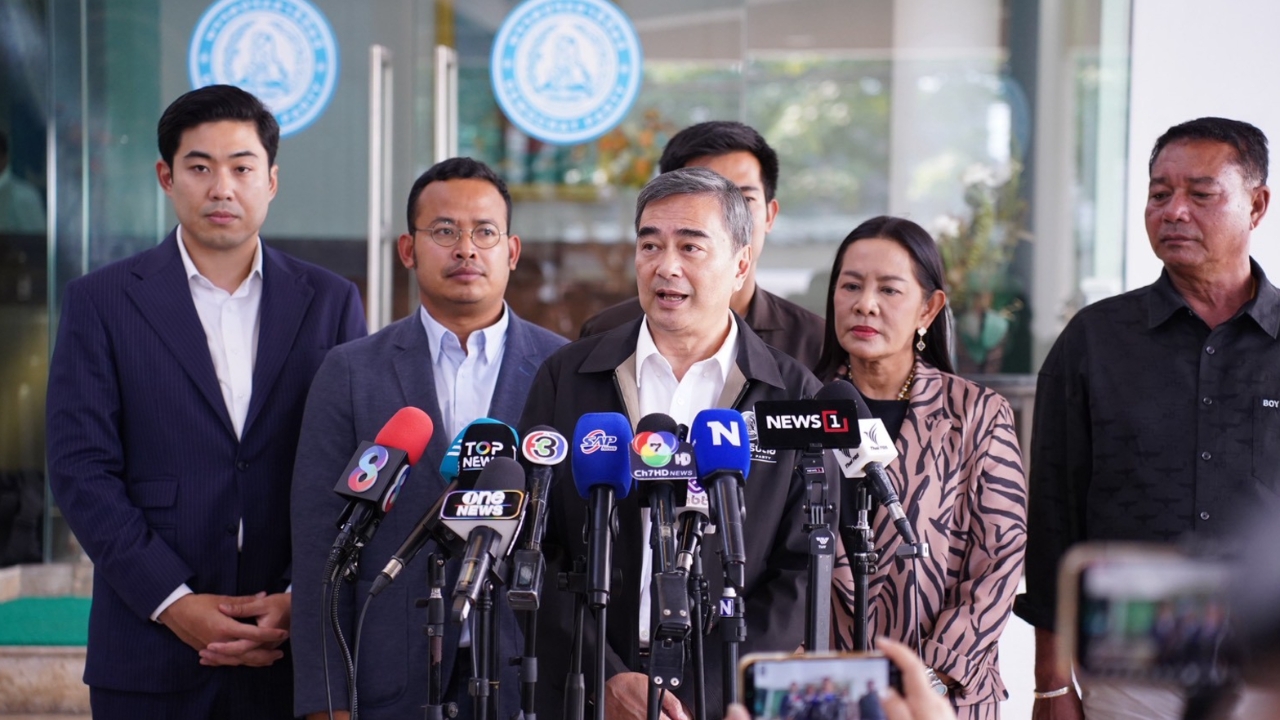
Abhisit presented two proposals urging the government to urgently find solutions to the oil crisis. He recalled that previous governments had suspended excise tax collection and required oil refineries to contribute 3 baht per liter to the oil fund, instead of passing the financial burden to the public through the fund.
At 15:30 on 18 Mar 2026 at the Democrat Party headquarters, Abhisit Vejjajiva, party leader, held a press conference after a party MP meeting regarding addressing the oil energy shortage caused by the Middle East war. He said the Democrat Party has clear, concrete proposals for the government on how to manage this issue to benefit the government, even if it is a caretaker government. After oil prices were impacted by the war—an uncontrollable factor with uncertain future trends—the important thing is that when the government aims to reduce the burden on the public, especially by fixing diesel prices, it must ensure that all stakeholders—citizens, traders, and industries—can act accordingly to avoid problems seen previously. The severe issues arose because the government announced fixed oil prices with a stated end date, which caused consumers to worry about impending price hikes, prompting them to rush to buy or hoard fuel. Meanwhile, businesses were incentivized to delay sales, expecting prices to rise soon.
Abhisit continued that this is an important lesson for government management: to avoid signaling that causes market chaos. The government must review price control measures that created disparities between pump prices paid by consumers and prices previously paid by industry, which led industry to compete with the public for fuel. The government must implement measures to solve these problems. The Democrat Party pointed out that using the oil fund to subsidize price differences puts a heavy burden on the fund, which has to compensate for unusually high daily price gaps. The government worries that if the fund goes into deficit, it will need to borrow money as collateral. The Democrat Party thus proposes urgent action.
Currently, the entire burden of rising oil prices falls on consumers, but two other sectors should share this load: first, the government, which still collects an excise tax of 6 baht per liter, though in the past it had exempted this tax to reduce oil costs; second, the private sector, which increased refining fees from 2 baht to 6 baht per liter. This refining fee increase does not mean all is profit, as there are price differentials between refinery gate prices, Singapore prices, and the fluctuating crude oil prices. In this situation, many countries have required the private sector to contribute funds to ease the public's burden. The UK, Italy, and Spain have done this in the past.
"The Democrat Party proposes that currently the government should require refineries to contribute 3 baht per liter from refining fees into the oil fund. This way, the three sectors—government, private business, and the public—can share the burden, helping ensure the oil fund has sufficient resources to manage operations without jeopardizing its future status. This support should at least last through Songkran, by which time the situation may have changed. Therefore, the party calls on the government to clearly present to the public the oil price structure. If all three parties share responsibility, management becomes easier. Additionally, the two problems causing market volatility and price differentials must be addressed. These are the party's preliminary proposals," Abhisit said.
Abhisit added that the government should also prepare in advance for issues related to plastics and fertilizers, which will impact agriculture and industry. When asked if the party plans to submit a letter directly to the government to communicate these points, Abhisit said they are waiting to see if, after the prime ministerial election session on 19 Mar 2026, the House Speaker will convene the parliament as usual. If so, the party can use parliamentary mechanisms to allow other parties and MPs to jointly present diverse perspectives to the government on these issues. He encouraged using parliamentary channels effectively.
When asked about the difficulty of requiring refineries to contribute to the oil fund since some are partly owned by politicians, Abhisit said that, fundamentally, his proposal resembles a windfall tax based on the current situation. There might be procedural complexities, but about 2-3 years ago, a similar situation arose, and the government then called operators to agree on sharing the burden by contributing additional funds to the oil fund for a limited period. It was feasible then, so there is no reason it cannot be done again. The figures are clear regarding what would be appropriate.