

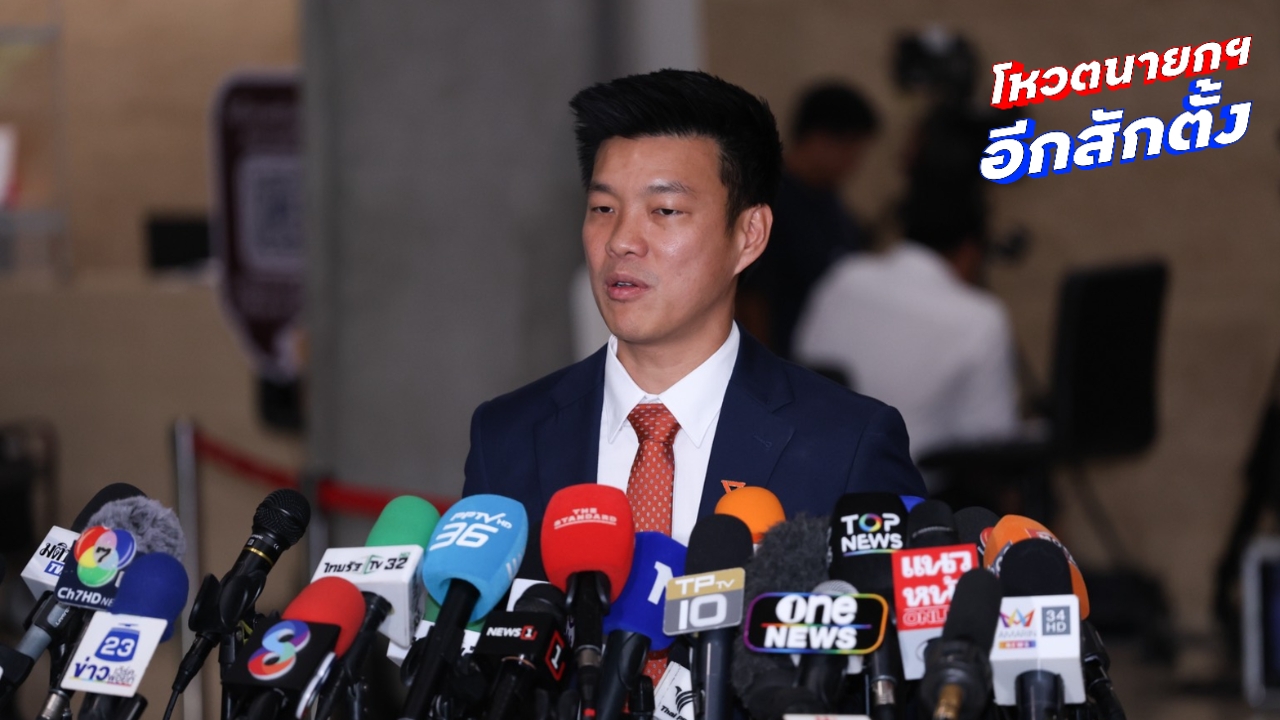
“Teng Natthapong” affirms the People's Party is nominating a prime minister candidate not to form a government but to seize an opportunity to communicate with the public. He denies the existence of defecting MPs, citing sufficient government support. The party is preparing to use the parliamentary platform to propose an urgent motion addressing the energy crisis.
On 19 Mar 2026 at the Parliament building, Mr. Natthapong Ruangpanyawut, party-list MP and leader of the People's Party, stated that as the opposition, they will orally submit an urgent motion today to the House of Representatives to propose solutions to the fuel price crisis. He believes the government will allow suggestions to be made. The key issue is preventing fuel shortages, especially refined fuel, and investigating possible hoarding or illegal exports. He noted that the government has convened all transport sector operators for discussions, and that transparency and data disclosure are the simplest ways to restore public confidence. Since the crisis began, the People's Party has dispatched MPs and representatives to survey various fuel stations and gather public feedback on issues including prices, and will compile all data to present to the government in parliament today.
Regarding criticism that the People's Party is collaborating with the Bhumjaithai Party, Mr. Natthapong insisted there is no such alliance. He added that if the Pheu Thai Party were in government, criticism would likely be greater. He confirmed he will debate the prime minister's qualifications today, clarifying that this is not a no-confidence debate or impeachment. Therefore, maintaining decorum and keeping the discussion within bounds is important, but he affirmed they will scrutinize government performance at every opportunity.
Concerning the nomination of a prime minister candidate, with the People's Party nominating himself and other parties expected to nominate theirs, Mr. Natthapong acknowledged being aware of this but declined to disclose details. He believes government formation occurred on 8 Feb; if Bhumjaithai cannot gather a majority, the parliamentary speaker would not schedule the PM election. He emphasized that the People's Party’s nomination is not to compete to form a government but to use the platform to communicate with the public. He did not comment on whether this effort is futile, viewing it as beneficial. Regarding concerns that the opposition lacks unity and that the People's Party is not coordinating with others, he said the party has communicated and informed all parties, but the decision on PM vote alignment is each party’s discretion.
Regarding allegations that People's Party MPs in the northeast lobbied fellow MPs to vote for Anutin as prime minister, Mr. Natthapong said the political situation shows Bhumjaithai has secured a relatively stable majority. There is no need to buy MPs across parties, known as "defectors." If such incidents occurred, there would be no need for explanation, and he doubted they would happen. Should they occur, it raises questions about whether such parliamentary conduct is acceptable and why it is done. He expressed trust in party colleagues and said he and party leaders will clarify this matter. The party has never avoided candidate issues, and parliament has faced defector problems beyond just the People's Party. He urged the public to place hope equally in all parties as they do in the People's Party.