

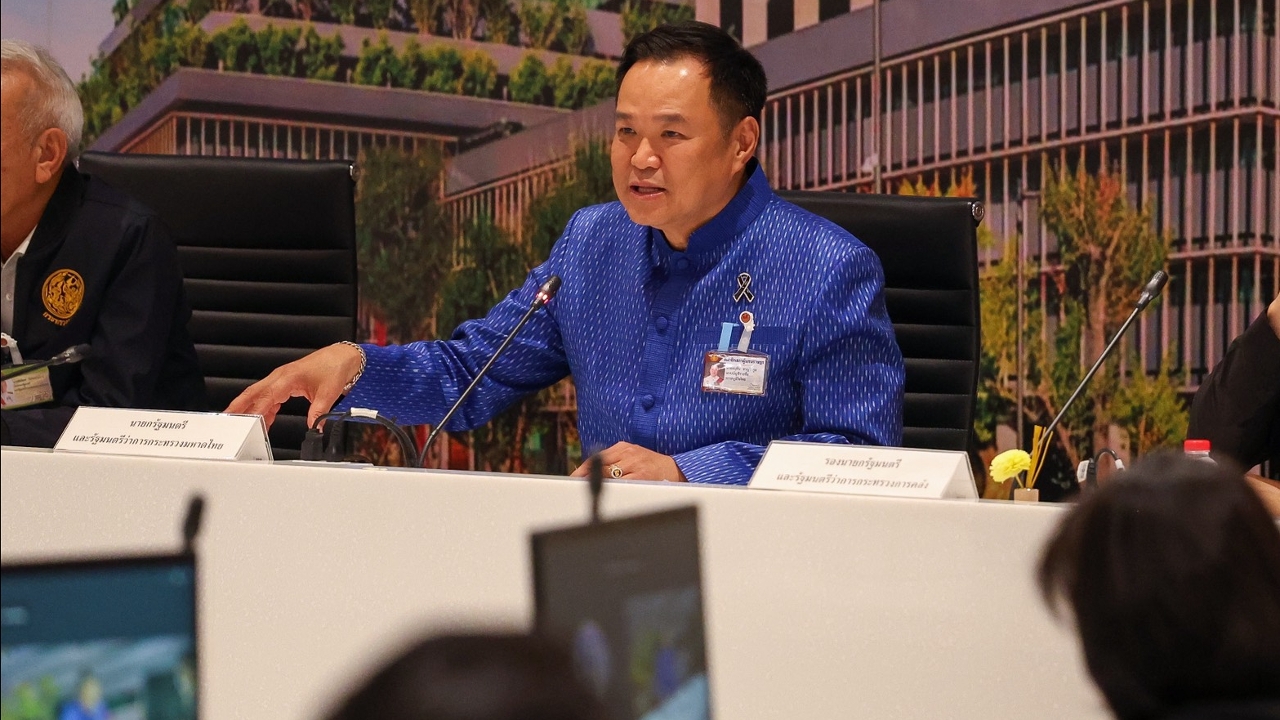
Anutin urges transporters and jobbers to present oil purchase contracts after a significant drop in volume, questioning whether there is profiteering beyond reasonable levels. He also orders the Department of Energy Business to control exports and emphasizes that domestic crude oil supplies are not lacking.
On 19 Mar 2026 GMT+7 at the Parliament, Prime Minister Anutin Charnvirakul chaired a meeting of the Center for Management and Monitoring of the Middle East Conflict Situation (CMMC). Attendees included Deputy Prime Minister and Minister of Transport Phiphat Ratchakitprakarn; Deputy Prime Minister and Minister of Finance Anek Laothamatas; Minister of Foreign Affairs Sihasak Phuangketkaew; Minister of Commerce Supachai Sutthumpan; Minister of Energy Atthapol Rerkpiboon; Police Chief Kittirat Phanpetch; Bangkok Governor Chadchart Sittipunt; and relevant government agencies. Private sector representatives involved in oil trading, refinery representatives, and transport representatives also attended. Among them were 12 domestic fuel station operators under Section 7, such as Bangchak Sri Racha Public Company Limited, Shell Thailand Limited, PTT Oil and Retail Business Public Company Limited, Star Fuels Marketing Limited (Caltex), Susco Public Company Limited, and Thai Oil Public Company Limited.
Additionally, there were representatives from six oil refineries, three oil storage operators, three oil traders, and three transport companies. Civil society representatives, including the Thai Fishing Association and other operators, also participated.

The Prime Minister stated that the meeting took place amid the ongoing Middle East conflict, which is widely recognized as likely to be prolonged, impacting the global economy including Thailand. Since the government adjusted energy policies to align with current conditions—such as setting new oil price ceilings, fixing prices to protect consumers from exploitation, promoting increased bioenergy production and consumption, and extending oil transport times to stations—the goal has been to allow consumers to refuel similarly to pre-conflict conditions.
He reaffirmed that efforts are focused on restoring the situation to how it was before 1 March. Regarding prices, the government will let market mechanisms operate but must implement measures to minimize impact on the public as much as possible.
However, he acknowledged practical issues remain, especially reports from local people unable to refuel conveniently and concerns about sufficient oil volumes, which is critically important. He informed the meeting that in both small and large gatherings involving stakeholders, it remains clear that there is no problem with oil reserves or crude oil imports. Thailand can still order and import crude oil from various global regions, with no indicators showing a reduction in the country's oil supply. He urged all sectors involved to help maintain public confidence.
He explained that the problem arises when the public worries despite stable supply, comparing it to an ATM containing 3 million baht but people trying to withdraw 10 million baht, which will inevitably be insufficient. Likewise, fuel stations cannot always be fully stocked because of delivery cycles. Therefore, methods must be found to reassure the public and resolve issues of queues forming at stations as previously experienced.

He also requested cooperation on extending transport permits from the Royal Thai Police to allow oil transport into Bangkok at all times. Equally important is addressing pricing issues by ensuring consistent prices at refineries, stations, and intermediaries, so consumers are not forced to seek cheaper sources due to inconsistent pricing between points of sale.
The Prime Minister added that responsible parties were invited to participate in the meeting to find operational methods according to CMMC committee directives and resolutions, aiming to clarify and issue necessary announcements in the Government Gazette to ease concerns about regulations and laws for practitioners.
He stated that questions will be directed to each responsible party for clear explanations to build confidence in the information for further action. For example, refinery operators must clearly report crude oil volumes entering each refinery, how they differ from normal levels, whether refineries are operating at full capacity, the quantities of each type of refined oil produced, and any delivery issues, including whether delivery quotas are set for service providers.
Regarding transport, he asked whether there are any problems, if oil storage operators have announced sales at depots as mandated by the government, whether sales to jobbers follow the new announced prices, and if there is documented evidence. This transparency is intended to show the public that directives are being followed or to identify significant volume reductions.
For jobbers, he requested explanations about purchase contract volumes, whether profits are being added at normal rates as before the conflict, or if this opportunity is being used to engage in excessive profiteering.
Concerning transport services after the extension period, he inquired if transport trips have increased and whether further increases are possible. Regarding exports, he instructed the Department of Energy Business to control and monitor exports, tracking locations and volumes involved.