

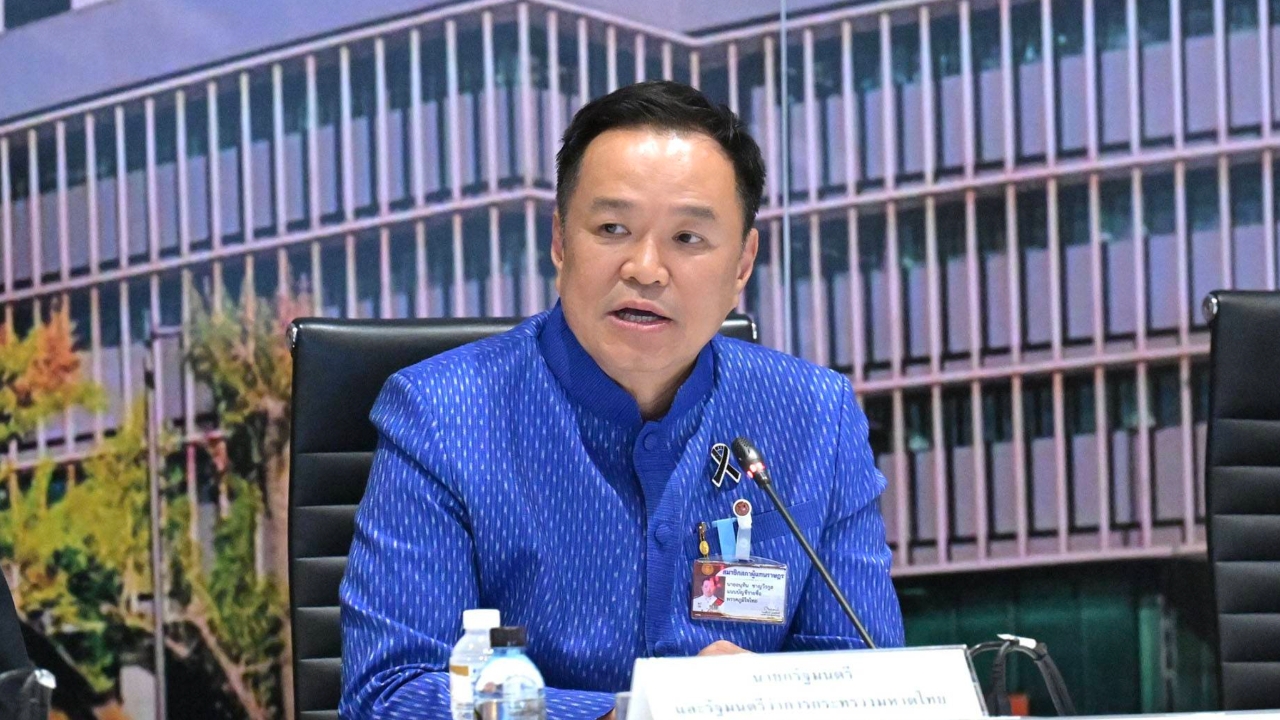
Prime Minister Anutin emphasized that Thailand has not experienced an oil import shortage. He pointed out there is no reason for undue worry, as refineries continue to operate at full capacity. He urged the public to remain confident and live their lives as usual.
At 17:55 on 19 Mar 2026 GMT+7. Mr. Anutin Charnvirakul, Prime Minister and Minister of Interior. He held a press conference after the sixth meeting of the Center for Management and Monitoring of the Middle East Conflict Situation (CMMC) in 2026, held in Conference Room CB 406 on the 4th floor of the Parliament Building. The meeting included government agencies and private sector representatives to monitor practical issues across the entire oil business supply chain, from upstream to downstream. Key summaries are as follows.
1. Upon reviewing oil volumes and prices at each stage of the supply chain—including refineries, oil depots, jobbers, transportation, and gas stations—the meeting found that all six refineries in the country remain at full production capacity. We produce 175 million liters per day and continuously procure crude oil from multiple sources to ensure sufficient raw material for refining into various types of fuel.
Both refineries and oil depots will announce prices at their gates, with PTT OR ready to sell oil to jobbers at prices no higher than those at gas stations. The Ministry of Energy will supervise refineries and oil traders to report production, sales volumes, and prices to the Department of Energy Business, enabling proper allocation of oil volumes to citizens and industries at fair prices.

Meanwhile, The Royal Thai Police (RTP) plans to issue regulations permitting oil tanker trucks to operate 24 hours nationwide starting today to facilitate oil transportation to gas stations across the country. They request cooperation from transport operators to enhance security measures during oil deliveries to gas stations.
Regarding refined oil exports, it has been confirmed that exports continue only to the Lao PDR and Myanmar. The average export volume to the Lao PDR is 5.29 million liters per day, a 25% decrease from previous levels. Exports to Myanmar stand at 300,000 liters per day, down 20% from before. The public is assured there is no oil shortage.
To boost confidence and resolve fuel shortages at gas stations, the government will expedite consideration of additional measures, such as relaxing oil reserve requirements to increase system supply, accelerating production of B20 biodiesel for market readiness, and considering compensation for various groups. The government aims to restore the system to normal operation, enabling jobbers to resume usual activities and enhancing transport capacity to deliver oil to gas stations to meet the needs of citizens, businesses, and industries at reasonable prices. "What I want to convey to the public is to have confidence. We have held multiple meetings and consulted relevant parties, verifying information through documents, verbal confirmation, and their experience. I reiterate that Thailand has not experienced any oil import shortage whatsoever."
"There are ongoing claims that crude oil no longer enters Thailand and that volumes have halved due to the Middle East conflict. Today, we convened further meetings—both small and large groups—and received clear confirmation that we can still produce oil at the same volume and capacity as before 1 March, prior to the Middle East fighting."
Therefore, there is no oil shortage. Oil reserves remain at about 100 days’ supply. At the start of the conflict, reserves were only 62 days, but through management measures and increased crude oil inflow, we have been able to maintain supply. Since 1 March, we have banned exports of refined oil except to Laos and Myanmar, which has helped increase national reserves to approximately 100 days.
This refers only to oil reserves. Daily, we continue to import crude oil globally despite the Middle East conflict. We utilize networks, including PTT—which is not a small company—and longstanding domestic refineries with established crude oil procurement networks. No problems have arisen thus far.
He explained that increased demand and public concern have led to fuel disappearance due to panic buying and stockpiling.

Today, the government and relevant sectors—including production, transportation, and distribution—are fully cooperating to manage the situation and ensure sufficient oil supply for the public.
At the same time, the government requests public cooperation, emphasizing that lost oil volume is not due to exports, increased electricity production, or industrial use. Everything remains normal. "The disappearance is caused by public concern, leading to increased refilling and household stockpiling, which creates shortages. People fill up early rather than waiting for tanks to run low, causing demand spikes and higher consumption. We ask citizens to cooperate by returning to normal usage patterns, as fuel at gas stations is sufficient, allowing supply to align with production." The Prime Minister reiterated that the 67 million liters previously consumed daily represented normal use, but it jumped to 84 million liters due to panic. Returning to normal use, without necessarily increasing conservation efforts, will align consumption with Thailand’s production capacity.
This adjustment may take one to two weeks. At the meeting, Deputy Prime Minister and Minister of Transport Pipat Ratchakitprakarn, Energy Minister Atthapol Rerkpiboon, and PTT agreed to release oil reserves into the system to restore sufficient volumes and synchronize consumption with production starting today.
Despite no current shortage, the Prime Minister urged the public to use oil responsibly.
The CMMC meeting concluded that there is currently no reason for excessive concern. The public is encouraged to live normally while the government addresses the situation swiftly. However, citizens are reminded that the conflict remains unpredictable in severity and duration. Responsible use will help increase national oil reserves.
