

Phiphat shouted close to the Prime Minister that it is impossible that oil was sent to gas stations in Songkhla on 1 April and asked for an investigation, noting many ill-intentioned people. The Prime Minister said he could not say who caused the oil shortage in the past seven days because there was no shortage. He confirmed there was no secret export of oil from Laos to Cambodia.
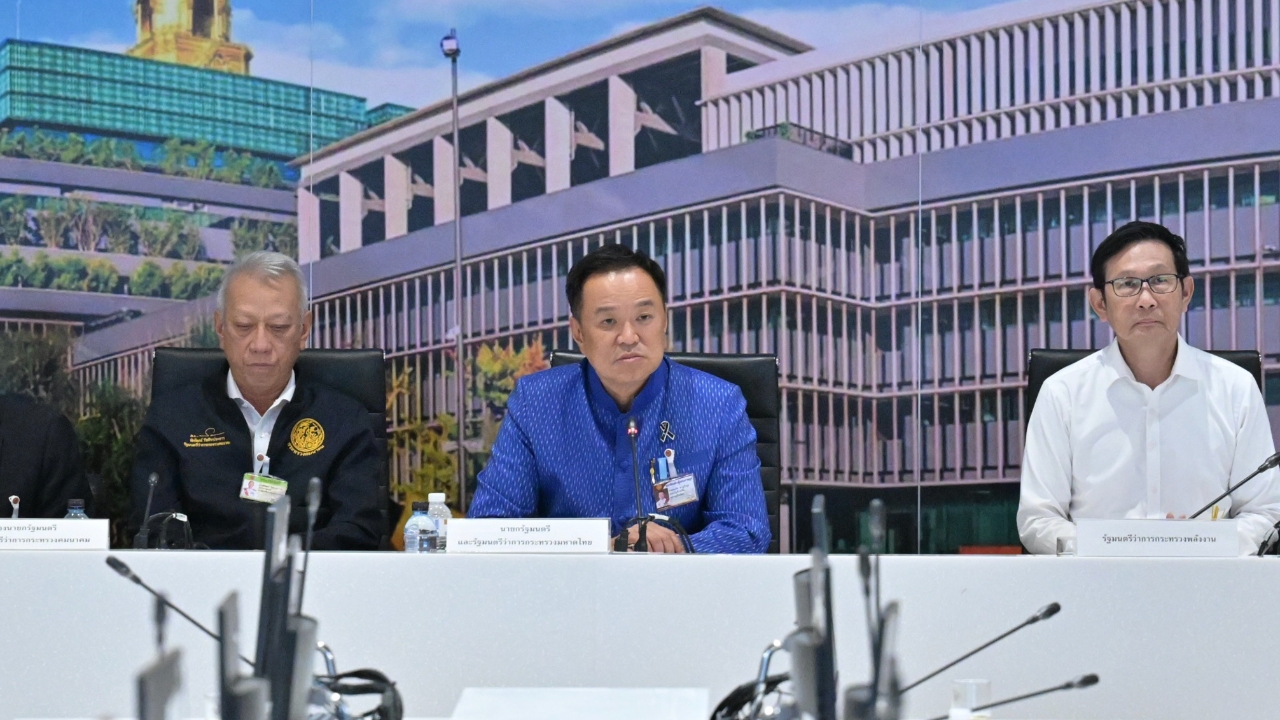
At 18:13 on 19 Mar 2026, in meeting room CB 406 on the 4th floor of the Parliament building, Prime Minister and Minister of Interior Anutin Charnvirakul, Deputy Prime Minister and Minister of Transport Phiphat Ratchakitprakarn, Deputy Prime Minister and Minister of Finance Akniti Nitithanprapas, Minister of Foreign Affairs Sihasak Phuangketkaew, Minister of Energy Atthapol Rerkpiboon, and Secretary-General of the National Economic and Social Development Council Danucha Pichayanan jointly held a press conference after a meeting of the Center for Administration and Monitoring of the Conflict Situation in the Middle East (CBK).
When asked about four gas stations in Songkhla having to close, and how to address the problem in that area, Anutin had an OR executive respond that there was no shortage. The increased use by the public caused the pumps to run out faster but restocking was expected daily. Regarding reports that oil deliveries to Songkhla were scheduled for 1 April, causing the closures, the Prime Minister said former gas station owner (Phiphat) shouted in his ear that this was impossible. The OR executive explained it was likely a wait for restocking, probably by the next day.
Then Phiphat asked reporters which gas stations were closed. When told it was Bangchak, he responded that this was unlikely since Bangchak's wholesale still supplied oil. He expressed uncertainty about whether the operator in question was the actual operator and requested investigation, adding that many ill-intentioned individuals are active today.
The OR executive stated that ships have been brought into the south as reinforcements, arriving daily. The shortage period may be related only to transport times and is not expected to be long.

Asked when the oil situation would return to normal as the public has hoarded quite a bit, the Prime Minister said this hoarding caused the abnormal situation and urged public cooperation. The government obtains data directly from the Department of Energy Business overseeing import-export and domestic sales, based on crude oil importers including PTT and other refiners. The meeting’s goal was to restore the situation to conditions before 1 March, when production capacity was sufficient at 67 million liters per day. This is expected to take 1–2 weeks. The solution is to inject oil reserves. If people stop hoarding, the situation will balance and return to normal. He requested public cooperation to avoid excessive hoarding, which can never be met by supply. The government will increase supply to balance demand.
When asked about subsidies for jobbers and how much oil is purchased daily from OR, Energy Minister Atthapol Rerkpiboon said the oil fund subsidizes every liter when excise tax is applied. OR sells 3–5 million liters per day to jobbers. Under normal demand, this is sufficient, but current demand exceeds normal levels.
Asked about the Department of Energy Business data reporting 231 gas stations closed, Phiphat said gas stations must be divided into two types: those with a parent company managing them and those without. If the 231 closed stations lack a parent company, no help is available except if they buy oil from jobbers, allowing them to reopen. Normally, such stations purchase oil from jobbers at prices lower than branded stations. They take on their own risk and thus bear the impact during crises.

When asked if the meeting discussed who caused the oil insufficiency in the past seven days, the Prime Minister said there was never a shortage. Thailand still exported oil to third countries. Previous consumption was normal at 67 million liters, while production capacity is 77 million liters. Diesel production remains unchanged. Public concern about price hikes and shortages led to hoarding. The government will not allow shortages.
"Who caused the oil shortage? I cannot say because there is no shortage yet, but excessive hoarding occurred. The government understands and tolerated it. Now we realize reserves cover 100 days and crude oil import capacity remains unchanged, so supply is normal. We ask demand to decrease to match supply so the situation returns to normal," the Prime Minister said.
Meanwhile, Phiphat urged traders to use stockpiled refined oil currently short in supply. The government plans to inject reserves within a week to restore normal conditions for both gasoline and diesel. The situation is currently overloaded. He assured that this stock injection will help reopen closed stations and resolve shortages within one week.
Energy Minister Atthapol emphasized confidence in crude oil sourcing, noting that from 1–18 March, imports came from multiple sources including the U.S., Brazil, Malaysia, Australia, Vietnam, Brunei, and Libya, totaling about 3.3 billion liters. He assured there would be no shortage. However, demand rose from 67 to 84 million liters. The government is injecting reserves and restricting exports to store oil. Thailand’s production capacity exceeds consumption. Relaxing transport restrictions will increase delivery. Under normal demand, the situation will normalize.

The Prime Minister also addressed reports of secret oil exports from Laos to Cambodia, firmly denying them. Having recently visited Laos and inquired with senior officials, he was told no such exports occur. He urged the media to report clearly. Currently, Thailand exports oil only to Laos and Myanmar for strategic reasons: these countries supply electricity and gas to Thailand, so fuel is sent there to support production serving Thailand.
When asked if the oil fund would last into the next government, Energy Minister Atthapol confirmed ongoing subsidies. The fund currently holds over 20 billion baht in cash. Compensation payments are monthly, not daily, with the March payout being relatively low at only a few hundred million baht. The next payment cycle is mid-April, so there is no problem expected.
