

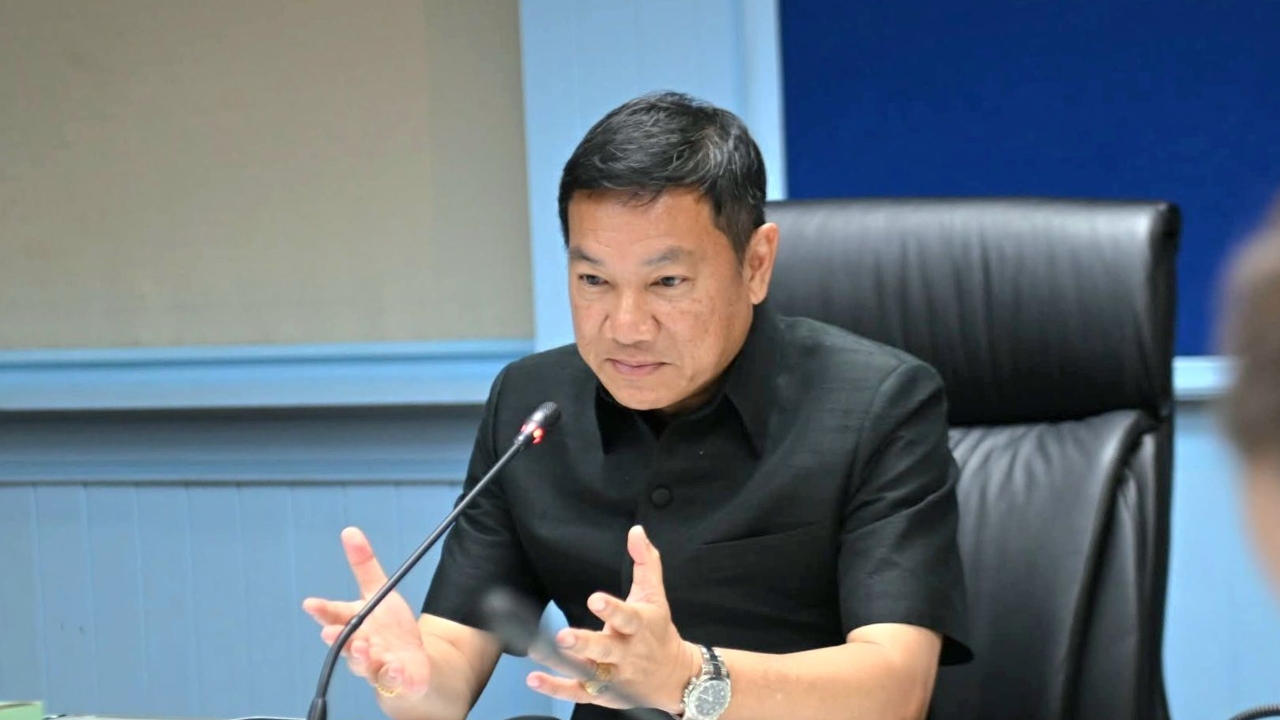
The Secretary-General of the Interior Ministry has urged governors nationwide to cooperate with all sectors to care for the public and manage three summer hazards: wildfires with haze and PM2.5 dust, drought, and seasonal storms.
On 22 Mar 2026 GMT+7, Mr. Assit Sampanarat, Secretary-General of the Interior Ministry and Deputy Commander of the National Disaster Prevention and Mitigation Command, reported that the Meteorological Department forecasted at 06:00 today that, over the next 24 hours, upper Thailand will experience hot daytime weather with thunderstorms and strong gusts in some areas due to a heat-induced low-pressure system covering the region. Southern Thailand will have isolated thunderstorms due to easterly and southeasterly winds over the Gulf of Thailand, the south, and the Andaman Sea. The north and northeast have moderate to high levels of particulate matter or haze because of low to moderate ventilation. The public in upper Thailand is advised to take care of their health due to the heat and be cautious of potential thunderstorms and strong winds in some places.
The Secretary-General stated that Prime Minister and Interior Minister Mr. Anutin Charnvirakul, as National Disaster Prevention and Mitigation Commander, has since December 2025 continuously instructed all 76 provincial governors and the Governor of Bangkok to integrate efforts with all sectors to prepare for possible climate change impacts during the 2026 summer. The three main risks are: 1) preventing and solving wildfires, haze, and fine particulate matter (PM2.5); 2) preventing and addressing drought; and 3) managing seasonal storms.
Regarding prevention and resolution of wildfires, haze, and PM2.5, authorities are to monitor, track, and assess situations that may cause incidents locally and raise awareness among people in risk areas about the situation and safety measures. Coordination with military and related agencies should ensure readiness of personnel, tools, equipment, and machinery to operate around the clock. Community participation, including volunteers, local administration, village chiefs, and local government organizations, is essential, as is protecting public health, especially vulnerable groups, and strictly enforcing related laws.
For drought prevention and mitigation, actions should follow rehearsed emergency plans, prioritizing water shortage solutions for consumption first, followed by agricultural needs. Authorities must prevent crimes such as theft of water pumps and other property that affect daily life and livelihoods. Vigilance against fires caused by heat and equipment deterioration is required in villages, communities, and agricultural areas. Local government fire trucks must maintain immediate water availability for firefighting.
In managing seasonal storms, continuous monitoring and weather updates are necessary, with ongoing public warnings about potential developments. Officials must regularly inspect the structural integrity of buildings, billboards, electric poles, roadside trees, and public facilities. Unsafe structures should be reinforced. Emergency machinery, personnel, and resources must be ready to assist affected citizens promptly. Additionally, the Ministry of Agriculture and Cooperatives' local branches must alert farmers to protect crops and livestock from damage.