

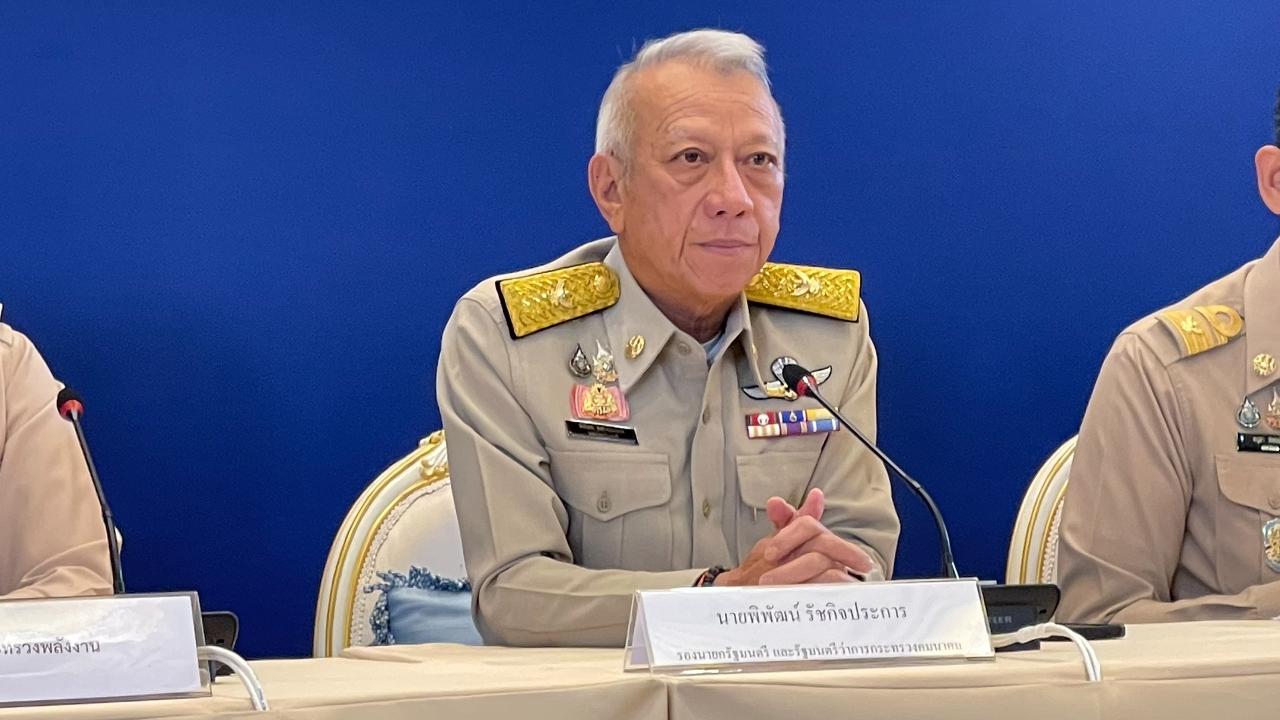
Phiphat revealed no evidence of oil hoarding in southern Thailand and is expediting diesel delivery for the transport sector after threats to halt vehicle movement. Meanwhile, the Secretary-General of the National Economic and Social Development Council (NESDC) explained the government has lifted oil reserve regulations to resolve quota exhaustion problems.
On 23 March 2026, at Phakdi Bodin Building, Government House, after the meeting of the Center for Administration and Monitoring of the Middle East Conflict Situation (CMEC), reporters asked whether the Ministry of Energy has calculated if the diesel consumption of over 84 million liters per day has sufficient reserves. Prasert Sinsukprasert, Permanent Secretary of the Ministry of Energy, said they need to monitor March's usage figures to see if consumption remains stable, as initial panic may have caused hoarding. Once people have refilled, usage might return to normal. They need to observe if the 84 million liters per day figure stabilizes. Additionally, increasing diesel types B5, B7, and B20 could reduce basic diesel use, increasing reserve levels, which are expected to range between 90 to 100 days.
Regarding current demand of 84 million liters per day but production of only 80 million liters, how can the government ensure sufficient fuel supply this week? Sarawut Kaewtatip, Director-General of the Department of Energy Business, stated that last month and up to now, consumption has exceeded production. Private sectors have therefore released stored reserves. Simultaneously, the government has allowed private entities to distribute more reserves during periods of higher-than-normal demand. Violations by refineries and middlemen failing to report daily usage carry fines and criminal penalties.
Concerning overall oil transport methods, the Director-General of the Department of Energy Business explained that truck transport is the main method. Refineries adjacent to pipelines, like Thai Oil, transport about 30% by pipeline, 40% by truck, 20% by train, and 10% by ship, which is the normal distribution mode. The Permanent Secretary of the Ministry of Energy emphasized that pipeline transport to the northeast region, such as Khon Kaen province, has increased from 3 to 3.5 million liters per day previously to now 5-6 million liters per day, with a continuing upward trend.
Regarding progress in securing oil reserves, the Director-General of the Department of Energy Business said crude oil has been sourced from non-Middle Eastern countries such as Angola and the United States, and shipments from Latin America are currently en route by ship.
On resolving fuel issues in the southern transport sector, Phiphat Ratchakitprakarn, Deputy Prime Minister and Minister of Transport, said that following complaints from the Southern Logistics and Transport Association, the government will sell oil through middlemen, which is expected to solve the problem. Regarding the eight sites suspected of hoarding in the south, Phiphat explained that the Prime Minister’s special task force inspected service providers and storage tanks and found no hoarding beyond 330,000 liters in Ang Thong and an attempted shipment of 20,000 liters to neighboring countries.
Regarding multiple service stations running out of fuel quotas and waiting to restock on 1 April, Danuporn Pichayanan, Secretary-General of the NESDC, said he has spoken with some Bangchak stations involved in the reports. Sales volume exceeded production, causing quotas to be depleted. Furthermore, the government had not yet relaxed the 1.5% oil reserve requirement, but currently Bangchak has confirmed it can supply fuel as usual.