

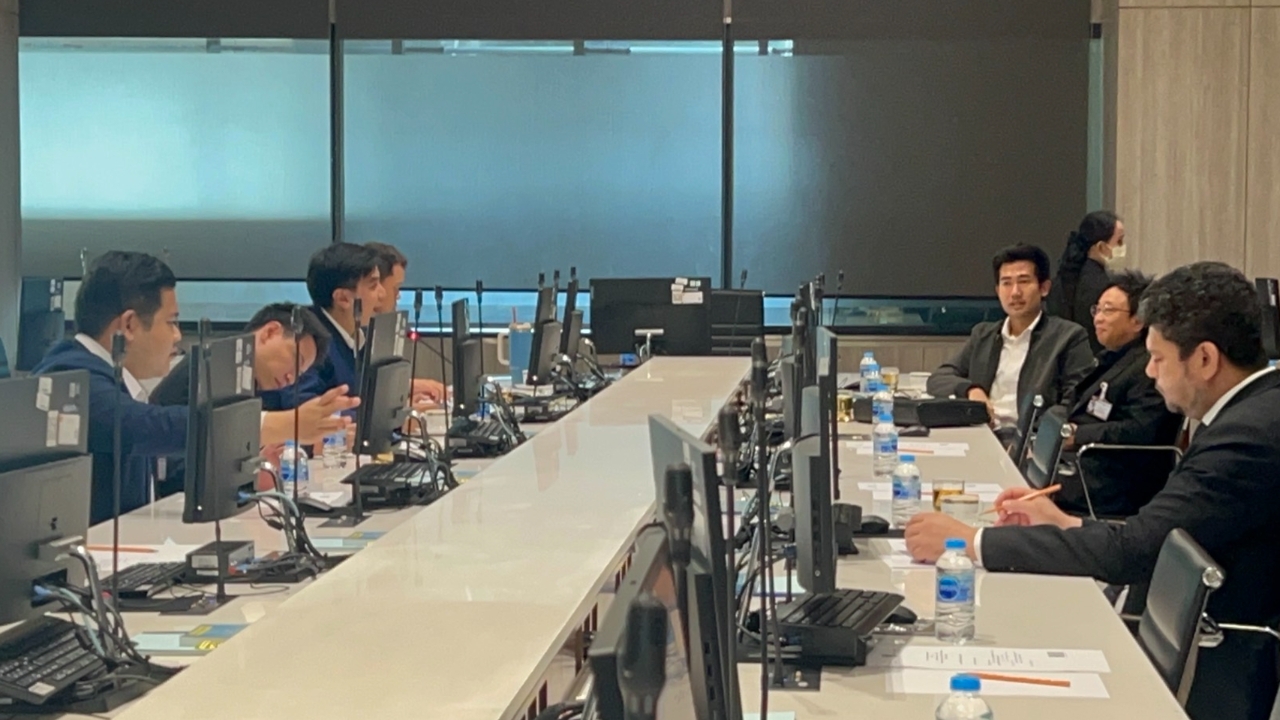
The opposition whip committee held its first informal meeting of the five parties that did not vote for Anutin to become prime minister. They are preparing to file an urgent motion to discuss the energy crisis. Parit 'Ice' Wacharasindhu said they have already coordinated with Bhumjaithai and are not worried about the meeting being prematurely closed as before. They are ready to have MPs debate topics such as the energy situation and oil price increases.
On 24 Mar 2026 at 09:30 GMT+7, an informal first meeting of the opposition coalition whip committee was held at the parliament. Representatives from five political parties attended: the People’s Party led by Pakornwut Udompiphatsakul, an MP on the party list and deputy leader; Parit Wacharasindhu, party list MP and spokesperson; Democrat Party led by Satit Wongnongtoey, party list MP and deputy leader; Phasin Pitutecha, MP for Rayong; Attakorn Sirilattayakorn, MP for Chachoengsao; Kla Tham Party’s Dr. Warong Dejkitvikrom, party list MP and party leader; Thai Pakdee Party; and a representative from Seri Ruam Thai Party.
Parit informed the meeting that this was an informal opposition gathering comprising five parties that did not approve Anutin Charnvirakul as prime minister. The informal meetings will continue until the new cabinet is appointed and the opposition leader in the House of Representatives is selected, at which point the opposition whip chair can be established. Meanwhile, such informal meetings are intended to regularly discuss parliamentary agendas on a weekly basis.
At 11:00 GMT+7, Parit reported that the five opposition parties unanimously agreed to submit an urgent oral motion to the parliament on 25 Mar, allowing MPs to propose solutions to the current energy crisis. They have preliminarily coordinated with Karavee Prisananantakul, MP for Ang Thong from Bhumjaithai, and are confident the motion will be considered. They are not concerned that Sopon Sarum, the parliament speaker, will block the discussion as happened last week when the meeting was prematurely closed. The People’s Party has already prepared MPs to debate the motion, focusing on topics such as the global and domestic oil situation, impacts on the public, price caps, and domestic oil price adjustments. Parit emphasized the government should have clear policies and measures to avoid harming farmers, low-income groups, oil-dependent professions, and transport sectors.
“Regarding the current energy crisis, I believe if the government manages transparently, there is no need to fear opposition questions. The first principle I emphasize is telling the truth to the people, because in many cases the prime minister’s statements contradict facts. For example, he claimed oil shortages are due to increased consumer demand, but the reality includes reduced oil deliveries to stations. Also, while officials say there is no hoarding by masked individuals, investigations found significant oil stockpiling in Ang Thong province and cases of overpricing,” Parit said.
Parit added that the opposition plans to request the parliamentary speaker to schedule a session on 26 Mar, arguing there is no reason to hold only one session this week. Given the country’s many problems, parliament should serve as a forum to find solutions. If the speaker changes his mind, the parliament can open for the session on that day.
Parit further stated that the meeting agreed to propose the establishment of four special parliamentary committees next week: one to study the impact of the Iran-US conflict; one addressing agricultural product price issues; one for compensation and relief for disaster victims, such as the floods in Hat Yai district, Songkhla province; and one to study cannabis regulation. These motions have been submitted. They will also discuss allowing the parliament to consider question agendas, even without a new government formed yet, so the caretaker cabinet can respond to ongoing issues. Additionally, they will seek to add one or two Friday sessions per month to consider pending bills proposed by MPs or civil society.