

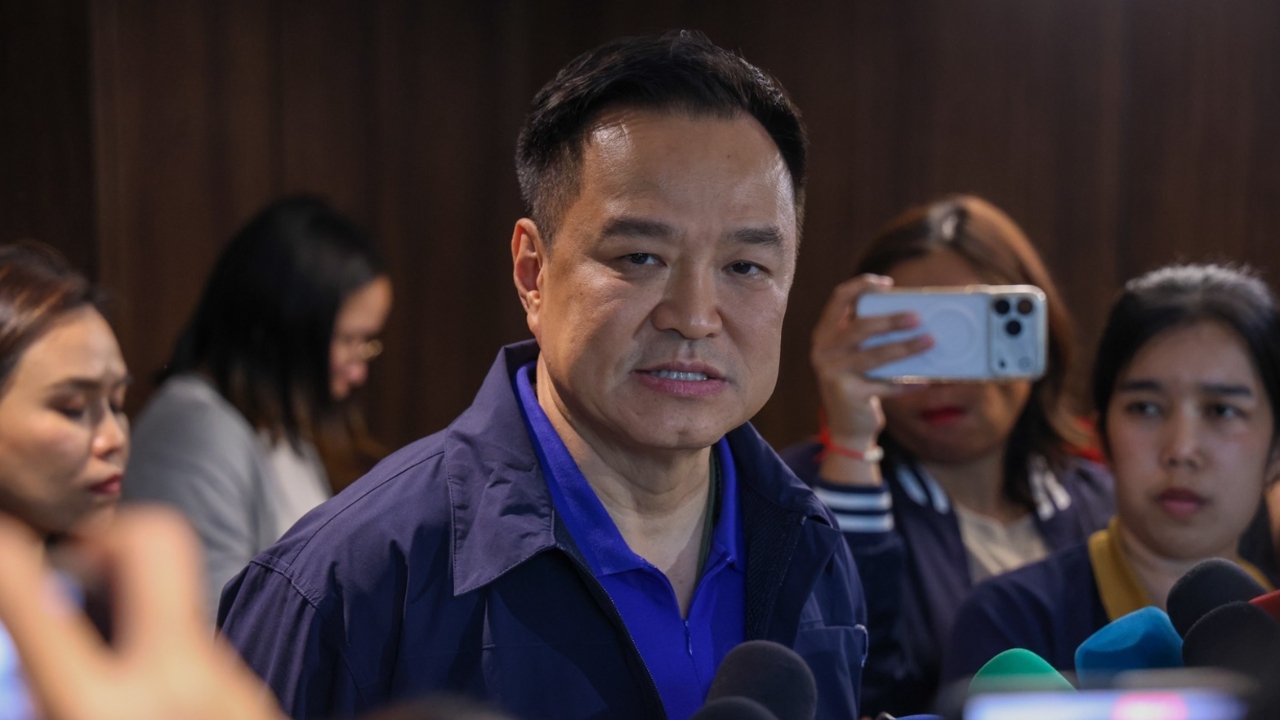
The Prime Minister said diesel prices will be allowed to follow market mechanisms, stressing that without a price cap, there is no ceiling. He pointed out that panic buying has caused fuel consumption to soar by 20 million liters. He affirmed the government will introduce energy-saving measures and emphasized that product prices will be kept stable as much as possible within their capability.
On 24 March 2026, Anutin Charnvirakul, Prime Minister and Minister of Interior, addressed the government's prior statement that diesel prices would not exceed 33 baht per liter. He clarified there is no price cap, so no ceiling exists, and that prices must follow market mechanisms. The government will consider measures for fuel users, including large industries, but will not override market forces.
Regarding whether the oil fund will need to borrow more money, the Prime Minister said that question should be directed to Deputy Prime Minister and Minister of Finance, Aekniti Nitithanprapas.
When asked if there was an estimate for how high oil prices might go, the Prime Minister laughed but did not answer. He acknowledged the situation causes distress for everyone due to the war. The government will implement various measures such as energy and fuel conservation. Currently, the government is assuring the public that before the war, daily oil demand was about 67 million liters, while production was 77 million liters per day, selling 5 million liters to Laos and Myanmar combined. Production capacity exceeds demand, but panic and concern have raised demand to over 80 million liters daily, surpassing production capacity. The government aims to reduce oil usage back to pre-28 February levels, before the Middle East war, assuring that if demand returns to normal, claims of oil shortages would be baseless.
He emphasized that if the additional 20 million liters caused by panic buying are excluded, the oil supply in the system can be managed. However, price control is not possible, which is normal during wartime. If conditions improve, prices are expected to decline.
The Prime Minister added that earlier that morning, he received reports of a Thai-flagged oil tanker entering, with the Ministry of Foreign Affairs and the Thai government coordinating closely with the Iranian embassy. The Thai oil tanker was able to pass through the Strait of Hormuz. The government is pursuing policies across diplomacy and trade to restore normal conditions.
When a reporter asked if there is a chance diesel prices could exceed 50 baht per liter, the Prime Minister said he does not know, adding that if fuel is used sparingly, and with the oil fund still providing support, the situation can be managed. He noted that the Middle East Situation Management Center (MSMC) has directed all agencies to assist the public, and each agency has established mechanisms to do so.
Regarding rising oil prices driven by market forces and how this will affect price controls on goods, the Prime Minister stated that everything is proceeding according to process. The government will stabilize prices as much as possible. The Ministry of Commerce has issued announcements to fix prices of consumer goods to prevent lost opportunities and excessive profiteering.