

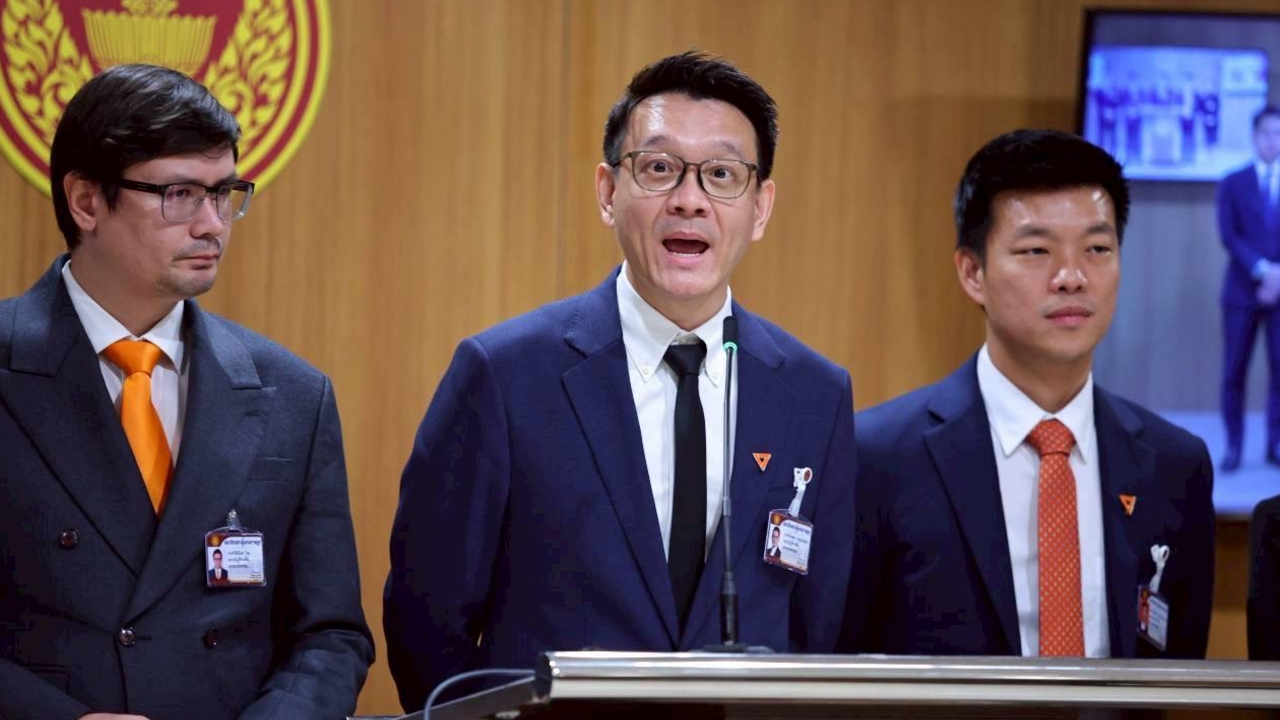
Veerayut, a party-list MP and deputy leader of the Prachachon Party, advises the government to change three approaches to resolve the oil crisis: work transparently, implement tiered subsidies, and distribute coupons to assist farmers. He asserts that the more chaotic the world becomes, the more leaders must stand by the people rather than apart from them. Tags: [oil crisis, government policy, subsidies, farmers, political leadership]
On 25 March 2026 at the Parliament, Veerayut Kanchuchat, deputy leader and party-list MP of the Prachachon Party, delivered an urgent oral motion on the "oil crisis" to gather recommendations for the government on measures to cope with and alleviate public hardship.Tags: [Parliament, oil crisis, government measures, public hardship]
Veerayut pointed out that oil is like the "major artery" of Thailand's economic system, enabling many people—riders, drivers, vendors, fishermen, and farmers during harvest season—to earn a living daily. Since over 60% of Thailand's crude oil is imported from the Middle East through the Strait of Hormuz, conflicts in the Middle East directly affect Thailand’s economic lifeline.Tags: [oil dependency, economy, Middle East conflict, supply chain]
Navigating Thailand through this “global turmoil” requires leadership beyond ordinary times—leaders must understand the global economy, make bold decisions, and most importantly, empathize with the vulnerable. Veerayut proposed three major changes the government must adopt to resolve this crisis.Tags: [leadership, global crisis, empathy, government strategy]
1. Shift from closed crisis management to open listening, transparency, and punishment of wrongdoers.Tags: [crisis management, transparency, accountability]
The government’s work under the “Center for Managing and Monitoring the Middle East Conflict Situation” (CM3EC), led by Deputy Prime Minister and Transport Minister Pipat Ratchakitprakarn, with Deputy Prime Minister and Finance Minister Akniti Nitithanprapas as deputy director, has been overly closed, mainly consulting large business groups.Tags: [government center, closed management, business consultation]
For example, on 15 March, CM3EC summoned only 5–6 large oil companies to inquire about oil reserves. When these firms confirmed sufficient supplies, Pipat and Akniti announced there was no shortage and no need to worry. However, other affected groups—small gas stations, farmers, fishermen, transport sectors—were never invited to provide information and had to appeal to the media or travel to Bangkok themselves, as seen with the National Farmers Council and Thailand Land Transport Federation on 18 March.Tags: [oil companies, information access, affected groups, protests]
Besides well-organized large groups, smaller, dispersed groups such as daily wage earners like riders, farmers, and fishermen lack time and money to come to Bangkok. Therefore, it is the duty of the government and CM3EC to reach out to these groups, understand their difficulties, and practice “open work” by listening openly and sincerely.Tags: [grassroots outreach, vulnerable groups, government responsibility]
Veerayut noted another sign of CM3EC’s closed operation is lack of information transparency. The public’s panic is due to the government not answering their concerns. Although the government repeatedly states “Thailand has over 100 days of oil reserves,” and “the largest in ASEAN,” people want to know “why do gas stations run out of fuel?” and “where can we still fill up?” To reduce public anxiety, the government must openly share clear information on which nearby stations still have fuel, enabling citizens to plan their lives and livelihoods.Tags: [information transparency, public anxiety, fuel availability]
Last Sunday, although the Ministry of Energy instructed Provincial Energy Offices to provide daily service station status summaries, the public must access this by searching for their provincial office’s Facebook page. Many provinces lack such pages or update only once a day around 8 a.m., with no updates during the day.Tags: [energy information, accessibility, social media, data updates]
Most recently, on Monday, the Department of Energy Business announced development of a new backend system called the Fuel Now app, to be available for download from 23 March. However, as of the ongoing debate, the app is still not found, leading the public to rely on self-reported data, such as from pumpradar.com, which lacks full coverage and constant updates.Tags: [digital tools, public information, data reliability]
To ensure transparency and build public confidence, the Prachachon Party calls on the government and CM3EC to shift from closed crisis management to “open crisis management” by listening widely, disclosing information publicly, and courageously punishing wrongdoers.Tags: [transparency, public trust, governance reform]
2. Shift from fixed price controls to tiered subsidies and support for vulnerable groups.Tags: [price policy, subsidies, vulnerable groups]
The second major change Veerayut recommends concerns oil price subsidies. He said recent chaos at gas stations occurred because the government announced a fixed 15-day price freeze. This deadline caused consumers and industries to “buy more than usual,” while wholesalers and retailers “sold less than usual,” leading to shortages. The government should not blame the public but accept that fixed-term price controls caused the disruption.Tags: [price freeze, market behavior, supply shortage]
Besides fixed-term subsidies, the government could adopt “tiered subsidies,” setting subsidy amounts based on global oil price ranges, allowing domestic prices to reflect global market changes without sudden spikes or excessive burdens.Tags: [tiered subsidies, price stabilization, market reflection]
Additionally, the government could provide “targeted subsidies” directly to vulnerable groups—low-income people, farmers, fishermen, or upstream sectors affecting transport and public vehicles—requiring coordination of data from multiple agencies for informed decisions.Tags: [targeted aid, vulnerable populations, data coordination]
Veerayut emphasized that in crises, the government should lay all available tools on the table and combine them appropriately. Besides the oil fund, it can reduce excise taxes—as done for green diesel in fisheries—and collect windfall taxes from refineries or businesses earning excess profits from external factors without additional investment.Tags: [tax policy, crisis tools, windfall tax]
Most importantly, the government must communicate clearly to the public the principles behind decisions: who benefits, who loses, and how the burden and relief are fairly shared in society.Tags: [communication, social equity, policy transparency]
3. Shift from the Green Flag publicity project to comprehensive supply chain management and widespread coupon distribution.Tags: [agriculture support, supply chain, subsidy methods]
The agricultural sector faces shocks from the Middle East conflict since Thailand imports about one-third of its fertilizer from there.Tags: [fertilizer imports, agriculture, Middle East impact]
Veerayut pointed out that the “Green Flag Fertilizer” project, recently renamed “Green Flag Plus,” is a standard government publicity effort that practically helps only a very limited number of farmers. Last fiscal year, the Department of Internal Trade sold 97,000 sacks—about 5 million kilograms—of subsidized fertilizer. However, as an agricultural country, Thailand’s annual fertilizer demand reaches 5.6 million tons, so the project covers only 0.1% of total demand—like a drop of water in the desert—with the rest remaining expensive or more costly.Tags: [fertilizer subsidy, agricultural demand, limited impact]
The government must rethink how to best and widely assist farmers. The Prachachon Party proposes a dual approach: first, monitor and ensure fair prices throughout the agricultural supply chain—from import to distribution and harvest—to prevent price gouging or hoarding during the crisis.Tags: [price monitoring, supply chain fairness, agriculture]
Second, distribute “fertilizer coupons” to farmers to reduce costs of fertilizers and other production inputs. Since the government already has farmer data—crop types, farm sizes, locations—it can tailor coupon distribution to harvest timings and control budget use accordingly.Tags: [coupon subsidies, targeted aid, data-driven support]
Veerayut proposes these three changes to resolve the oil crisis: shift from CM3EC’s closed management to open listening, transparency, and accountability; replace the oil fund’s fixed price controls with tiered subsidies and targeted support combined with tax measures; and change from limited Green Flag projects to comprehensive supply chain oversight and widespread coupon distribution.Tags: [policy reform, crisis resolution, government strategy]
Veerayut said the greatest concern among Thais now is the feeling that the government and national leaders are not standing with them during the crisis. Restoring trust requires transparent and fair governance. He concluded by inviting those still suffering from the oil crisis—especially groups whose voices have not reached the government, like farmers, fishermen, riders, laborers, and tourism and transport operators—to raise their concerns with the Prachachon Party.Tags: [public trust, leadership, outreach, affected groups]