

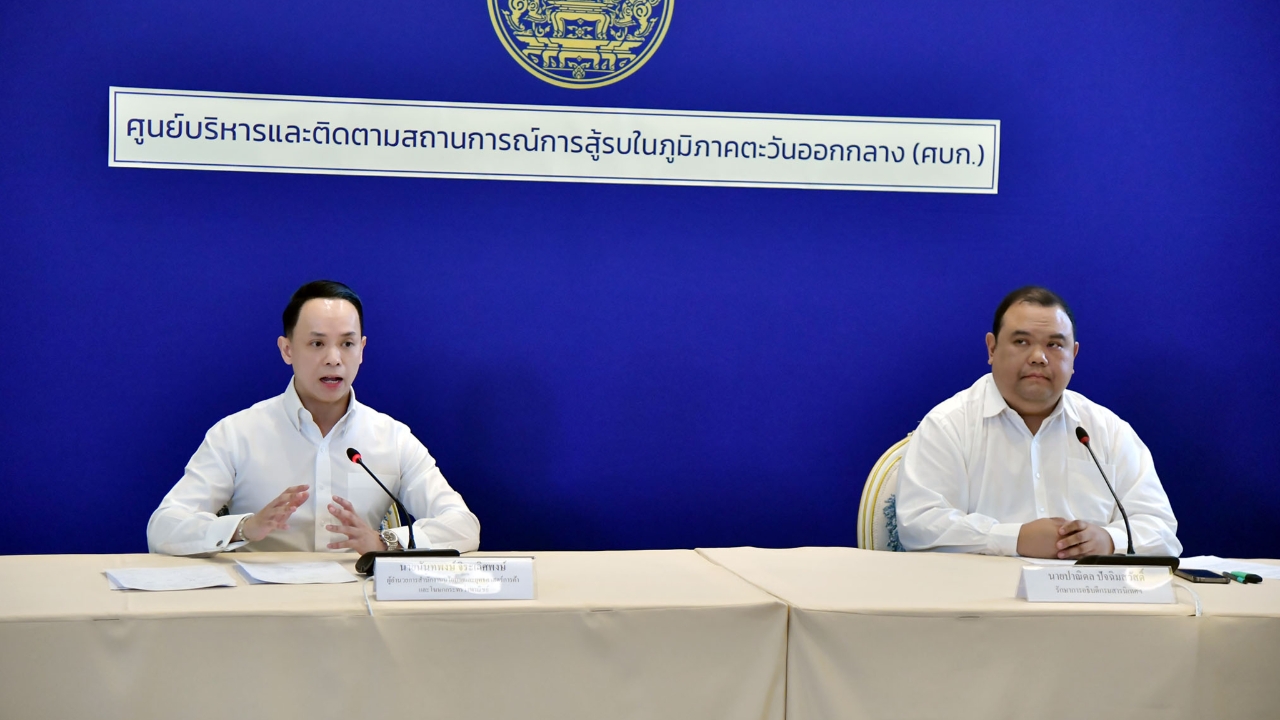
The Center for Administration and Monitoring of the Middle East Conflict (CAMMEC) revealed that the Commerce Ministry plans to increase the list of price-controlled products to 71 items. Approval will be required before raising prices on 13 of these items. Prices for noodles and curry rice remain stable, with fresh pork and chicken having increased by 10 baht only.
At 11:00 a.m. on 25 March 2026, at the Government House, the Center for Administration and Monitoring of the Middle East Conflict (CAMMEC) gave its daily situation report. Mr. Nanthapong Jiralertpong, Director of the Office of Trade Policy and Strategy (OTPS) and spokesperson for the Commerce Ministry, reported that from March 5 to 24, 2026, provincial commerce offices across all 16 provinces, in coordination with provincial energy offices and governors, conducted inspections at 2,726 locations. These included 1,650 gas stations, 569 fertilizer shops, and 57 retail markets and malls. Violations of the Price of Goods and Services Act B.E. 2542 (1999) were found in nine provinces totaling 14 cases, mainly for failing to display price tags. Accusations and fines have been issued accordingly. Regarding complaints received through the Department of Internal Trade hotline 1569, there were 372 cases: 14 involved missing price tags, 3 had prices not matching the tags, 1 had unclear tags, 119 showed no violation, and 235 are under investigation. Additionally, there are 33 complaints about selling goods above reasonable prices, which are under cost-price analysis and will be handled according to the law.
Meanwhile, officials from the Commerce Ministry, including central staff and executives, conducted on-site monitoring of market conditions—both prices and product quantities—in Bangkok and its metropolitan area. This is to adjust measures to better support lowering living costs and reducing business expenses. The findings revealed two key points: first, product quantities are sufficient; second, prices remain stable, especially for single-dish foods like noodles and curry rice. However, some price increases were noted in line with cost structures, specifically for pork, chicken, and eggs, which rose following higher transportation and raw material costs.
Secondly, packaging costs, such as plastic bags, have increased along the supply chain. Following the Commerce Ministry’s field inspections, measures have been adjusted to align with the needs of the country, citizens, and costs. These include expanding the sales areas for the 'Thong Fah' (Blue Flag) products and implementing 'Green Flag' measures to reduce fertilizer prices by increasing both the budget and frequency of subsidies, as well as enlarging the coverage areas.
Another initiative is the 'Thai Helps Thai' program, which connects large and small businesses to present products and implement regulatory measures. It also facilitates negotiations to keep prices of essential goods stable, preventing excessive increases in product prices and costs.
This afternoon, Ms. Suphajee Suthumpun, Minister of Commerce, convened a meeting of the Central Committee on Price of Goods and Services (CCPGS) to consider adding 12 more controlled products. These include items related to living costs, such as bottled water, and products linked to cost increases. The total list will rise from 59 to 71 items.
The products requiring Commerce Ministry approval before raising prices, which previously numbered eight, will increase by 13 items, totaling 21. Examples include tissue paper, dishwashing liquid, soap, and shampoo. If approved by the CCPGS, the proposal will be submitted to the Cabinet for further consideration on 31 March.
When asked about price increases in some areas that may not have been fully inspected by the Commerce Ministry, the ministry spokesperson explained that most price hikes in the market fall into three main categories: first, fresh food such as chicken and pork, which have increased by about 10 baht due to cost structures like energy and transportation; second, bottled oil products at two price levels—one adjusted by brand and the other maintaining quality but priced between 40 to 50 baht; third, costs related to plastic pellets used for bags. These three factors signal rising prices or inflation, making measures to reduce living costs urgently necessary.