

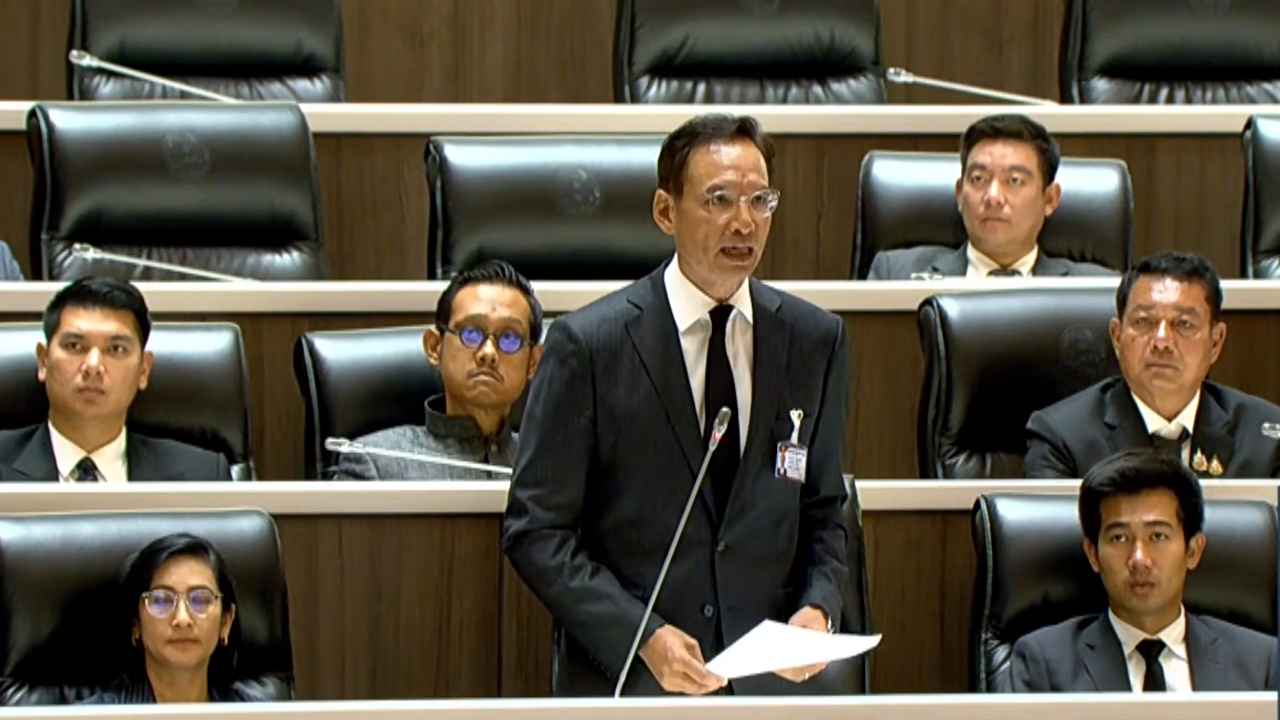
Six coalition parties submitted a motion to resolve the energy crisis. Ekkanat urged not to rely solely on officials' data. Korn emphasized the existence of 'masked figures' in refineries and pressed the government to cut oil excise taxes, aiming to reduce fuel prices by 9 baht per liter.
At 09:30 at the Parliament, the House of Representatives convened with Sopon Sarum acting as chairman. Before proceeding to the agenda, the assembly acknowledged the royal decree appointing Anutin Charnvirakul as Prime Minister. They then discussed the weekly parliamentary schedule, agreeing to hold sessions two days per week on Wednesdays and Thursdays, with one to two additional Friday sessions monthly to expedite lawmaking.
At 10:00, the House considered an urgent oral motion on strategies to address the Middle East crisis impacting Thailand. Six MPs from government and opposition parties jointly submitted the urgent motion: Ekkanat Promphan (party-list MP, Bhumjaithai Party), Weerayut Kanjanachuchat (party-list MP, Prachachon Party), Korn Chatikavanij (party-list MP, Democrat Party), Jatuporn Chaisang (party-list MP, Pheu Thai Party), Sanya Nilsuphan (Nakhon Sawan MP, Kla Tham Party), and Police Colonel Tawee Sodsong (party-list MP, Prachachat Party).
The opposition demanded government clarification.
Meanwhile, Rangsiman Rome and Natthawut Buapratum, party-list MPs from Prachachon Party, along with Apisit Vejjajiva, party-list MP of the Democrat Party, called on Prime Minister Anutin Charnvirakul or relevant ministers to explain their solutions to the public to build confidence. However, Kornvee Prisanananantakul, Ang Thong MP of Bhumjaithai Party, argued that the Prime Minister's explanation could be allowed only with the Speaker's permission, and the urgent motion must be referred to the government for consideration. It is not a vote of no confidence. The Prime Minister could respond during live questions. Sopon Sarum, Speaker of the House, added that the executive branch is not compelled to respond to oral urgent motions; it is their discretion whether to do so. The session then proceeded to consider the urgent motion.

"Ekkanat" warns against relying solely on official sources.
Subsequently, Ekkanat Promphan, party-list MP of Bhumjaithai Party, presented the motion stating the current problem is mixed messaging causing public confusion. Although the Ministry of Energy asserts sufficient crude oil reserves for hundreds of days and refineries operate at full capacity, producing increased oil quantities, with over 77–84 million liters distributed to oil retailers, questions remain why many gas stations receive smaller oil quotas. The conflicting data causes doubt. The first step must be to collect and disclose all production and distribution data to the public. Why can't this information be released to reduce public panic? All agencies must report refinery output and deliveries to stations to ease government work. If the situation worsens, stricter measures must be implemented. The oil fund misleads Thais into believing cheap oil remains, whereas neighboring countries pay over 50 baht per liter. The oil fund mechanism needs reviewing; temporary subsidies should replace permanent ones. We must face reality, not illusions.
"Today, we do not yet know who the new Energy Minister will be, but I take this opportunity to send a message to the incoming minister. If forgotten, I ask fellow members to remind him: while many experts understand energy issues, those appointed lack courage and political will. I warn the new minister not to trust official data more than the people's voices. Believe the public, work diligently, and use courage and political will to resolve the problems," Ekkanat said. .
"Korn" insists refinery 'masked figures' exist.
Korn Chatikavanij, party-list MP of the Democrat Party, argued that the government's failure to manage the oil shortage has three main points: 1. Refineries do not supply enough oil to gas stations. He confirmed the existence of 'masked figures.' The government knows refineries withhold oil from stations but has not tracked who controls the oil. 2. The oil pricing structure is problematic. Thailand has three oil market prices: 2.1. The lowest price at the pump, subsidized; 2.2. Wholesale price via jobbers without subsidy; 2.3. The "green oil" for fishermen, excise-tax exempt, but the government cannot prevent buyers from other markets buying the subsidized pump-priced oil. Industrial sectors should buy from jobbers to reduce competition at the cheaper pump price. 3. The oil fund has accumulated debts over 20 billion baht, but no cabinet resolution allows it to borrow to reimburse oil traders. Consequently, refineries avoid supplying stations because increased sales worsen liquidity. The public knows 'masked figures' exist. The government must seriously tackle this to prevent public suspicion that it colludes with those figures.
Suggests cutting refining fees and excise taxes.
Korn stated that the Prime Minister's signal to float oil prices confuses the public about whether pump prices will reach 50 baht. The government's failure to control prices stems from ignoring refinery stock levels early on, allowing refineries to profit by selling existing stocks at inflated refining fees three times the norm. This causes artificially high prices. The excise tax remains at 6.95 baht per liter without reduction. The government signals citizens to save fuel, so it should share responsibility. Excess refinery profits should help reduce the oil fund's burden. Cutting excise tax by 6 baht per liter would help lower prices by 9 baht per liter. Every government faces its crisis; this one's is the Middle East crisis. The government should be truthful, not push officials to speak on its behalf. Ministers should not hide or avoid public explanation, as people need reassurance to ease panic.

Stops pushing burden onto people.
Jatuporn Chaisang, party-list MP of Pheu Thai Party, argued the government must explain why people cannot find fuel at stations and how it will reassure the public that shortages will not occur. The government must be truthful about the severity of the crisis, which affects not only oil prices but also transportation, production costs, commodity prices, living costs, and the entire economy. It must clarify whom it will assist first, the budget source, and plans for the next three to six months. Leaving matters to market forces burdens citizens alone. Short-term priorities include improving oil distribution and finding diverse import sources to reduce dependence on the Middle East. Solutions should not be temporary but include sustainable energy security planning.
