

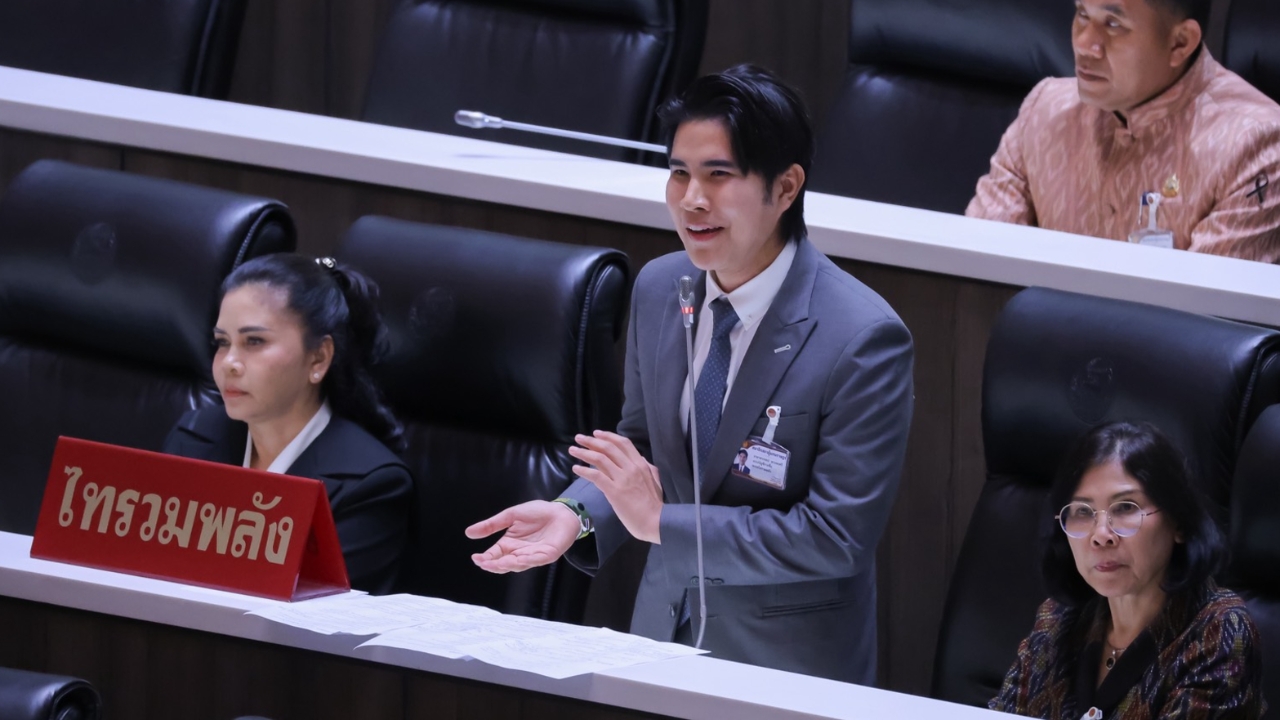
Wasawat, leader of the Thai Ruam Palang Party, made his first parliamentary speech proposing a temporary halt to oil exports to neighboring countries, stressing that Thai citizens must be prioritized. He also recommended using the Emergency Operations Center (EOC) as the sole communication channel to prevent confusion.
On 25 March 2026 at the Parliament building, Mr. Wasawat Puangpornsa, party-list MP and leader of the Thai Ruam Palang Party, further debated the domestic oil situation. He questioned the government why oil exports to neighboring countries continue despite Thai citizens facing shortages and being unable to refuel.
Mr. Wasawat stated that he does not reject international relations, but in a crisis, the government must prioritize its own people first. He proposed the government consider temporarily "delaying, reducing, or limiting quotas" on oil exports until the domestic situation returns to normal.
He also suggested integrating the work of relevant agencies such as the Ministry of Energy, Department of Energy Business, Ministry of Commerce, and security agencies to manage oil fairly and ensure wide distribution.
Mr. Wasawat criticized the government’s current lack of unified information. Ministers from different departments provide inconsistent statements; some have pre-announced oil price hikes, causing public panic and rush to refuel, worsening the situation. He proposed that all communication be channeled solely through the Emergency Operations Center (EOC) to ensure clear, unified information and reduce confusion. He pointed out that in a crisis, conflicting news can cause more harm than shortages themselves.
He also emphasized the problem of managing the entire oil system. Although the government insists there is sufficient oil supply, many citizens still cannot access fuel. Therefore, concrete measures are needed, including delaying exports in problem areas, adjusting export volumes according to the situation, and clearly defining quotas.
Regarding oversight, Mr. Wasawat noted that while the government inspects petrol stations and wholesalers, this is insufficient. Inspections should extend upstream to oil depots and refineries to increase transparency and address public concerns.
He proposed four key solutions:
1. Delay, reduce, and limit oil export quotas.
2. Use the Emergency Operations Center (EOC) as the sole communication channel to prevent public confusion.
3. Conduct comprehensive inspections from source to endpoint, including depots and refineries.
4. Manage distribution fairly to ensure equitable access.
In conclusion, Mr. Wasawat stressed that the government must manage not only the oil supply but also public confidence. He warned that if people continue to queue for fuel while the government insists there is no shortage, public trust will decline, potentially escalating into a crisis of confidence in the government itself.