

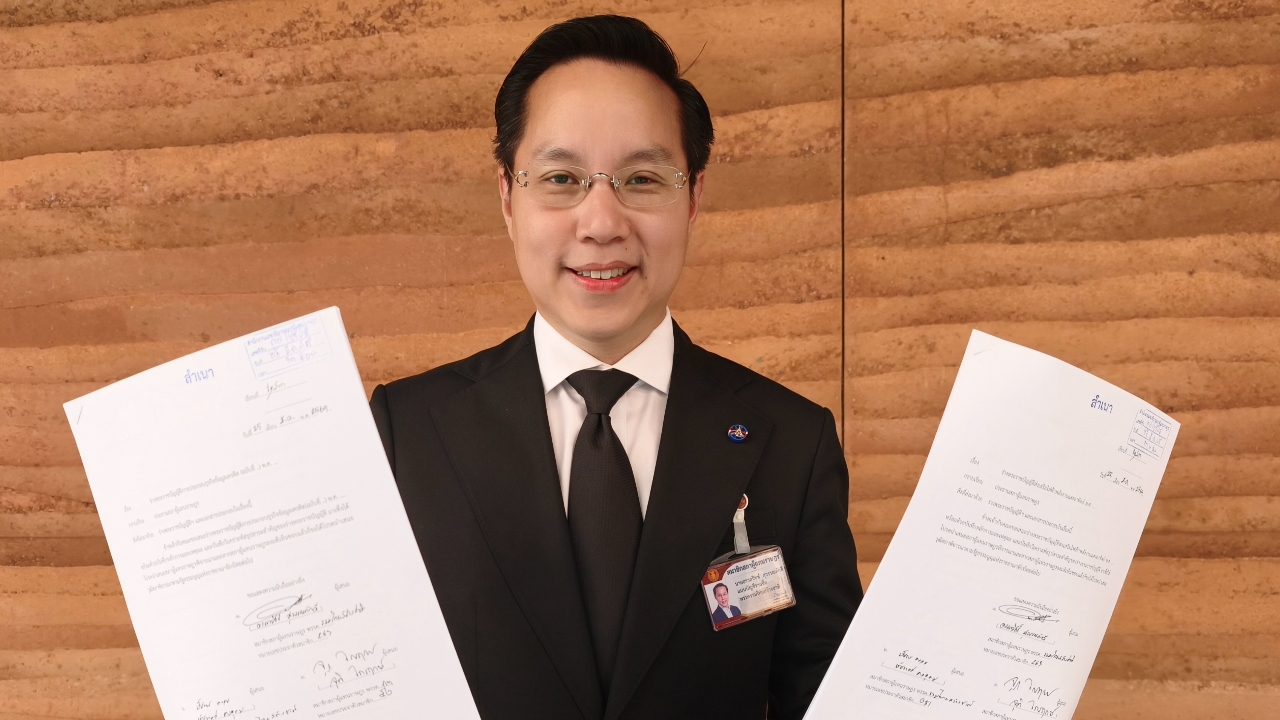
Attawit submitted two bills from the Ruam Thai Sang Chart Party promoting "Solar Freedom" and credit bureau reform to reduce energy costs and improve financial opportunities for the public. He expressed gratitude to fellow MPs for signing in support, enabling successful submission to the parliament.
25 Mar 2026 GMT+7 Attawit Suwanpakdee, party-list Member of Parliament (MP) and deputy leader of the Ruam Thai Sang Chart Party, submitted two key bills from the Ruam Thai Sang Chart Party (RTSC) to the Speaker of the House of Representatives after gathering at least 20 MPs' signatures as required by the constitution. He revealed that although the party has only two MPs, they have persistently pushed these two bills forward, thanking fellow MPs for their support that made the submission to parliament possible.
Regarding the first bill, the Act Promoting Solar Power or the "Solar Freedom Bill", which is Thailand's first of its kind, aims to remove restrictions on solar panel installation by the public. It proposes abolishing the permit process from five main agencies: the Energy Regulatory Commission (ERC), Department of Alternative Energy Development and Efficiency (DEDE), Department of Industrial Works, local government offices (district, municipality, subdistrict administrative organizations), and the Metropolitan Electricity Authority (MEA) or Provincial Electricity Authority (PEA). Instead, it would switch to a single online notification system and require safety certification by licensed engineers to reduce costs, eliminate redundant steps, and facilitate easier public access to clean energy.

The second bill is the amended Credit Data Business Act, or the "Credit Bureau Reform Bill", which aims to solve the problem of debtors being frozen in the system. It proposes that those who have fully repaid and closed their accounts can have their records deleted immediately, prohibiting financial institutions from sharing old data. It also suggests replacing full credit history disclosure with a Credit Scoring system, excluding debts from the COVID-19 period from calculations, and allowing the public to check their credit scores free of charge to enhance fair access to credit.
At the end, Attawit emphasized that both bills primarily aim to reduce structural barriers directly affecting citizens regarding energy costs and financial opportunities, promoting fair competition and strengthening the country's long-term economic potential. .
