

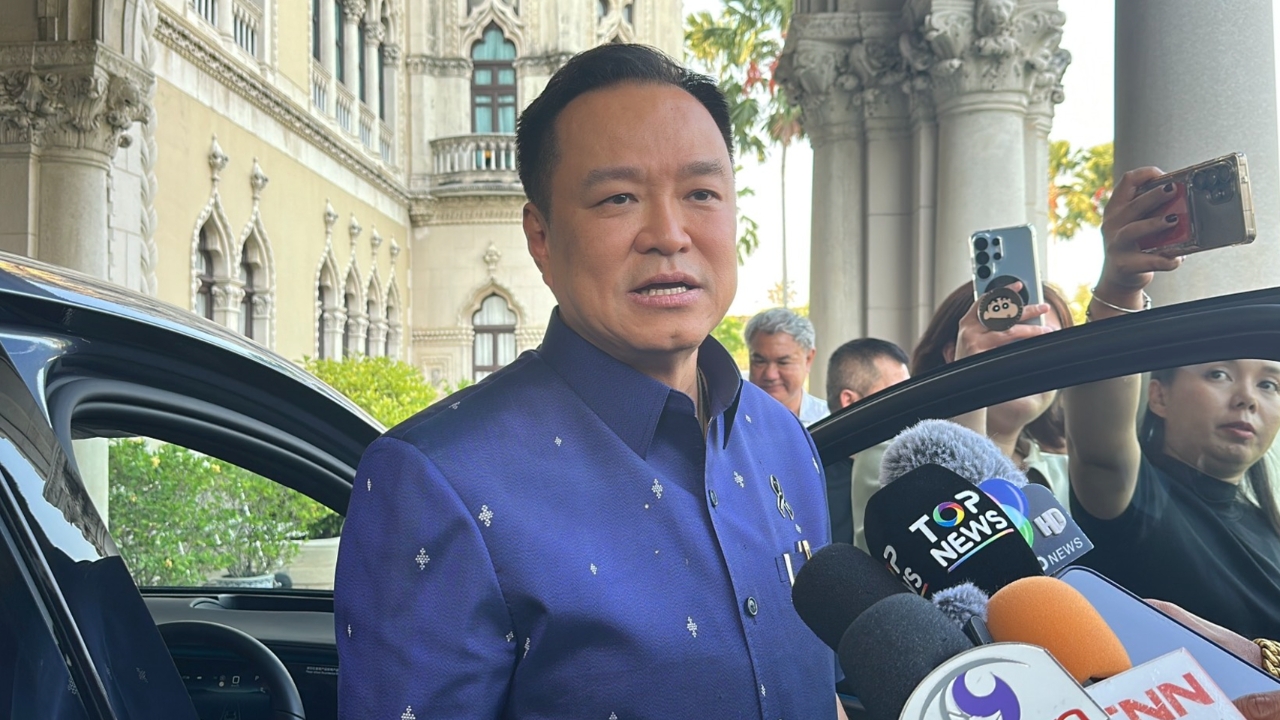
Prime Minister Anutin Chanvirakul asserted that citizens must have fuel to return home during Songkran. He ordered that prices at fuel depots must not exceed refinery prices. He expressed disbelief that people would break the law while the country is suffering and vowed to take action against hoarders. He trusts his management team and is confident they will overcome this crisis.
25 Mar 2026 GMT+7 Prime Minister Anutin Chanvirakul spoke at the Government House regarding a meeting with the economic team to address the energy situation. When asked if any measures would be announced today, he said there are many issues and requested waiting for the energy meeting, which will include oil traders. The main concern is whether there will be enough fuel available. After more than three weeks, nearly a month, it is clear that Thailand is not facing a fuel shortage. Production capacity is still operating at full strength.
However, regarding illegal profiteering, he has instructed Pol. Lt. Gen. Rutthapon Naowarat, Minister of Justice, the Department of Special Investigation (DSI), and police to take action. He admitted he did not expect people to break the law while the nation is in distress. He has also pressed the management board of PTT Public Company Limited about crude oil orders, which are scheduled through the end of May and will continue arriving.
Furthermore, on 24 March, positive news emerged about Thai ships ordered to transport oil and goods from Iran through the Strait of Hormuz. He has been monitoring whether these shipments have actually passed through. He has ordered the Ministry of Finance and oil refineries to announce prices at fuel depots that must not exceed refinery prices, in accordance with Section 8 enforcement. Everyone is complying, and prices float according to market mechanisms. Therefore, illegal profiteering should naturally decline. However, once illegal acts occur, they must be prosecuted. There are names, investigations, and ongoing evidence gathering.

, When asked whether the public can be assured there will be fuel available during Songkran travel, the Prime Minister said he has already informed the Energy Situation and Middle East Tension Impact Management Center (ESMIC) that the goal is for citizens to have no problems traveling during the Songkran festival. He has already issued orders, which were actually already being implemented. Now that panic has subsided, authorities will arrest hoarders—not just anonymous culprits, as the hoarding is visible. The limit is not just 50 or 100 liters but involves storage facilities. If investigations find excessive use, those responsible will be penalized. The Minister of Justice and Director-General of the Energy Business Department are handling this.
At the same time, mechanisms are being adjusted to make prices reasonable. Previously, fuel was purchased in neighboring countries, but now he admits priority must be given to Thai citizens by supporting prices during the first two weeks using the Oil Fuel Fund to avoid rapid changes. After two weeks, new measures will be introduced. Meanwhile, the Ministry of Commerce must oversee price controls on goods. The Ministry of Finance has been invited to issue directives—not requests—to find assistance measures, including excise taxes, refining fees, and other taxes that can help various sectors such as goods transport, passenger transport, and fuel transport. All instructions have been given, and further announcements will follow.

Asked if the previous Work From Home (WFH) measure should be reiterated, the Prime Minister said it is a normal policy. If feasible, it is beneficial as it reduces workplace expenses. If possible, work from home; if not, that is understandable. Importantly, he urged awareness that although there is currently no problem importing crude oil or daily fuel supply, the global situation is uncertain regarding when tensions will end or whether negotiations will be successful. Therefore, self-reliance and energy conservation are necessary. All agencies have been advised to conserve energy.
Currently, Thailand consumes 67 million liters per day, which is normal. Now consumption has increased to over 80 million liters. Some say this is due to neighboring countries where fuel prices are cheaper, causing cross-border refueling or stockpiling rather than hoarding. He reiterated there is enough fuel. If consumption returns to 67 million liters per day, no further action is needed, similar to the situation on 28 February. In this scenario, usage could be reduced to 55 million liters per day, which is feasible and would lower energy use without impact, allowing control over living costs.

Regarding communication strategies to build public confidence, the Prime Minister said he is making efforts and assured everyone is working. Sometimes responding to criticism distracts from work or creates uncertainty about actions previously deemed correct. Currently, they are brainstorming with experienced personnel from outside and the private sector, and also listening to parliament. They implement anything feasible.
When asked if the situation would be declared an emergency, the Prime Minister shook his head before entering an electric vehicle on the driver's side. Reporters asked again, if he feels stressed facing such difficulties, the Prime Minister replied it is normal. The government mechanisms are in place, and this is not the first crisis. Everyone has crisis management experience. They must persevere and are confident they will get through it. . .
