

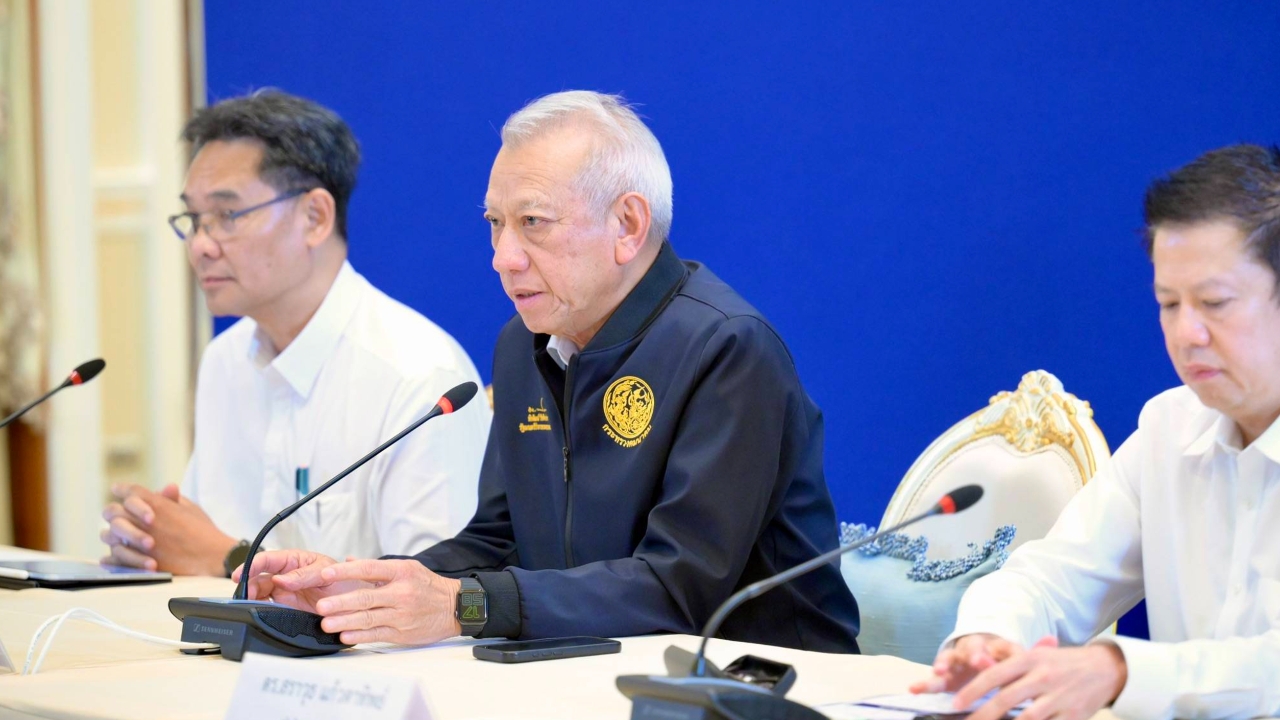
Phiphat has ordered GPS monitoring of oil transport trucks to detect hoarding and off-route travel. He revealed the Prime Minister has instructed the Ministry of Finance to adjust the excise tax structure. He also shared plans for accommodating travelers during Songkran and criticized parliament for merely criticizing, urging them to propose solutions.
At 18:00 on 25 March 2026 GMT+7. Mr. Phiphat Ratchakitprakarn, Deputy Prime Minister and Minister of Transport, serving as Director of the Center for Energy Situation Management and Impact from Middle East Tensions (Director of CESM), spoke at the Government House following a meeting to discuss the energy situation, saying Prime Minister Anutin Charnvirakul convened relevant parties to discuss ways to address the current Middle East crisis, affirming that the Prime Minister is not idle. He asked the media to convey to the public that neither the government nor the Prime Minister is sitting still or indifferent; they are seeking solutions by every possible means. They will detail every step of oil distribution starting from the six refineries, through major traders and jobbers, with complete records and data showing the destination of each liter loaded onto transport trucks.
Phiphat added that discussions have been held with all major traders to request GPS tracking, which the Department of Land Transport mandates for transport trucks with a war room monitoring system. This will allow monitoring of each truck’s journey from the refinery to destinations in the north, northeast, or central regions, checking for route deviations and speeds. All movements will be monitored to verify if hoarding or illegal stockpiling occurs and by whom. It is believed that reputable major traders would not risk such practices. Meanwhile, citizens bringing cans and tanks for agricultural use must be sold to them.
He said, "Within a week, we expect to gather evidence of the facts. If I speak alone, some may doubt it, so we seek cooperation from the Ministry of Justice, Royal Thai Police, Customs Department, and the Ministry of Energy through the Department of Energy Business to support GPS data for verification. If anomalies are found, such as purchases for stockpiling without resale, authorities will request details about the source and purpose. Regardless of whether the trader is a major player, a jobber, or registered oil dealer, if they can provide reasonable evidence, they will not be penalized. But without proof, enforcement will be increasingly strict."

The Prime Minister further instructed that if the war prolongs, all agencies—including the Ministry of Finance, Ministry of Energy, Oil Fund, and Thai citizens—must cooperate to save energy in case of crisis. The Ministry of Finance will consider using the windfall tax and review excise tax structures, though it is not yet the time due to the current caretaker government status. He tasked himself, Deputy Prime Minister and Finance Minister Anek Niti Thantapprapas, the Secretary-General of the National Economic and Social Development Council, and the Permanent Secretary of Energy to discuss with refineries. Ultimately, oil users may need to share some of the burden.
"Currently, parliament is debating that the government is inactive and not solving problems. I must say we are trying every possible way within limited authority as this is a caretaker ministry. To those criticizing us, ask what you have done or can suggest—not just criticize. If knowledgeable and understanding, please advise me. I am open to all ideas, and I believe the Prime Minister is also willing to accept good advice to solve problems. Mere criticism is unhelpful, and slander will not advance our country. But if all possible ways are presented, I believe the country can move forward."
He went on to say that the country has not reached the crisis level feared by many because crude oil currently ordered and stored in reserves exceeds 100 days’ supply. There is good news that Thai oil tankers are now permitted to pass through the Strait of Hormuz since Thailand is not a conflicting party but a good trading partner. He urged others to send oil so that Thailand can reciprocate by sending food in the future. This crisis can be seen as an opportunity. Therefore, he asked critics not to attack before the government has had a chance to act, as the current government is still incomplete. He welcomed criticism—whether well-intentioned or not—and said he has already endured many within the past 10–20 days.

When asked about calls for public energy saving and whether that implies future fuel price deregulation or limited subsidies, Phiphat replied that if global prices continue rising or the situation lasts 1 to 5 months or more, the government cannot sustain subsidies indefinitely. The Oil Fund has already spent over 30 billion baht in just a few days, up from 2.5 billion baht previously.
Still, the government will bear the cost and not abandon the people, but Thai citizens must help by conserving energy wherever possible, especially in a crisis when crude oil supply might be insufficient. Under normal conditions, diesel usage is about 67 million liters across all industries, but on some days it reaches 100 million liters and has been reduced to 84–87 million liters. If production declines and the government limits usage to half without preparation, the question is how to manage. He reaffirmed that whether prices are deregulated or not, the government will fight to the end and find ways to assist.
/ There are public concerns that during Songkran, the Transport Company Limited (BorKorSor) might not accept ticket bookings due to fuel shortage fears. Phiphat said he has met with BorKorSor, which confirmed that there are still partner and supplemental buses available as usual. BorKorSor will be responsible for fuel and has requested assistance from PTT to supply fuel at Mo Chit and Borommaratchachonnani stations for buses departing to the south and east on all routes. They will prepare fuel reserves to fill every bus leaving Bangkok and also set up fuel reserves at destinations to support return trips. Provincial governors will coordinate with public transport providers to ensure fuel availability. He emphasized that preparations are complete. For individual travelers, he assured that by the end of this week or at the latest by the end of March, fuel stations will return to normal operation, so there is no need to worry about fuel availability.
