

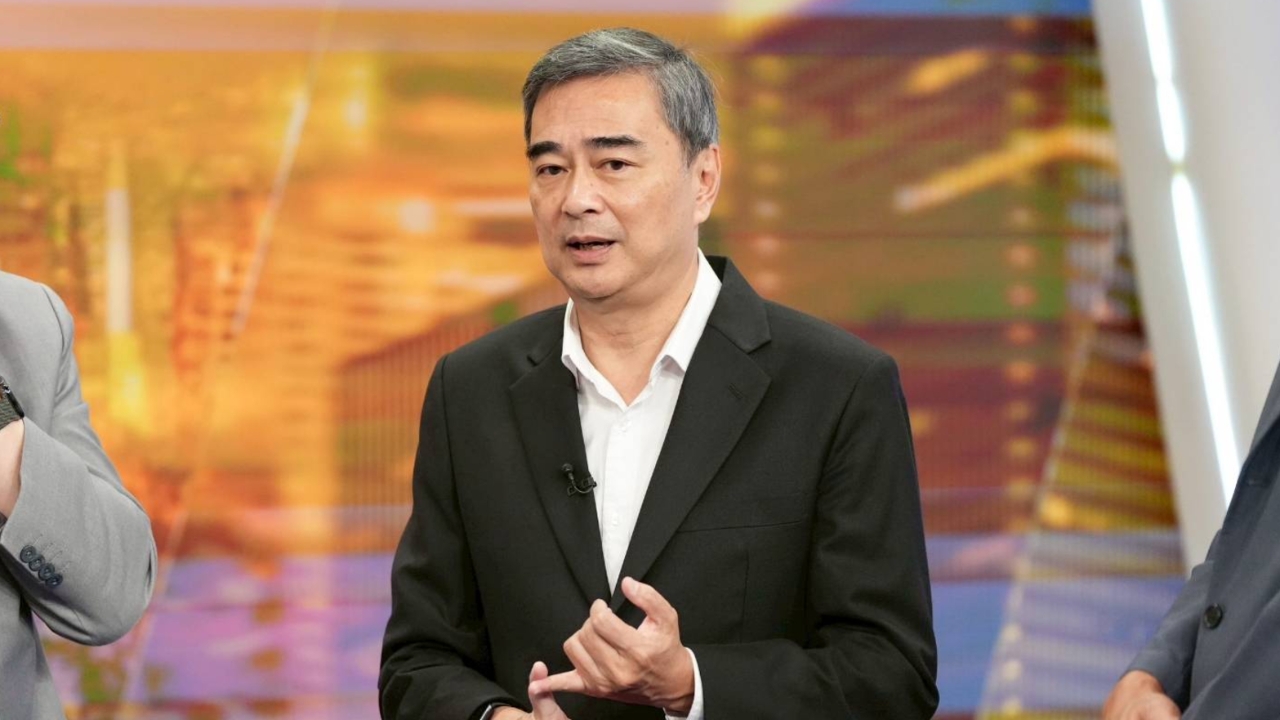
The Democrat Party criticized the government for sneakily raising fuel prices by 6 baht without a clear strategy, placing the entire burden on the public. They questioned whether the price hike was deliberately announced after parliament had adjourned to avoid scrutiny or questioning.
26 Mar 2026 GMT+7 Mr. Abhisit Vejjajiva, leader of the Democrat Party, . Mr. Korn Chatikavanij, deputy party leader, Ms. Kandej Liaopairoj, party-list MP, and Mr. Chainarong Dechadecho, MP for Nakhon Si Thammarat, joined a discussion on the program "Worker News, Off-Screen Talk," criticizing the government's announcement of a sudden 6-baht fuel price increase late last night. They described it as lacking strategic clarity and shifting the burden onto the public without attempting to manage other budget areas.
Mr. Abhisit revealed that he learned of the fuel price hike between 10:00 and 11:00 p.m., after the House of Representatives session had ended. He suggested this was a deliberate move to announce the hike after parliament closed, avoiding confrontation and scrutiny from MPs. He added that, under democratic principles, ministers should explain and justify such decisions to parliament so the public can understand the clear rationale.
At the same time, the Democrat Party leader summarized three main points illustrating the government's failure to handle this fuel crisis.
1. Lack of strategic clarity The government has not set clear targets or criteria on how to stabilize fuel prices or what level to maintain relative to global market prices, leaving the private sector and public unable to plan ahead.
2. The public bears the entire burden Mr. Abhisit questioned why the government did not seek cooperation from oil refineries to contribute additional funds to the oil fund from the increased "refining margin" (windfall profits) or consider cutting excise taxes to help stabilize prices, instead of allowing diesel prices to surge immediately.
3. Delayed relief measures Although the government announced targeted assistance for five specific groups, these measures have yet to be implemented while fuel prices have already soared. Mr. Abhisit believes support should have been provided concurrently with the price increase.

Mr. Abhisit further explained, referencing remarks by Mr. Eknat Promphan, party-list MP from Bhumjaithai Party, who noted contradictory government statements claiming sufficient oil reserves while gas stations face shortages or reduced quotas. He interpreted this as evidence of actual fuel hoarding, calling it the "masked bandit" phenomenon, and drew a comparison: The government's announcement of a sudden 6-baht fuel price hike last night effectively "released the masked bandit," because once prices rose to the desired level, the hoarded fuel was immediately released for sale.
"The 6-baht price hike last night is like releasing the masked bandit, because previously fuel was hoarded due to prices not reflecting reality. But now that prices have risen, no one is going after the hoarders anymore."
Meanwhile, Mr. Korn added that fuel shortages at various gas stations stem from the government's delayed compensation payments exceeding 20 billion baht to refineries, due to the Cabinet not approving the oil fund's loan authority. This caused liquidity problems for refineries, making them hesitant to release fuel at low prices. He warned that if the government lets prices adjust fully to the market without price caps, fuel prices could rise by more than 10 baht per liter based on refinery prices and taxes. He called on the government to be transparent about the oil fund budget so the public can prepare for rising living costs.
Additionally, Mr. Abhisit commented on the government's role in the parliamentary democratic system, saying: An important duty of the government in this system is accountability to the House of Representatives. In democratic countries, the prime minister or relevant ministers should appear in parliament to explain and discuss important decisions, especially fuel price hikes, to hear MPs' views and clarify matters directly for the public through parliament. The late-night announcement of the fuel price increase yesterday raised suspicions that the government deliberately made the announcement after parliament adjourned to avoid scrutiny or questioning by MPs.