

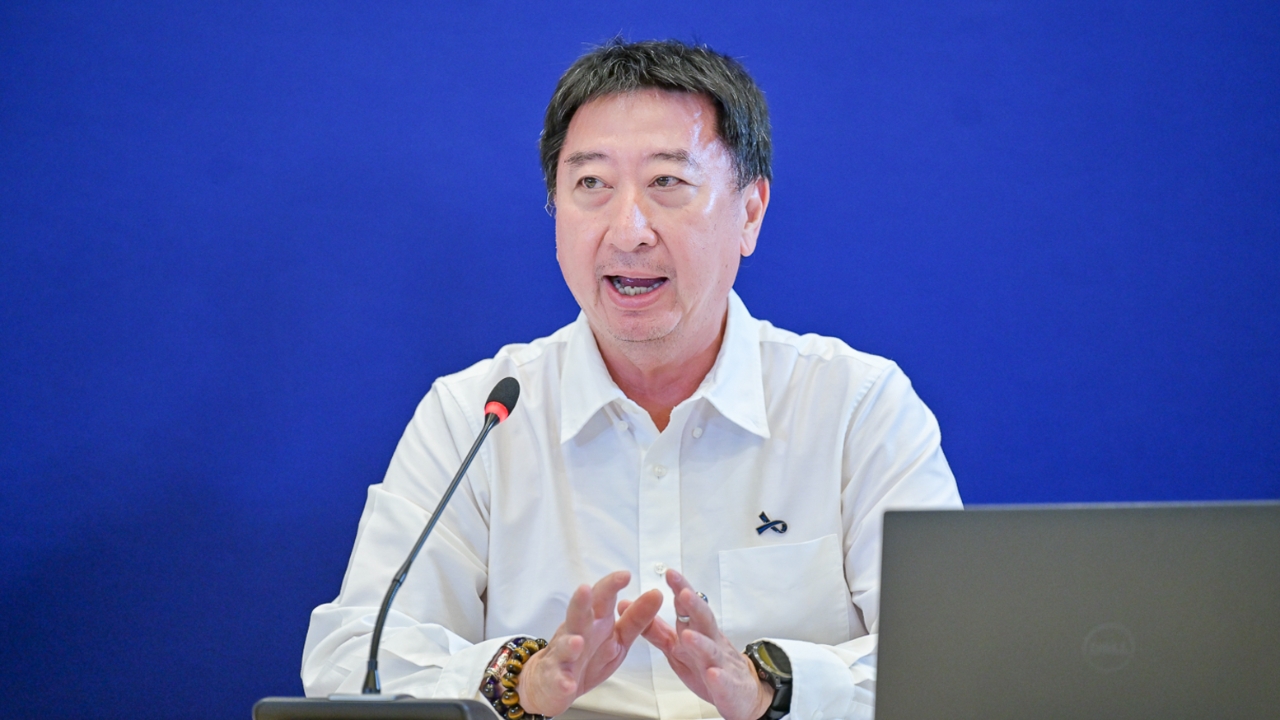
The Director of the Oil Fund explained the 6-baht per liter fuel price increase, waiting for global market closing prices and considering multiple factors. He pointed out that Thailand's prices are not higher than neighboring countries and are actually quite low. He guaranteed that no one knew about the increase in advance.
At 11:05 a.m. on 26 March 2026, at the Government House, the Center for Administration and Monitoring of the Middle East Conflict Situation (CMEC) issued its daily briefing, stating that Mr. Pornchai Jirakulpaisan, Director of Policy and Planning Office, Oil Fuel Fund Office, said that the ongoing unrest in the Middle East shows no sign of resolution yet, despite various proposed agreements still under consideration. This situation has caused global fuel prices to rise sharply, from 198 dollars per barrel on 17 March to 242 dollars per barrel on 23 March. This has impacted retail prices in Thailand, causing the Oil Fund's liquidity to worsen, with a deficit now calculated at over 35 billion baht and a daily outflow of about 2 billion baht.
Regarding fuel prices, especially on the night of 25 March 2026, Malaysia also raised prices, adjusting diesel by 1 to 7 baht. It shows our prices are not higher than our neighbors; in fact, they remain relatively low. For all these reasons, the Oil Fuel Fund Management Committee (OFMC) considered multiple aspects and concluded it was necessary to reduce subsidies for diesel and gasoline, resulting in a retail price increase of up to 6 baht per liter. This reduction in subsidies means the Oil Fund will continue supporting certain fuels, such as diesel, which is an economic fuel, and we still provide assistance.
For gasohol types, including E10 and E20, the Oil Fund continues to support these to keep prices affordable for the public. We assure citizens that the Oil Fund will maintain retail price stability appropriately and encourage everyone to conserve fuel. We will proceed together. This adjustment is expected to help us withstand potential future global oil price increases because with less liquidity outflow, we can continue to provide support.

When asked about the unexpected 6-baht sudden price hike without prior notice, despite earlier statements on 17 March 2026 by Mr. Danucha Pichayanan, Secretary-General of the National Economic and Social Development Council, that increases would be gradual, Mr. Pornchai responded that the global situation on that day was at 198 dollars per barrel, but within 2–3 days it jumped to 242 dollars per barrel. This caused fuel prices worldwide, including Thailand’s, to rise. Although the Oil Fund intended to provide support, the high prices increased expenses and liquidity shortages, necessitating a 6-baht hike to maintain the Fund's stability. This surge is not unique to Thailand; ASEAN countries experienced similar jumps, with Malaysia raising prices by 7 baht on 25 March.
Asked whether there is no guarantee that future price increases will be gradual and that prices could rise unpredictably daily, Mr. Pornchai replied that each increase is considered from multiple perspectives. Previously, increases were only 50 satang or just over one baht. The committee reviews many factors, not only oil prices but also neighbors’ situations and the public’s impact. There is no guarantee of sudden large hikes; decisions are made day by day.
Regarding why the current approach differs from the management style during General Prayut Chan-o-cha's government, Mr. Pornchai said that regardless of method, the principles are the same. However, at that time, the Russia-Ukraine conflict was not as severe, so prices were not as high. Conversely, the US-Iran situation caused prices to spike by 20-30 dollars per barrel in a day. Therefore, some decisions must be made quickly to prevent further escalation. Measures to contain the situation are necessary. Nevertheless, we continue to maintain stability to reassure the public.

Regarding Deputy Prime Minister and Minister of Transport Mr. Phiphat Ratchakitprakarn’s statement about using excise tax measures, and whether the Prime Minister currently has full authority to enact laws to alleviate fuel issues, Mr. Pornchai said that he would not comment on legal matters. However, the Oil Fund and Ministry of Finance have previously coordinated on tax reductions, including during the Russia-Ukraine war period. When the Excise Department requested funds from the Oil Fund, arrangements were made. If the new government is ready, negotiations can proceed.
Asked whether domestic fuel prices will exceed 70 baht per liter during the Songkran festival, Mr. Pornchai responded that domestic fuel prices depend on global market conditions. Whether prices reach 70 baht depends on the Oil Fund’s ability to maintain liquidity. If possible, we will do so. The current reduction in collection will help, but we cannot guarantee how high global prices will rise.

Regarding public criticism about the fuel price increase announced late at night and suspicions of hoarding before the price hike, Mr. Pornchai said that the late-night announcement was due to the Singapore fuel market closing around 7:00 p.m., with prices released gradually for each type (diesel, Dubai crude, gasoline). He had to calculate the price structure in baht, which took until 9:00 p.m. The OFMC then met around 9:00 p.m. to consider multiple aspects. It was only then they learned that neighboring countries also raised prices.
Therefore, the late-night announcement was not intended to favor anyone but to wait for complete information to set accurate prices. As for suspicions that traders hoarded fuel to wait for higher prices, he assured there was no such hoarding, and traders did not know about the increase in advance. Even he and the staff were unaware beforehand. The data input was done at that moment, guaranteed.
When asked how to explain previous fuel shortages at stations before the price rise, but no shortages after the increase, Mr. Pornchai said they consider the fund's monetary rate aspect. Regarding fuel stockpiling, he suggested that the Department of Energy Business would be better placed to answer, as they can provide clearer information.