

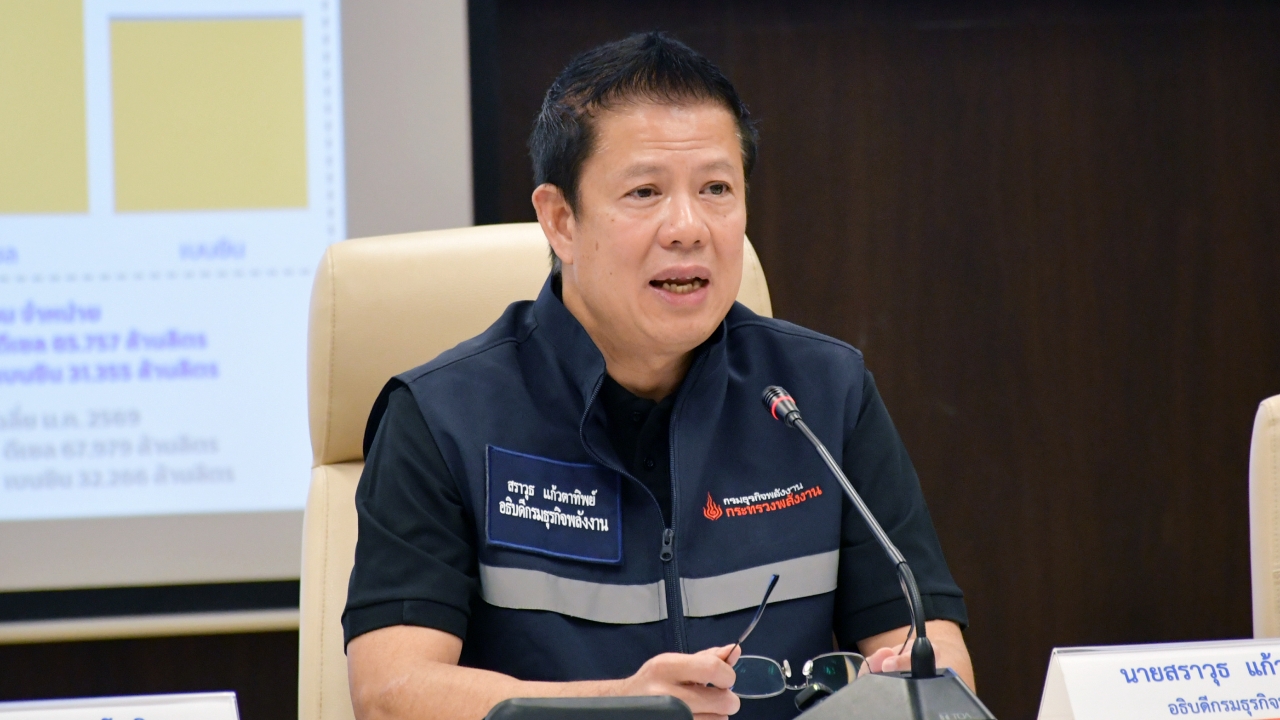
The Director-General of the Department of Energy Business requests two weeks to apprehend oil hoarders. Currently, retrospective data from refineries, gas stations, and jobbers are being called in to trace the oil transport routes.
On 26 March 2026, Mr. Sarawut Kaotathip, Director-General of the Department of Energy Business (DEB), revealed that the department is currently tracking and examining oil transportation and distribution data to expedite management and ensure sufficient supply across all regions nationwide. Clarity is expected within two weeks.
The department is requesting retrospective data from refineries, Section 7 traders (gas stations), and Section 10 traders (jobbers) from 1 February to the present to verify where oil volumes in the market have disappeared or leaked, tracing from origin to destination.
Regarding oil trucks that receive oil from jobbers to deliver to industrial plants, gas stations, independent or small-scale gas stations (tube stations), or construction projects, the department will investigate the origin-to-destination transport routes for any leakages to detect irregularities.
Concerning allegations of illegal oil sales to Laos and onward transport to Cambodia, preliminary data from January to February show Thailand exported 5.85 million liters of diesel and 1 million liters of gasoline per month to Laos. After the government imposed export bans, exports to Laos dropped to 4 million liters per month, indicating no irregularities.
Mr. Sarawut acknowledged that the US-Iran conflict leading to the closure of the Hormuz Strait is an unprecedented severe crisis affecting oil transportation from energy sources. Although the Ministry of Energy conducts annual crisis preparedness drills, this crisis is severe due to a sharp oil price increase. While oil remains available on the global market, transportation systems face greater difficulties than usual.
“The department will strive to examine retrospective data to reach conclusions as quickly as possible. This problem is unprecedented legally, so it requires time and efforts to identify and punish the offenders.”
Currently, Thailand imports crude oil mainly from the Middle East (53%), East Asia (11%), and produces 9% domestically, with 27% from the US, West Africa, and Latin America. This is refined into 78.286 million liters of base diesel (B0) that has not been blended with biodiesel. The base diesel is stocked in refinery tanks and Section 7 traders' oil storage tanks.
As of 24 March, the total national stock of base diesel in storage tanks amounted to 854 million liters, divided into three parts: 1. Sales to neighboring countries such as Laos and Myanmar.
The second part is sales to Section 7 traders, who supply other industries such as electricity and construction with B0 diesel or base diesel.
The third part is diesel that must be blended with biodiesel (B100) to produce regular diesel known as B7. This is stored in blending tanks called B7 tanks. On 24 March, domestic production of regular diesel totaled 90.29 million liters, with stocks of 43 million liters in blending tanks ready for sale to the public.
Distribution is divided into three parts: first, direct sales from refineries or Section 7 traders to gas stations, industries, government and state enterprises, and transportation sectors.
Second, delivery by rail, ship, and trucks to regional oil depots operated by main traders (Section 7 traders), who then supply other sectors, especially gas stations, similarly to the first part.
Third, sales to Section 10 traders or jobbers amounting to 6.337 million liters. Combined with previous sales, this totals 79.42 million liters of diesel sold domestically, summing to 85.757 million liters of diesel sold in the country.
Additionally, the Department of Energy Business has instructed Section 7 oil traders to submit daily reports on stock inflows and outflows from their depots. There are 92 oil depots for sales: 53 are reserve storage depots operated by Section 7 traders, with 18 required to report. So far, 13 have reported, and 5 have not.
The remaining 39 depots belong to Section 10 traders. The department has also created additional reporting forms requiring depots to specify delivery destinations and transport vehicle registration numbers for submission to the Ministry of Justice, Ministry of Interior, Department of Special Investigation, and the Royal Thai Police.
Previously, from 15 to 17 March, the Department of Energy Business inspected fuel shortages at 2,649 gas stations nationwide. Officials from the department and provincial energy offices found 247 stations (9.1%) closed due to fuel shortages.
Stations open but lacking or nearly out of some fuel types numbered 1,912 (72.2%), while 496 (18.7%) had sufficient fuel. Major causes include a 45.7% increase in fuel demand, a 40% reduction in allocations by oil traders, insufficient oil transport trucks (7.4%), and empty oil depots (6.8%).
From 21 to 23 March, inspections of seven oil depots were conducted jointly with the Metropolitan Police, Department of Special Investigation, and Ministry of Commerce. No irregularities were found in price posting, and fuel volumes in March were comparable to or higher than those in January and February.
On 25 March, the department, together with the Department of Special Investigation and Saraburi Provincial Energy Office, inspected three suspicious sites in Sao Hai district, Saraburi province, after receiving intelligence about illegal oil trading or hoarding. Officials found 40,000 liters of oil stored without notification or permission and seized the oil as evidence for legal proceedings.
“This act constitutes a legal offense punishable by up to 2 years imprisonment, a fine up to 200,000 baht, or both. If the act involves hoarding for profit or causing market disruption, additional legal violations may apply.”