

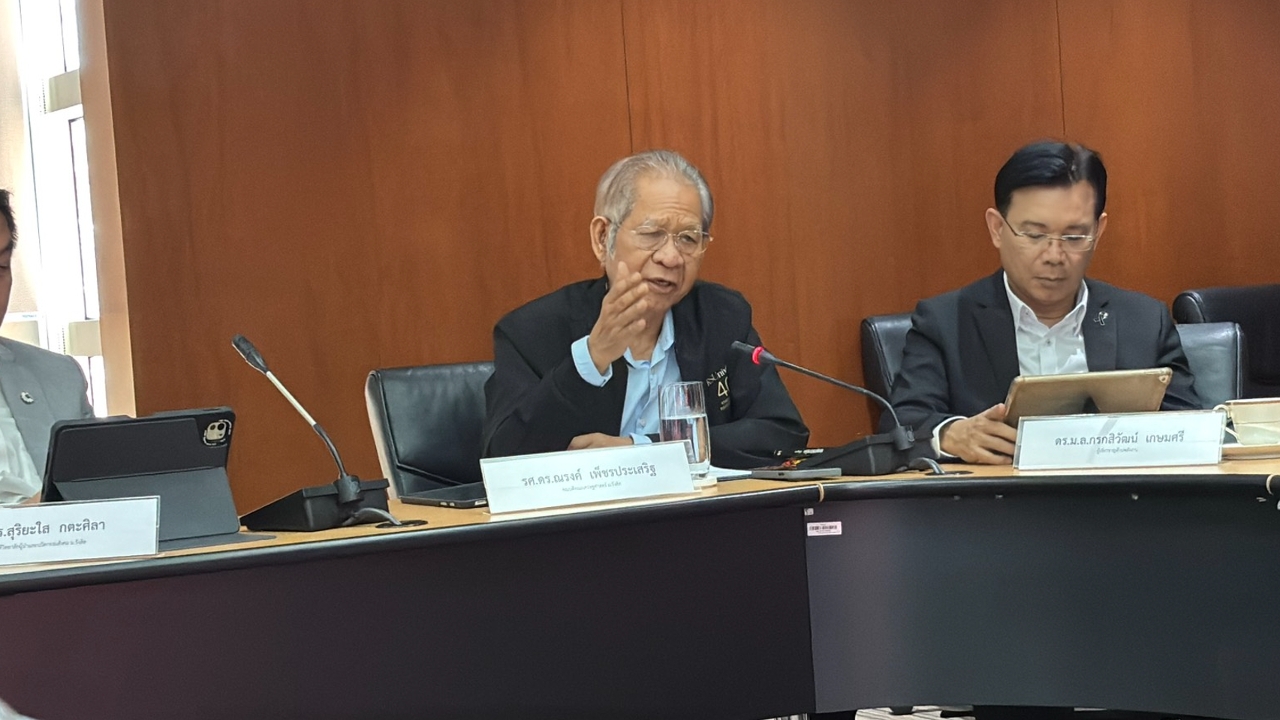
Scholars gathered to brainstorm solutions to the high oil prices, calling for a comprehensive restructuring of the energy system to fix problems with non-transparent price structures and unfair pricing.
At 1:00 p.m. on 27 March 2026, a panel discussion was held in the meeting room of the Arthit Urairat Building at Rangsit University on the topic “The 6 Baht Question… How Will Thai Leaders Lead the Country Out of the Energy Crisis?” The discussion included Associate Professor Narong Phetprasit, Dean of the Faculty of Economics at Rangsit University; Associate Professor Chittawan Chanakul, Economics lecturer at Kasetsart University; Mom Luang Korakasiwat Kasemsri, energy expert; and Associate Professor Suriyasai Katasila, Dean of the College of Leadership and Social Innovation at Rangsit University.
Associate Professor Suriyasai said that the recent oil price surge is like an iceberg that could trigger overlapping crises. It reflects a failure in government management. Agencies responsible for oil have tried to divert attention by comparing prices with neighboring countries but cannot explain how to resolve the issue. He questioned the purpose of government if citizens have to solve problems by planting bananas and raising chickens themselves. He stressed that it is time to consider bringing PTT back, as long as the structure remains centralized and unfair. Even a company ten times larger than PTT cannot resolve the energy crisis without systemic structural reform.
Associate Professor Narong said he is not surprised by the situation, viewing the U.S. as waging war to seize oil resources while Israel fights over territory. The energy conflict has long roots and reflects great power interests. He suggested Thailand should free itself from U.S. influence to increase bargaining power over concessions.
Questioning the “Illusory Cost”
Mom Luang Korakasiwat explained that Thailand has faced oil crises since 1977 when General Kriangsak Chamanan consolidated energy businesses to establish the Petroleum Authority of Thailand (PTT) to balance foreign companies. Later, in 1981, General Prem Tinsulanonda approved Thailand holding oil field shares without paying cash, using production sharing instead, minimizing state risk. Subsequently, PTT Exploration and Production, a fully state-owned enterprise, was established. The state also previously owned refineries such as Thai Oil and Summit (now Bangchak). During crises, cost management helped the country survive. However, structural changes later caused the state to lose significant control over refineries.
Additionally, since 1997, oil pricing structures have been based on assumed Singapore prices, including hidden costs like transportation, insurance, and loss during transit, which have been questioned as “Illusory Costs” that inflate oil prices. Every 1 baht increase translates to a burden of over 36 billion baht annually on citizens. He noted that no state agency has seriously addressed this pricing structure problem.

Criticism of Opaque Structures
Similarly, Associate Professor Chittawan said that following international conflicts, oil prices have fluctuated. Although Thai oil prices are not the highest compared to many countries, citizens are heavily affected due to economic structural factors and corruption. He pointed out that initial price caps followed by a sudden increase made citizens feel the burden sharply. He warned this could lead to recession, inflation, and unemployment. He urged the government to build confidence and avoid more borrowing, as the current budget deficit exceeds 900 billion baht. Additional borrowing of 150 billion baht could cause compounded crises. He proposed cutting unnecessary budgets and allocating 100–200 billion baht to subsidize electricity instead.
Recommendation to Upgrade PTT
When asked about the kind of decisions good leaders should make in this crisis, Associate Professor Suriyasai said that the order from Deputy Prime Minister Anutin for the Internal Security Operations Command (ISOC) to check oil stocks might be too late. During the 2–3 days of shock, reports indicated some parties earned profits of up to 64 billion baht from price increases from 33 to 39 baht per liter, with some companies reporting at least 2 billion baht. He emphasized the need for investigations to ensure fairness toward the private sector, as no one can predict when or if the war will end or negotiations will succeed. He proposed “bringing PTT back” through multiple approaches: 1. The state buying back PTT shares from private owners (not necessarily 100%), 2. Using legal processes to reclaim PTT, or 3. Establishing a new company to compete with PTT.
He also suggested upgrading PTT to a national energy company to comprehensively manage oil, gas, and investments in renewable energy.

Expecting the War to Last Years
When asked about future prospects, Associate Professor Narong predicted the situation will likely persist for years. He analyzed that China does not want the war to end soon, as prolonged conflict disadvantages the U.S. Meanwhile, Iran’s conflict with neighboring Persian Gulf countries arises because those countries are major U.S. oil business financiers, and oil is vital to the dollar’s value. Furthermore, China and Russia do not want the U.S. to control the world’s oil supply, as U.S. dominance would severely impact China, the world's manufacturing hub with high oil demand. Therefore, the Middle East situation is expected to continue.
Proposed Export Ban
Associate Professor Narong proposed solutions: 1. Declare an oil emergency and ban exports while Thailand faces shortages, 2. Use PTT shareholders, namely the Ministry of Finance (51.38%) and the Vayupak Fund (7.5%), to subsidize oil prices, similar to Malaysia's PETRONAS model. In the long term, promote renewable energy in all aspects such as extracting oil from rubber, producing oil from the Yangna tree, or substituting coal for gas.

Policy Fails to Support Farmers
Mom Luang Korakasiwat suggested a Zero Import Energy concept, noting Thailand’s equatorial location with abundant surface and underground energy resources that have not been seriously utilized. The energy sector has been dominated by private interests controlling state policy. Starting with ethanol or alcohol produced from cassava, sugar, and corn, which can be used in vehicles. Ethanol’s chemical formula is similar to gasoline but with an additional oxygen atom, giving it an octane rating of 100. In Brazil, vehicles called Flex Fuel Cars (FFV) run on 100% ethanol or gasoline, but this technology has not been adopted in Thailand to avoid threatening the petroleum industry’s control over ethanol, so Thailand still relies mainly on blended fuels.
If oil prices stay around 40 baht per liter, ethanol revenue would circulate entirely within the country, boosting the economy and reducing energy shortages. Additionally, waste, especially plastic, can be converted into energy. Plastic can be transformed back into oil through pyrolysis — heating without oxygen to break it down into oil. However, some policies classify plastic-to-oil conversion as crude oil, which must be sold only to refineries.
Clear Decision Needed: Is PTT State or Private?
Associate Professor Chittawan stated that Thailand must decide definitively whether PTT is 100% state-owned or 100% private, avoiding the current semi-state, semi-private status. He proposed establishing a new national oil company as a structural solution and a fresh start to reorganize the country’s energy system.