

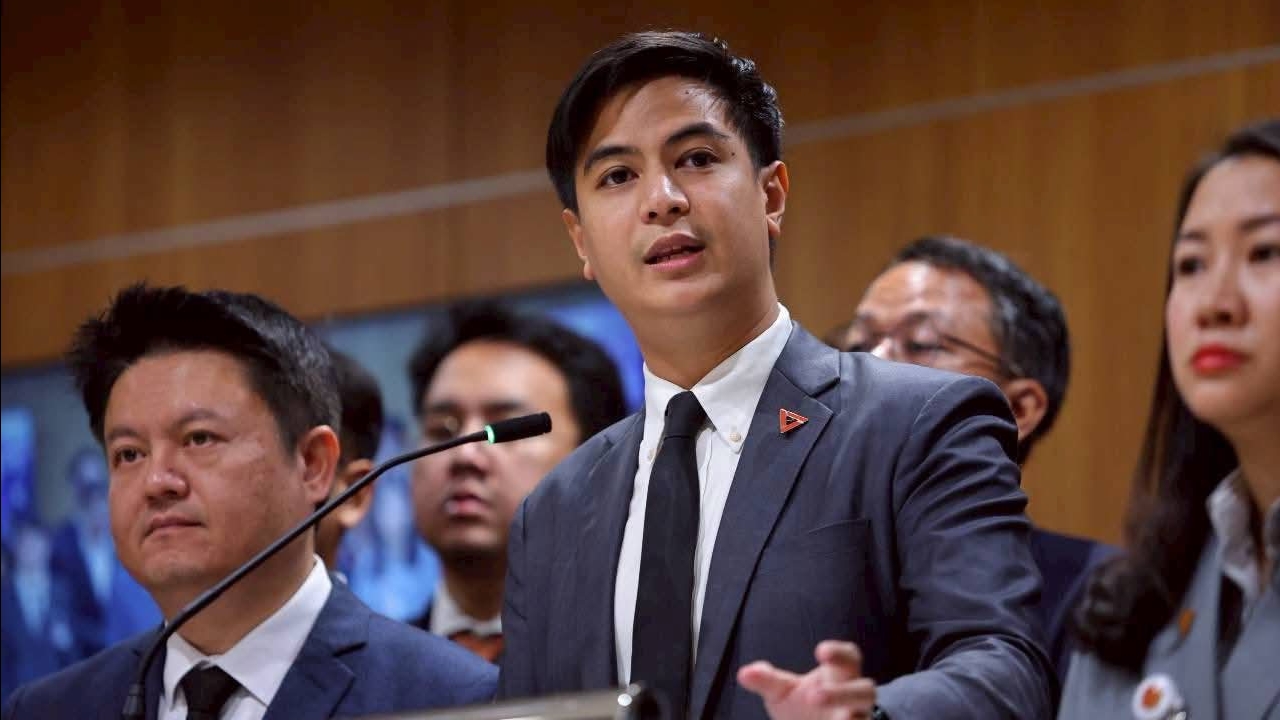
Parit calls on the Prime Minister to replace Phiphat, the primary official responsible for the energy crisis, with another deputy prime minister to resolve allegations of conflict of interest.
On 27 March 2026, Parit Watcharasindhu, spokesperson for the Prachachon Party, commented after watching an interview with Deputy Prime Minister and Minister of Transport Phiphat Ratchakitprakarn on the program "Workers' News: Off the Record." He reaffirmed his stance expressed in a parliamentary debate on 25 March that the Prime Minister should "replace" the main official handling the energy crisis—Deputy Prime Minister Phiphat—with someone else to clear up conflict of interest allegations. During the interview, Deputy Prime Minister Phiphat mentioned that the Prime Minister had once discussed raising oil prices with him in a "small group meeting without industry operators because this issue cannot be disclosed to them." "(The exact price increase) was kept secret because they feared operators might close service stations prematurely or hoard fuel."
However, the "elephant in the room" is that Deputy Prime Minister Phiphat himself is also part of the industry operators because
1. Deputy Prime Minister Phiphat holds a 5% stake in Ratchakit Holding Co., which is the major shareholder (25%) in PTG Energy (with his younger brother serving as a director and executive).
2. Although Deputy Prime Minister Phiphat tries to deny involvement in business management, throughout the interview he often used terms like "we" or "us" when referring to PTG Energy's operations.
3. While PTG Energy does not own its own refinery, Ratchakit Holding or PTG Energy hold shares in numerous companies covering almost every other stage in the oil supply chain, based on the latest information available to me.
Shares are held in major oil traders or oil depots (Section 7) in at least two companies.
- Company 1: PTG holds 70.50%.
- Company 2: PTG holds 40%.
Shares are held in smaller oil traders or jobbers (Section 10) in at least six companies.
- Company 1: PTG holds 100%.
- Company 2: PTG holds 99.98%.
- Company 3: PTG holds 99.98%.
- Company 4: PTG holds 99.98%.
- Company 5: PTG holds 99.97%.
- Company 6: PTG holds 99.97%.
Shares are held in oil transportation companies (Section 12) in at least four companies.
- Company 1: PTG holds 100%.
- Company 2: Ratchakit Holding holds 25%.
- Company 3: Ratchakit Holding holds 25% indirectly.
- Company 4: Ratchakit Holding holds 19% indirectly.
4. One of the major oil trading companies (Section 7) in which PTG holds shares operates a biodiesel refinery business, benefiting from government policies that propose increasing biodiesel blending ratios (such as B10 or B20).
Parit emphasized that he is not accusing these companies of wrongdoing but wants to point out that "if I were a private company with a broad network across nearly every stage of the oil supply chain and had advance knowledge of daily government policy decisions, this situation would create huge opportunities to speculate at the expense of the public's hardship." He added,
"Therefore, regardless of whether there has been any misuse of power for the benefit of one's business network in the past, as long as the government continues to design the energy crisis management structure by assigning the main policymaker role to someone connected to the oil business network, it will be difficult for the public to trust the government's transparency or straightforwardness in handling the issue." He concluded that if the government wants to clear the conflict of interest allegations:
"The Prime Minister should replace the director of the energy crisis center or the main person responsible for the energy crisis from Deputy Prime Minister Phiphat to someone else. If the Prime Minister is hesitant to make that decision, Deputy Prime Minister Phiphat could consider stepping down himself." Parit said this in closing.