

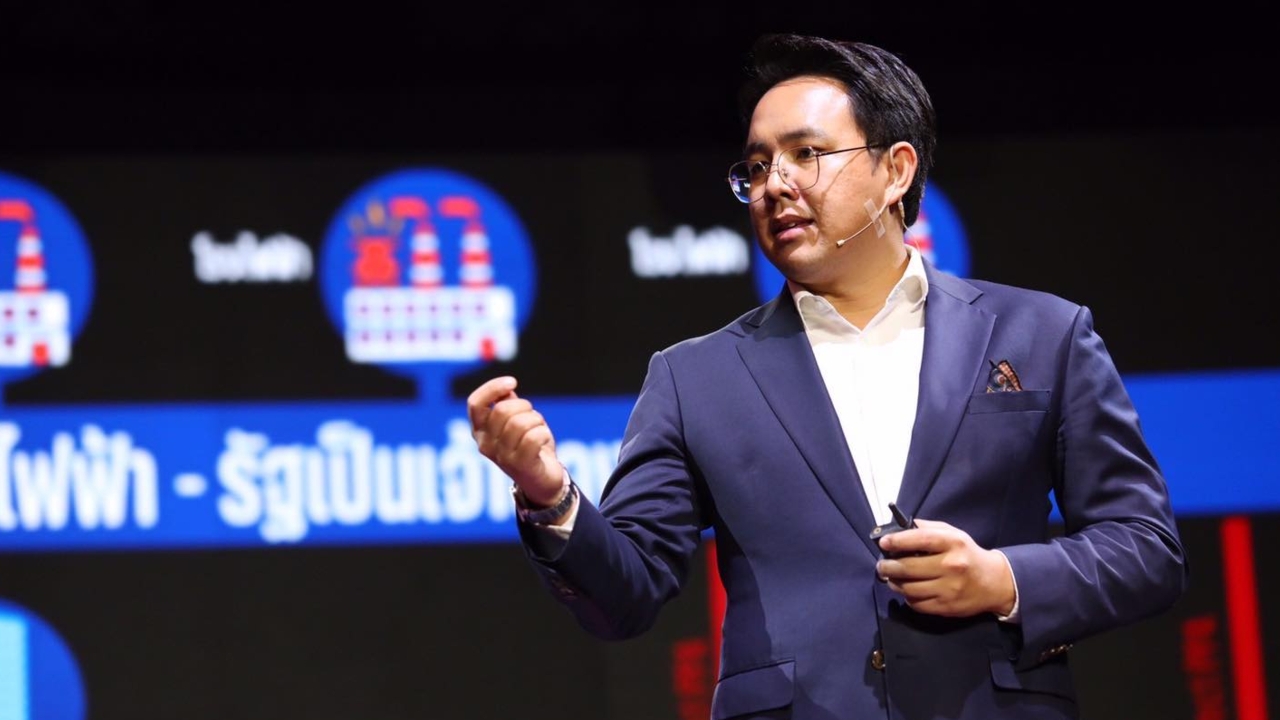
Supachot, a People's Party MP, slammed the government for failing to manage the oil crisis, instead constantly running after the crisis and shifting the burden back to the people. They allowed a 6-baht price increase with no advance relief measures.
On 27 March 2026 GMT+7, Mr. Supachot Chaisat, a party-list MP from the People's Party, commented after listening to an interview with Mr. Pipat Ratchakitprakarn, Deputy Prime Minister and Minister of Transport, who also serves as director of the Center for Management and Monitoring of the Middle East Conflict Situation (CM3E). He said the more he listened, the more the public questioned whether the government is truly controlling the situation or merely trying to explain its failures day by day.
The first point that was unacceptable was when Mr. Pipat said he only learned of the 6-baht oil price hike late at night. This seemed like an attempt to shift responsibility away from himself, although according to the Fuel Fund Act of 2019, such decisions do not happen without government briefing and approval. Given the continuous rise in Singapore oil prices during the crisis and the government's policy to cap prices, especially in the first 15 days, it was hardly unpredictable that the Fuel Fund's status would collapse and prices would surge. If Mr. Pipat claims he and the government failed to foresee this, it is not just a mistake but shows ineffective crisis management.
The second point further underscores the government's role as reactive rather than proactive. When oil prices jumped 6 baht overnight, the government had no pre-planned relief measures. If the government had assessed the situation properly, it should have prepared these measures beforehand. Instead, it waited until after the price rise to announce a 1-baht excise tax cut and said it needed approval from the Election Commission (EC), fearing legal issues since it is a caretaker government.
“Everything is upside down because what should have been done first was for the government to coordinate with the EC and prepare policy tools before the price hike, not let the public bear the shock first and then try to fix the problem later. This crisis management only worsens the crisis and raises public suspicions that the government might be deliberately causing chaos to enable masked groups to release hoarded supplies.”
The third point concerns the windfall tax issue. It is clear the government protects vested interests over the public. The People's Party proposed imposing a windfall tax on oil refiners from the start of the crisis because, amid global turmoil, refiners have earned abnormal profits while the public suffers. Instead of using its authority to immediately impose such a tax via a royal decree to subsidize fuel prices through the Fuel Fund and relieve the public's burden, the government delayed.
Instead, it extended the timeline by another week and asked refiners for voluntary contributions on how much refining fees they would share with Thai people. This forced the public to pay higher fuel prices for another week. This contradictory approach favors vested interests by allowing them time to decide rather than immediately taxing their profits to help the public.
He emphasized that giving vested interests an extra week means making the public bear high fuel prices longer. More worrying is that Mr. Pipat told the Ministry of Finance to study the issue, but recently the Fiscal Policy Office director confirmed the study was completed a long time ago. The question is what the government is still waiting for if not the courage to touch vested energy interests. In this crisis, the government could immediately issue a royal decree on windfall tax if it had sufficient political will.
The final point concerns the so-called masked groups. To date, Mr. Pipat still denies their existence, though in the same interview he admitted that news about the seizure of oil trucks trying to cross the border at Mae Sot district, Tak province, was true. How then can he claim there are no opportunists or smuggling networks profiting from this crisis?
“What is more worrying is that the government continues to shift the burden back to the public with the usual explanation that people panic or hoard supplies themselves. The real question is whether the government has inspected the trucks crossing into Myanmar, Laos, or Cambodia—sometimes declared as carrying other liquids like used oil—to determine if they are actually smuggling fuel for profit. Without such inspections, how can it quickly conclude there are no masked groups?”
Supachot reiterated that everything he heard clearly showed Mr. Pipat was not clarifying doubts for society but trying to excuse himself and energy business interests while repeatedly blaming the public. He even lamented being accused of having stakes in energy companies and said anyone managing the situation would be the same. If so, perhaps someone with no ties to the oil business should manage it to see if there is a difference. If that is true, it’s worth trying.
“If those overseeing the country's energy crisis see all these mistakes as normal and claim no one can do better, then society’s question should not just be how the government will fix this but whether it is time for Mr. Pipat to resign as CM3E director and Deputy Prime Minister overseeing energy to make way for someone more capable.”