

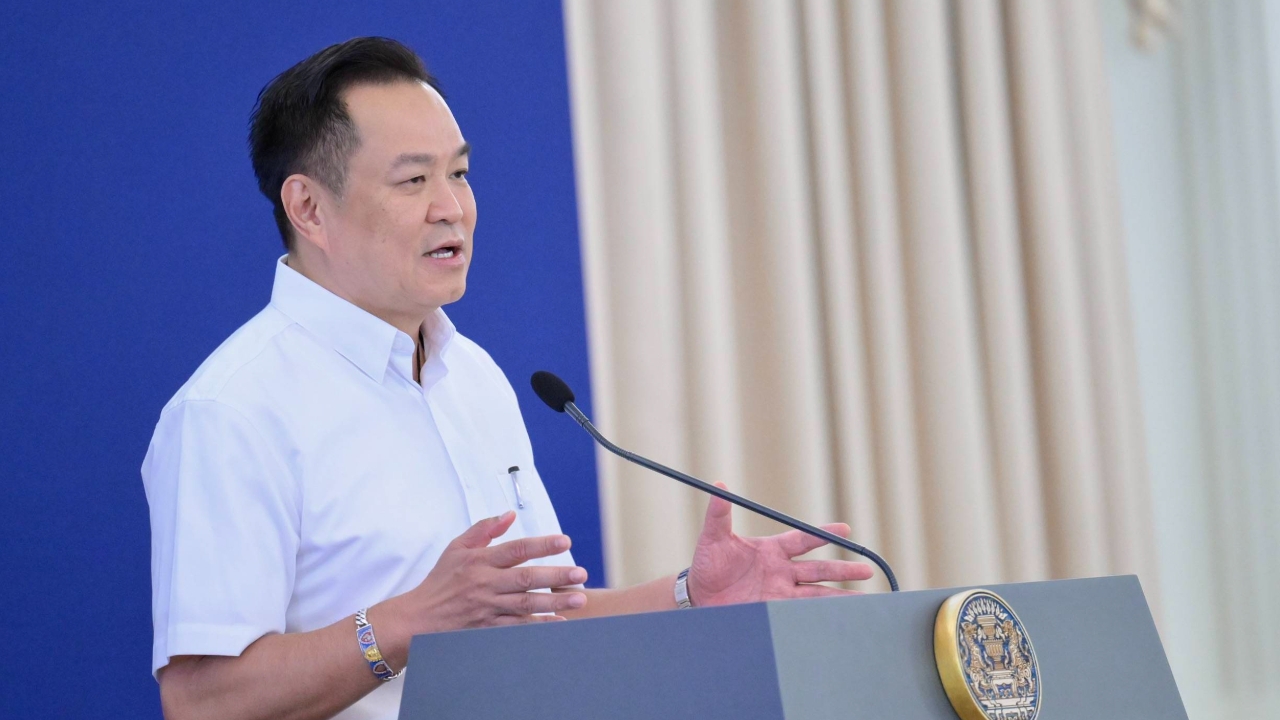
The Prime Minister confirmed that there will be enough fuel this Songkran, assuring people they need not fear being unable to get home, but requested public cooperation in conserving energy. If expenses can be reduced, the savings will be used for assistance measures, including the 'Khon La Khrueng Plus' program.
At 10:30 a.m. on 28 March 2026 GMT+7. Mr. Anutin Charnvirakul, the Prime Minister. He said during a “Meet the Press” session titled “One Month of Global Crisis: Thailand’s Preparedness in an Unfamiliar World,” regarding oil and living costs, that the government prioritizes low-income people. This is why the Ministry of Commerce is working hard to create a list of controlled products, which currently includes 66 items with a goal of reaching 71. Other measures announced by the Center for Administration and Monitoring of the Middle East Conflict Situation (CMOC) include products under the Thai Help Thai program and Blue Flag shops, offering these at prices up to 25% below market rates. According to the Minister and Permanent Secretary of Commerce, these items will be available to the public starting 1 April.
These measures aim to help with basic living costs. Prices of goods and services outside this controlled list may rise according to market forces, as they are not essential daily items. Consumers can choose products that offer value and avoid those with excessively inflated prices. If sellers increase prices too much, they will face competition from other products, leading to poor sales. Market mechanisms will pressure sellers to return prices to fair levels, as competition always exists in terms of quantity, quality, and price.

Other measures to alleviate impacts across all sectors include urgent actions approved at a special Cabinet meeting. The Ministry of Finance will implement tax reductions, increased welfare, fuel price compensation for transport sectors, fertilizer aid for farmers, energy support for fisheries, and credit facilities for SMEs. However, these measures will only take effect once a new government is formed.
The Prime Minister further urged everyone to understand and cooperate in sharing accurate information, acting as the government's eyes and ears to monitor illegal behaviors that exploit citizens regarding fuel trading or violations of controlled product measures. Citizens can provide tips, and the government will use administrative, security, police, and military mechanisms to arrest offenders and take strict legal action to prevent such misconduct.

Importantly, the government asks all citizens to help build confidence and energy security by adjusting lifestyles to save energy. We can overcome this situation. For example, if 10 million households each reduce usage by just one liter of any fuel type, Thailand would save 10 million liters daily. This reduces imports or increases reserves by the same amount, cutting government subsidies of about 20 baht per liter per day, saving 200 million baht daily. Citizens saving one liter each at 40 baht per liter would save 400 million baht daily in expenses.
Overall, if we collectively reduce fuel use by one liter per household, we save 600 million baht daily. These savings can be allocated to expand assistance measures, such as the immediate rollout of 'Khon La Khrueng Plus' to provide spending options and stimulate the economy during this fuel crisis. Cooperation will ensure we overcome this crisis.

“This Songkran, I have convened all agencies and yesterday (27 March) called a meeting with governors of all 77 provinces—the longest such meeting. As Minister of Interior, I pressed each province about the fuel situation and appointed governors as incident commanders. If they can prevent shortages, each province will have fuel available for the public. Normally, people can fill up their vehicles for Songkran trips, but filling 200–300 liters per vehicle with jerrycans will not be sustainable.”
Mr. Anutin added that normal conditions must be restored, with fuel continuously available so people need not fear not reaching home. Every province has orders to manage fuel supply, especially at main road gas stations, to ensure constant availability. All governors confirmed that as of yesterday, fuel dispensing at pumps has improved significantly. Direct sellers (jobbers) who deliver fuel to communities or factories now charge prices close to pump prices, eliminating reasons for communities to request shared fuel from regular pumps. Thus, this system issue has been resolved.
“To reiterate, we typically use 67 million liters of fuel per day, rising to over 80 million liters during the crisis around 1 March, creating a 20 million liter gap causing shortages. Our refining capacity is 77 million liters daily, so under normal conditions supply meets demand. We even export 5 million liters daily to Laos. Yesterday, I discussed with PTT and the Department of Energy Business to reassure that PTT and refiners can still import finished diesel from abroad, with sellers available at global market prices. However, these imports will be sold to Laos.”
In summary, from now on, every drop of fuel produced in Thailand will be reserved for Thai people’s use. If consumption is mindful, surplus fuel will build reserves to ensure normal operations regardless of how prolonged the crisis is. We managed the situation from day one; fuel reserves were at 62 days and have been increased to 100 days through stock and logistics management.
If citizens reduce fuel use by one liter per household, combined with stopping exports of domestically refined fuel abroad and instead acting as a middleman selling imported diesel directly to Laos, we will increase reserves by about 5 million liters daily. This will steadily raise our fuel reserves.

Regarding questions that the fuel is not state-owned but belongs to PTT, refiners, and public companies, the Prime Minister said the fuel is legally reserved. When reserves are necessary to use, the government has authority to utilize and control these reserves, which cannot be moved freely. The government manages fuel reserves under the law regardless of the owning company. He asked the public to understand this amid criticisms causing concern, assuring that the state has considered these factors carefully.
He asked the public to understand this point and said the government is ready to take full action to gradually reduce public worries. While the reduction will not be immediate within one or two days, he assured that this Songkran people will be able to travel home safely and encouraged use of public transport and carpooling to further assure sufficient fuel availability. He emphasized that the government will continue working daily to minimize risks and problems as much as possible.
