

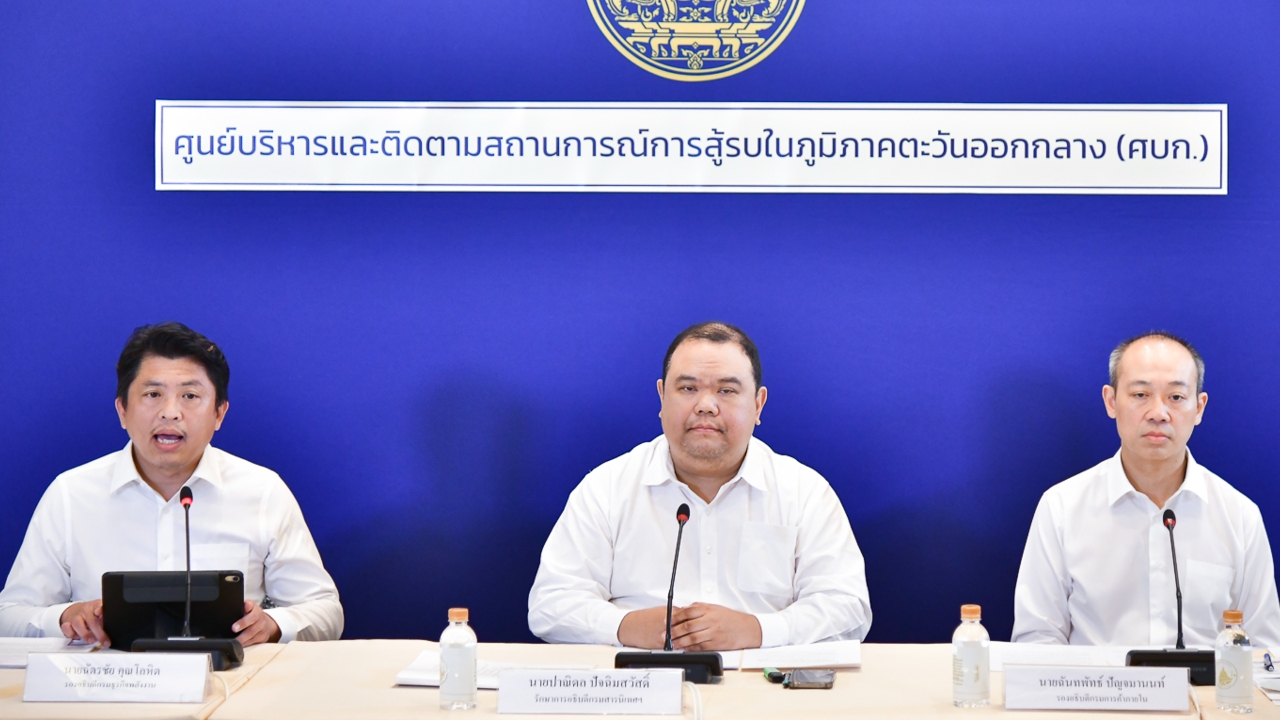
The Energy Center revealed progress on the Prime Minister's order for comprehensive nationwide stock inspections, enforcing a system that requires daily and retrospective one-month oil stock reporting to prevent hoarding. Full legal action will be taken if oil hoarding is found.
On 29 March 2026, Chatchai Khunlohrit, Deputy Director-General of the Department of Energy Business, spoke about energy measures, especially fuel oil. The latest data as of 27 March (1-27 March) shows diesel production averaging 82.21 million liters per day, with sales at 82.99 million liters per day. Exports average 10.43 million liters per day, totaling 87.42 million liters daily for sales and exports combined. Gasoline production averages 34.40 million liters daily, sales at 35.25 million liters, and exports at 0.84 million liters daily, totaling 36.09 million liters for sales and exports. Overall, diesel production and sales have increased compared to January-February, when domestic sales were around 70 million liters per day.
The Department of Energy Business emphasized the importance of public confidence regarding fuel sufficiency and distribution. They have continuously conducted on-site inspections beyond reported data to verify actual oil volumes in the field.

In the second week of March, inspections covered the entire country's oil stock to verify compliance with legal reserve requirements. The Department and provincial energy offices jointly inspected and confirmed that stock levels complied with legal standards and matched reported figures.
Additionally, joint inspections with provincial energy offices checked gas stations nationwide. About 10% of approximately 3,000 surveyed stations were temporarily closed. Inspections included verifying whether these closed stations had oil stock in their tanks to ensure no one was hoarding fuel. They also examined jobbers and oil transport service providers for any suspicious behavior indicative of hoarding.
Following the Prime Minister's order on 20 March, the Department integrated inspections with the Department of Special Investigation (DSI), the Royal Thai Police, and the Department of Provincial Administration. They held joint meetings with provincial administrative units to inspect oil depots across various provinces.
Furthermore, the Energy Minister visited oil depots in Lam Luk Ka, Pathum Thani province, emphasizing full fuel sales. It was confirmed that fuel sales to the public are normal. The Ministry of Energy has issued a directive enforcing the Fuel-DM (Fuel Distribution Monitoring) system, requiring oil traders to report daily receipt, delivery, and transport route data. This allows detailed tracking of oil movement from depots to endpoints, including retrospective monthly data to verify full sales to the public.
In addition, the Department of Energy Business launched the Fuel Now application to provide the public with real-time information on gas station status nationwide, showing which stations are open or closed and available fuel types. This works alongside the Pump Radar app developed by civil society to enhance data completeness.
These measures aim to ensure public access to information and confidence that the Department of Energy Business supervises full fuel distribution. If hoarding or suspicious cases are found, legal action will be taken. Recently, unauthorized oil storage was discovered at three locations holding about 30,000 liters of oil. Legal complaints have been filed, and authorities reaffirm their commitment to taking action to the fullest extent.
