

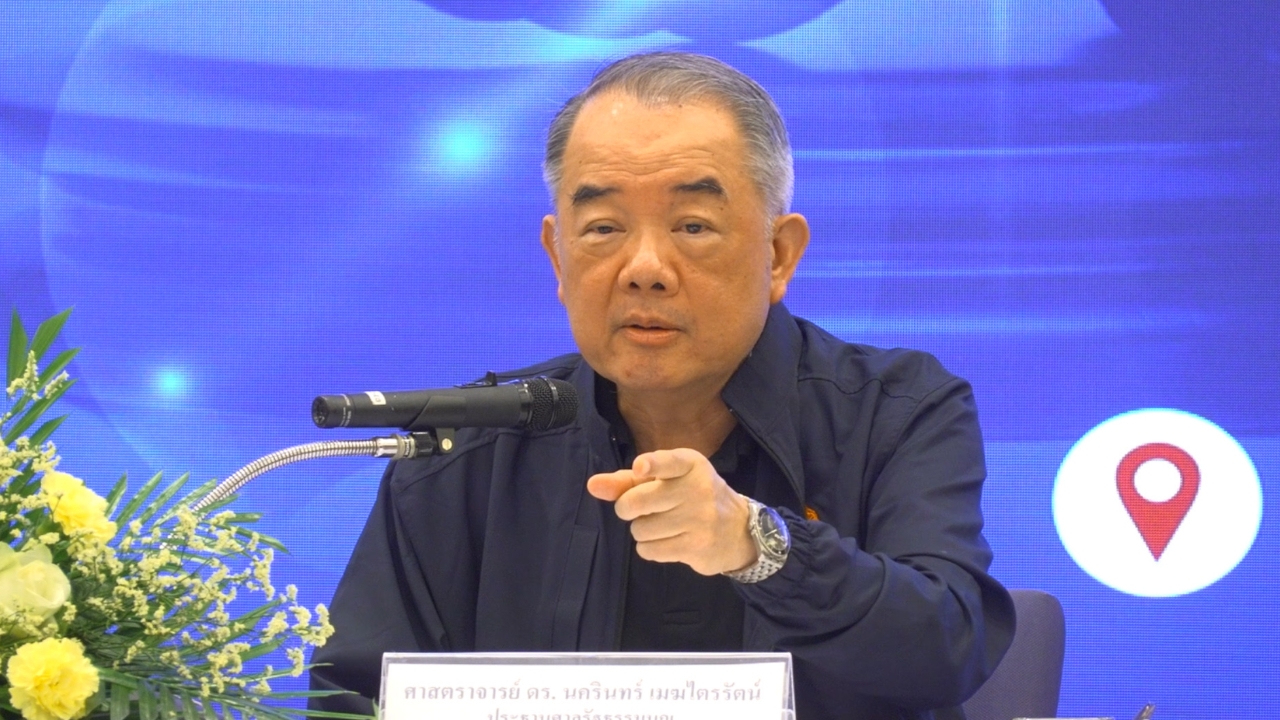
Nakarint reflects on 28 years of the Constitutional Court, affirming that its nine judges work independently without pressure or lobbying. He explains the purpose of overseas study trips to strengthen ties with the global judiciary, acknowledges public challenges to the court's image, stresses it is not a tool to harm opponents, and notes rulings inevitably dissatisfy some parties due to their nature.
On 30 Mar 2026 at 09:00 at Divana Plaza Hotel in Krabi province, Mr. Nakarint Mektrairat, President of the Constitutional Court, spoke about the court's role and operations at the event 'Constitutional Court Meets the Media.' He said the Constitutional Court is a judicial body, and all discussions must stay within its framework. The nine judges each exercise independent discretion in decisions, free from interference, pressure, or lobbying, which are impossible. Established 28 years ago, the court has matured like a young adult, showing that both the court and Thai society understand its functions. Over 28 years, Thailand has had three constitutions—in 1997, 2007, and 2017—with significant changes in the court's powers and duties, such as reducing judges from 15 to 9 and other adjustments, both positive and negative. Judges come from diverse backgrounds, including former engineers who led the Department of Highways and legal experts, reflecting the varied nature of constitutional cases. The court independently decides whether to accept disputes. Thailand has consistently faced constitutional case challenges throughout its history.
The Constitutional Court President also explained about overseas study visits. The court, established 28 years ago, has 260 staff—smaller than some subdistrict or municipal offices—and a budget of 368 million baht. The judiciary does not primarily focus on study visits, but such visits are part of organizational care. Therefore, court expenditures on foreign travel are not for leisure but to build relationships and enhance staff knowledge. The court has respected Cabinet resolutions and has since canceled all study visits. He asked for understanding that international work is important. There are 125 constitutional courts worldwide, and Thailand is one of Asia's constitutional courts. Therefore, overseas study visits are conducted cautiously and as part of court administration. Enhancing the court’s work and understanding internationally is crucial, as the Constitutional Court cannot operate in isolation in today's interconnected world.
Mr. Nakarint also addressed media questions regarding the Constitutional Court's public image. He acknowledged that court rulings face challenges from academics and society, with criticism suggesting the court may be used as a tool within the rule of law to harm opponents. Questions about restoring the court’s neutrality image were also raised. He said this is an evolutionary issue. The Constitutional Court was created to adjudicate constitutional disputes. Petitioners come from all sides, whether majority or minority voices. When disputes arise, cases come before the court, which must rule one way or another. As a result, court decisions are accepted or rejected based on which side they favor—right or wrong. Decisions inevitably displease some. The court's image evolves as society and politics mature, meaning political problem resolution should have socially accepted rules, and society must reach sufficient maturity to accept these.
"Societal maturity means that the rules for gaining and relinquishing power must be widely accepted. Constitutional courts worldwide typically face issues in their early years. At first, people are confused about the court’s purpose, believing other means might resolve disputes. But in today's Thai society, when constitutional problems arise, people expect the Constitutional Court to be a refuge. I believe the court's rulings come with explanations that help Thai society understand, for example, what constitutional secrecy in elections means," the Constitutional Court President said.
Mr. Nakarint further noted that constitutional courts in other countries face similar problems. For instance, in the United States, when the president imposed tariffs on foreign goods, the U.S. Supreme Court ruled that taxing authority belongs to Congress, not the president. He questioned whether the court favored the minority or majority. In South Korea, the situation was more severe: the president declared martial law, was then voted out by the parliament, but the removal required constitutional court review to determine its constitutionality, which upheld the removal. Thus, the question of whether the majority or minority prevails is complex. This mirrors Thailand’s challenges. Emotional reactions lead to one perspective, but rational analysis reveals the problem's complexity. When matters reach the court, decisions inevitably favor one side.