

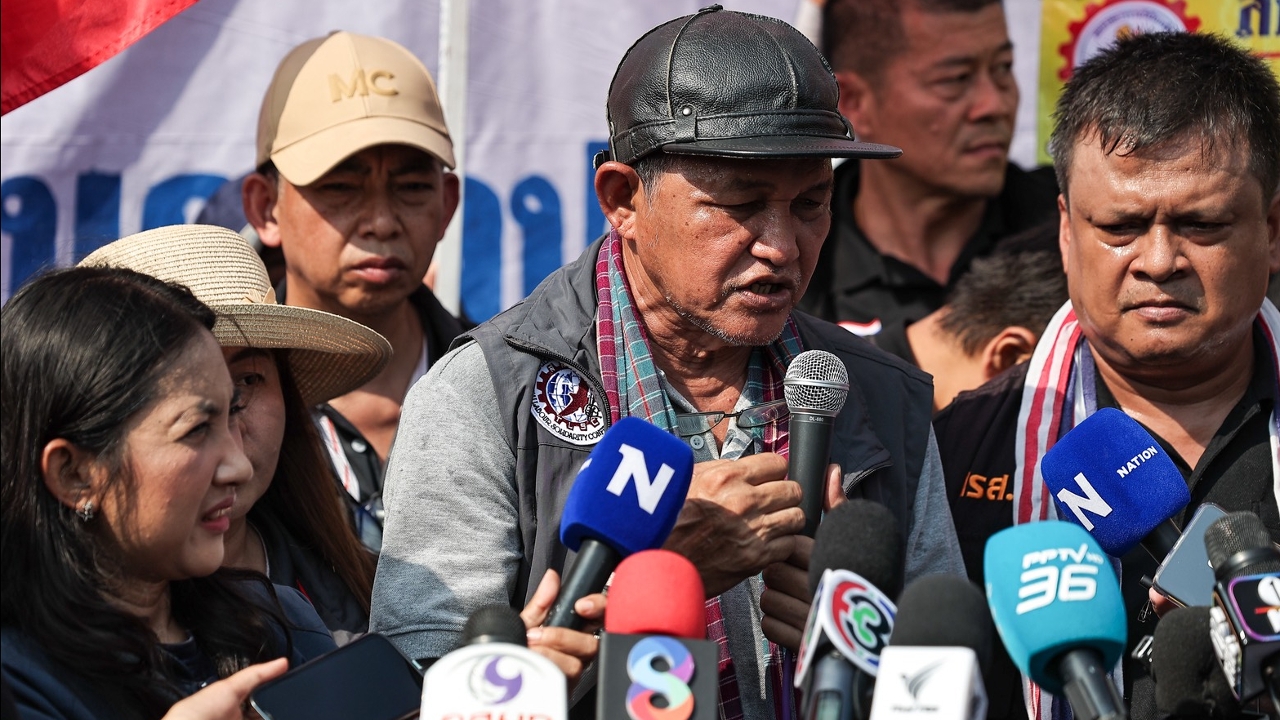
A labor network stormed the Ministry of Energy, protesting soaring refining fees and demanding the government stabilize oil prices and bring PTT back to full state ownership.
At 09:00 on 2 April 2026, leaders of civil society groups and labor networks, led by Mr. Sawit Kaewwan, president of the Thai Labor Solidarity Confederation (TLSC), gathered in front of the Ministry of Energy. They pressured the ministry’s executives and submitted a letter urging the government to urgently resolve the energy crisis, oppose oil price hikes that directly impact living costs, and implement transparent, fair energy policies prioritizing the public interest.
Mr. Sawit stated that Thailand is currently affected by the Middle East war, causing continuous rises in living costs due to oil prices. If the government had strong regulatory bodies prioritizing national interest, today’s protests might not have occurred. He highlighted the abrupt price hikes late at night (around 21:00–22:00) and the unprecedented sharp increase of 6 baht per liter at once, which was equivalent to “a sneak attack” on the people.

He added that the oil shortage crisis in many areas, especially rural provinces, has led to fuel purchase limits of only 500 baht per vehicle, causing long queues at gas stations. This contradicts the Prime Minister’s earlier claim that Thailand has oil reserves sufficient for 106 days. He attributed these problems to an unfair pricing structure that references refined oil prices from Singapore’s market (including transport costs that don’t actually occur and refining fees rising from 2 baht per liter to over 7 baht per liter).
Although Thailand has PTT as a state enterprise, its shares are traded on the stock market, forcing it to prioritize profits over direct public benefit. This raises questions about how much the people truly benefit from PTT’s operations and whether PTT can still act as a market counterbalance to prevent exploitation. Furthermore, there is criticism of state enterprise privatization policies in sectors like electricity production, where private sector involvement has increased, leaving the Electricity Generating Authority of Thailand producing less than 30% of the country’s total capacity. This leads to questions about how much the public benefits from such a structure.

Mr. Sawit also mentioned allegations of hoarding old fuel stocks to sell at higher prices and product hoarding ahead of the Songkran festival. He urged the government to seriously investigate and punish offenders instead of blaming the public. He presented proposals and solutions to the new Minister of Energy, calling for transparent exercise of authority as follows:
1. Short-term measures: Quickly fix or reduce oil prices, as global oil prices have already decreased.
2. Long-term measures: * Reform the entire energy pricing structure and simplify tax collection.
- Review and control refining fees to appropriate levels.
- Manage domestic energy resources to sufficiently meet demand.
◦ Special proposal: Return PTT to full state control (100%) to truly implement fair policies for the public’s benefit.
Regarding calls to boycott fuel stations owned by the family of Mr. Phiphat, Mr. Sawit said this reflects the public’s stance and dissatisfaction. The labor union group will discuss future actions to closely monitor and push for problem-solving measures.
