

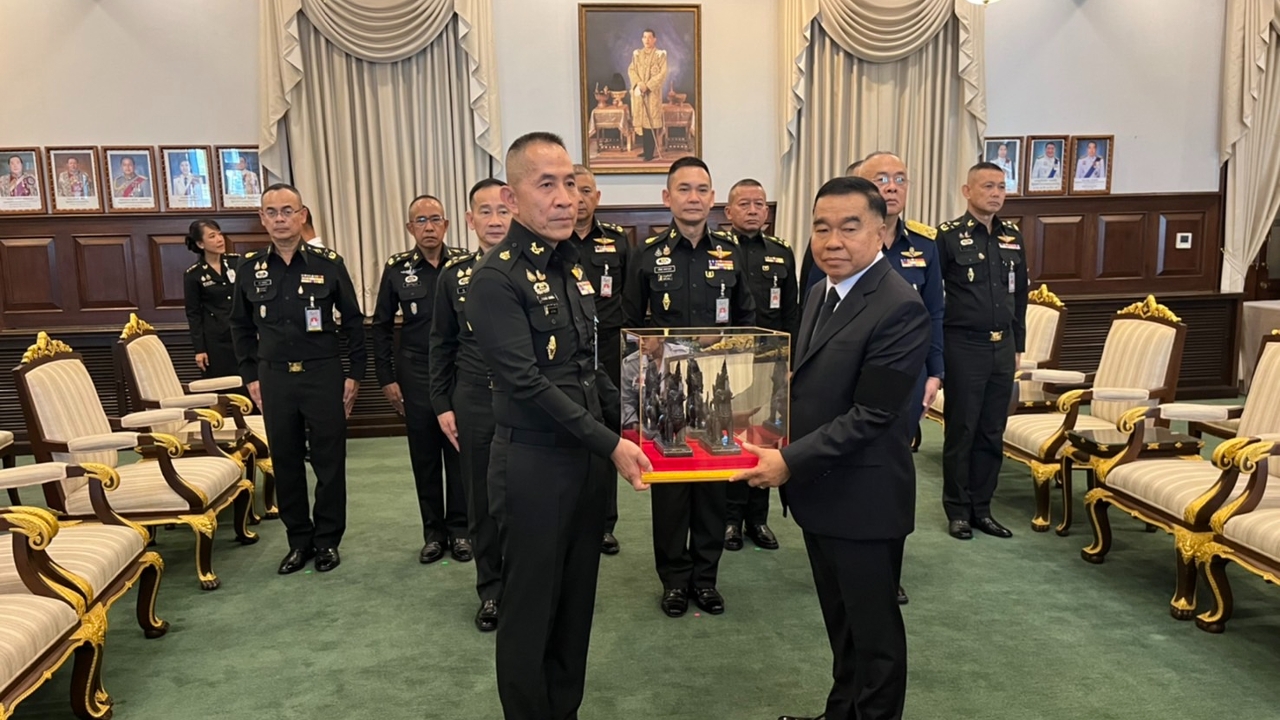
"Big Lek" bids farewell as Defense Minister, openly sharing his thoughts during the conflict period. He accepts criticism because some issues couldn't be discussed. He reveals his mindset: he did not want war, but when fighting occurs, victory is imperative. He expresses sadness over the loss of 42 personnel and trusts "Big Dul" to handle the job well.,
On 3 April 2026 GMT+7, at the Ministry of Defense, General Natthaphon Nakpanich, former Defense Minister, visited to pay respects to the ministry's sacred symbols and participated in a farewell tribute ceremony. Lieutenant General Adul Boonthamcharoen, the new Defense Minister, General Tharapong Malakham, Permanent Secretary of Defense, and other ministry officials attended the ceremony and presented farewell roses.
General Natthaphon thanked the media for their efforts to understand, explaining that during the Thai-Cambodian border conflict from July to December 2025, he was advised by senior officials to limit his public statements. He responded that if he remained silent, no one else would dare speak. He recalled that affected villagers, agricultural associations, and industries called for easing restrictions due to hardships. He encouraged them to speak publicly about their difficulties, but they hesitated for fear of public backlash. He acknowledged facing criticism himself and advised that those suffering should voice their concerns first, though ultimately they refrained from speaking out.
General Natthaphon continued that observing wars in the Middle East showed that global society now often resolves issues through force. Therefore, Thailand might follow a similar path. He said he does not feel discouraged by criticism; people often ask how he can stay cheerful despite harsh criticism. He explained that he understands the situation and has told the media that public misunderstanding or some media outlets' lack of understanding stems from his inability to disclose all information. Some matters cannot be revealed because doing so could harm the nation, the military, and reveal our thinking to Cambodia. Hence, criticism is to be expected. If he wanted to avoid criticism, he would have spoken openly, but since he could not, he accepts the criticism with understanding. He said he just had to wait for the mission to conclude and then leave his post.
General Natthaphon said he has no specific messages for the new minister or the younger military personnel regarding the current situation, as the new minister is capable. Lieutenant General Adul rose through the military ranks, commanding units and eventually becoming commander of the 2nd Army Region. He believes this leadership may please society and be a good path forward. He added that although he himself did not come from a combat unit but served 19 years in the Army Operations Department until becoming its chief, his thinking is operational, viewing the big picture rather than purely academic. His guiding principle is “win without fighting, but when fighting, must win.” He recalled that before the two clashes, he spoke with General Tea Seyha, Cambodia’s Deputy Prime Minister and Defense Minister, requesting troop withdrawal as they wished to avoid fighting and bloodshed, believing other solutions were possible. But when the Cambodian side did not withdraw, they had to prepare and be ready to fight.
General Natthaphon further explained that during the first clash, he felt their readiness was incomplete and told the army to hold off and prepare better. By the second clash, confidence was higher, so they pressed on. At a certain point, they considered the mission complete. In military terms, when the higher command assigns to capture objectives 1-2-3, if the subordinate units secure those, the mission is considered done. Sometimes subordinate units want to take objectives 4 and 5, but the higher command says it’s enough, and the mission is complete. He asked the media to understand this military perspective.
When asked if there were any current concerns, General Natthaphon said he has no worries about the border situation. However, another matter nearing completion is an increase in compensation for company sergeants, battalion sergeants, and regimental sergeants. Due to the parliament’s dissolution, the process could not continue, and the government said approving compensation now would bind the next government. So, it was postponed. Lieutenant General Adul likely agrees with this approach, as it supports lower-ranking personnel, the backbone of the army. This matter has been finalized at the Ministry of Defense and sent to the Ministry of Finance, but the new cabinet will decide. He is confident Lieutenant General Adul will approve since he is a former noncommissioned officer and understands their concerns.
General Natthaphon also reflected that the soldiers who died in the fighting were mostly noncommissioned officers and sergeants, which saddens him. He referenced a U.S. operation in Venezuela with no casualties, illustrating superior combat power. In Thailand’s two clashes during his tenure as deputy and then full minister, 42 personnel died, which he regrets. Still, he considers the mission a success. He said soldiers, when fighting is necessary, must not dwell on losses but always hope for peace and no casualties. However, when combat happens, soldiers must be ready to sacrifice for the nation.
At the end, General Natthaphon thanked the media, saying he adhered to correctness and used wisdom in resolving issues, viewing force as a last resort, following the best principle. “Win without fighting, but when fighting, must win.”