

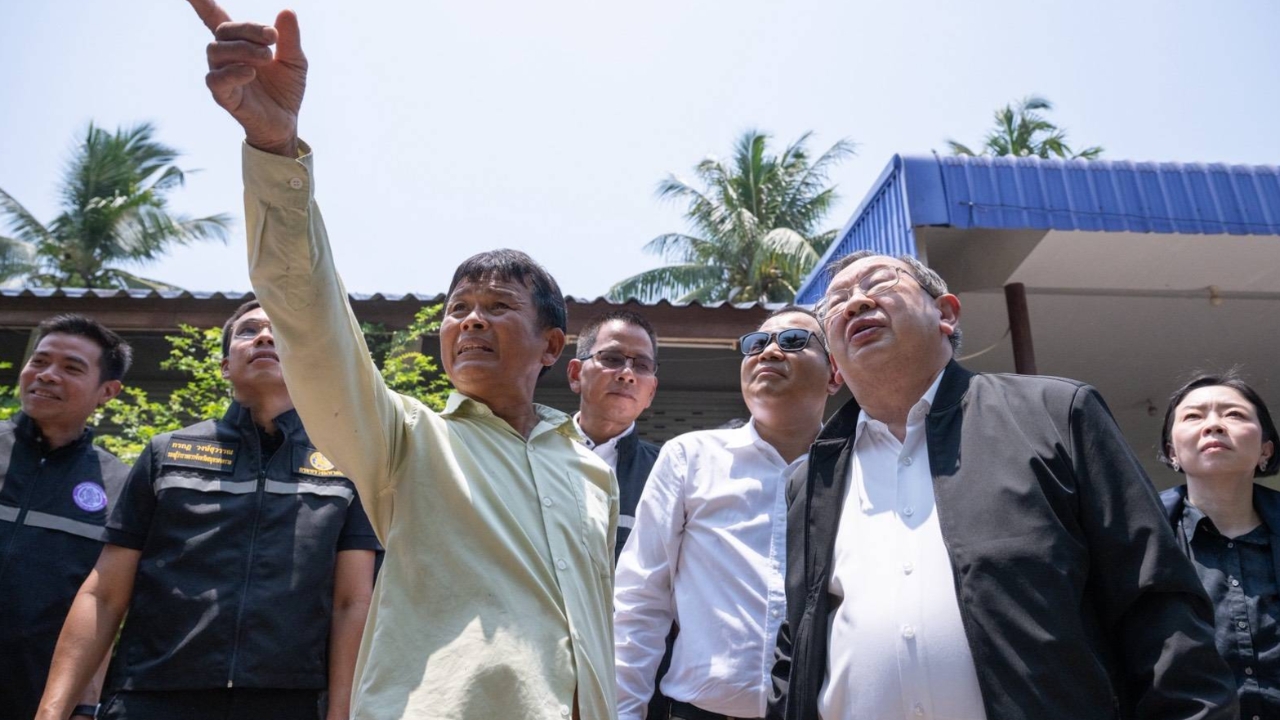
The Ombudsman president discussed with aromatic coconut farmers to address falling prices but faced complaints from farmers during the meeting who expressed distrust in government agencies' inspections after no irregularities were found. They fear inspections are merely ceremonial and lament that coconut prices are even lower than those of limes.
On 3 Apr 2026 at 10:00 AM at the Samut Songkhram Provincial Hall, Mr. Songsak Saichue, the Ombudsman president, visited Samut Songkhram and Ratchaburi provinces to follow up on complaints about falling aromatic coconut prices. He met with relevant agencies and coconut farmers to resolve issues regarding low coconut prices, adulteration by operators, and monopolistic business practices by multinational capital affecting farmers in Samut Songkhram and nearby provinces. Discussions included agencies such as the Department of Internal Trade, Department of Business Development, Office of Trade Competition Commission, representatives from Samut Songkhram province, and complainants to urgently address the low price problem after joint meetings and proposals for solutions.
They followed up by gathering information and listening to facts from operators and relevant agencies, as well as hearing directly from operators and farmers.
Representatives of farmer groups from Phraek Nam Daeng and Plai Phong Phang subdistricts, Amphawa district, Samut Songkhram province, led by Mr. Seree Sukrungreungchai, village headman of Moo 5, Plai Phong Phang subdistrict, stated that coconut prices have fallen sharply, with large coconuts bought at 3 baht each and smaller ones at 50 satang, while the farmers’ cost per coconut is 7 baht. This forces farmers to bear the cost burden, leaving insufficient funds to buy fertilizer or maintain coconuts to required standards. Consequently, foreign orders have been canceled despite Samut Songkhram being the province with the largest coconut cultivation and full potential. They question why prices have fallen so drastically and urge relevant agencies to urgently assist affected farmers.
“Regarding the government's proposal to establish a commercial warehouse to buy all types of agricultural products to compete with Chinese warehouses, I am not confident it will be able to handle the large volume of produce. I also acknowledge that farmers lack sufficient experience and time to distribute coconuts themselves, even if facilities are available. The Prime Minister’s statement that involvement will make Thai people wealthy seems unlikely, as currently farmers are all struggling,” Mr. Seree said.

Mr. Kampee Thongplew, a member of the Maeklong Lovers Community and an aromatic coconut farmer who filed the complaint to the Ombudsman, said Samut Songkhram has about 350 coconut warehouses, including about 10 large ones. He filed a complaint requesting an investigation of large warehouses mainly transporting coconut water by tanker trucks. He expressed suspicion about the FDA’s random inspections of nine warehouses for adulterants in coconut water which found no contamination and questioned whether officials followed up on the mixing formulas set by factories. He said he cannot trust government agencies inspecting warehouses, as officials cannot access in-depth information and inspections are coordinated in advance, allowing warehouses to prepare and show only what they want inspected. This is widely known in the province and is seen as an attempt to whitewash operators, though officials should be suppressing wrongdoers, not protecting them. He suggested that working procedures need to build public trust to obtain deep information for action.
Pharmacist Suwassa Sukcharoenkana from the Samut Songkhram Public Health Office admitted that joint inspections with related agencies collecting coconut water samples from nine warehouses found no coconut water in tankers but found packaged coconut water. Tests showed no syrup mixing and no bleaching or chlorine agents from simple tests. Some factories used preservatives within acceptable standards that are safe for consumption. Regarding standards for 100% coconut water, the Department of Medical Sciences is researching and developing criteria to guide testing of genuine coconut water, which varies by variety and season. This is a key issue with central public health urging rapid policy and standard enforcement. Meanwhile, the FDA has inspection guidelines for coconut drinks in the market and will work with the Department of Special Investigation (DSI) and provincial public health to test all coconut drink companies in Samut Songkhram to trace back to the producing warehouses and forward to operators.
A representative from the Department of Business Development said that inspections of warehouses, mostly in Ratchaburi province, found that foreigners hold no more than 50% shares. They found evidence suggesting possible nominee violations and have worked with the Central Investigation Bureau (CIB) to raid companies suspected of nominee activity, finding evidence and prosecuting for foreign business license violations. However, law enforcement faces challenges under the Foreigners' Offenses Act since parliament was dissolved. With a new government, they plan to push this issue back into parliament and propose a prime ministerial regulation to manage and resolve illegal foreign business and products for cabinet consideration to ensure continuous action against nominee businesses.

Then Mr. Songsak Saichue, the Ombudsman president, and his team visited to receive information on resolving complaints at the Large-Scale Aromatic Coconut Farmers Agricultural Cooperative Ltd., Wat Phleng district, Ratchaburi, and the Safe Pesticide-Free Fruit Producers Community Enterprise in Wat Kaew subdistrict, Bang Phae district, Ratchaburi. Most farmers complained similarly that coconut prices are low, with warehouses buying only 1.5–3 baht per coconut depending on size. Additionally, Chinese warehouse representatives control market mechanisms and have reduced purchases from farmers in Ratchaburi, citing their own coconut plantations. Coconut water processing is forced to follow mixing formulas dictated by Chinese factories; otherwise, they refuse to buy coconut water from farmers.
Ms. Thipwimon Wutthiamphon, a coconut farmer and board member of the Large-Scale Aromatic Coconut Farmers Agricultural Cooperative Ltd., said today they want the government, especially the Ministry of Commerce, to urgently establish a central warehouse and find new export markets, especially in Europe, besides China. Currently, Chinese investors suppress Thai coconut purchase prices but sell them at higher prices. Exporting coconuts to European markets requires farmers to obtain organic certification from the European Union. Thus, they ask the government for urgent assistance.
