

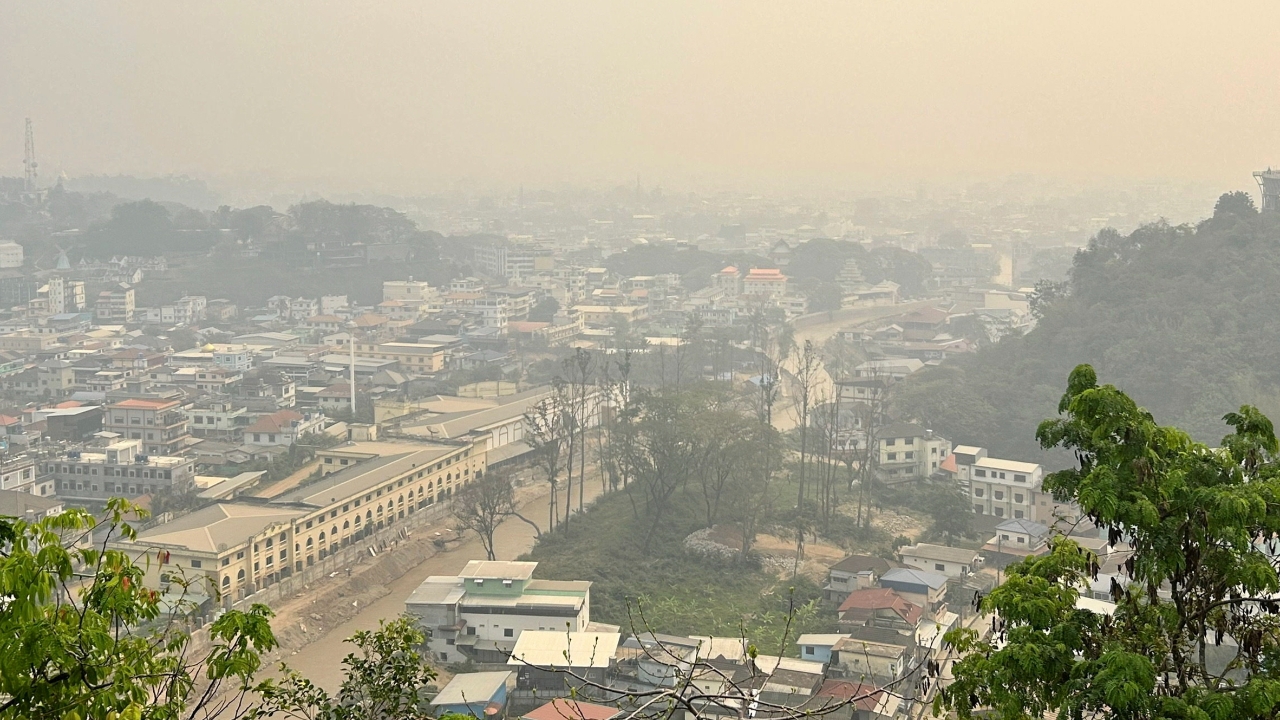
The Permanent Secretary of the Ministry of Public Health has issued nine directives to address PM 2.5 dust in northern Thailand, expressing concern as Nan, Chiang Rai, and Lamphun have remained in the red zone for 12 consecutive days. Forecasts indicate that dust levels are likely to increase in many areas over the next one to two days.
5 April 2026 GMT+7 Dr. Somruk Jungsaman, Permanent Secretary of the Ministry of Public Health, spoke about the PM 2.5 dust situation which is trending upward. He said that Mr. Patthana Prompat, Minister of Public Health, is concerned and has emphasized close monitoring and urgent management to protect public health and reduce its impact.
As of 07:00 today, air quality monitoring shows PM 2.5 levels (24-hour average) exceeding the standard of 37.5 micrograms per cubic meter (µg/m³), reaching the orange level that begins to affect health, in 41 provinces. Among these, 32 provinces have exceeded the standard for three or more consecutive days.
Meanwhile, PM 2.5 levels at the red level, which pose significant health risks (above 75 µg/m³), have been recorded in 13 provinces. These provinces include:
1. Chiang Mai: 314.30 µg/m³
2. Chiang Rai: 225.40 µg/m³
3. Lamphun: 183.00 µg/m³
4. Mae Hong Son: 175.20 µg/m³
5. Nan: 161.70 µg/m³
6. Phayao: 149.50 µg/m³
7. Bueng Kan: 147.50 µg/m³
8. Lampang: 124.60 µg/m³
9. Phrae: 119.20 µg/m³
10. Phitsanulok: 93.40 µg/m³
11. Nong Khai: 92.00 µg/m³
12. Nakhon Phanom: 83.60 µg/m³
13. Loei: 75.60 µg/m³
In some provinces, PM 2.5 has remained in the red zone for consecutive days, such as Nan, Chiang Rai, and Lamphun (12 days), Phayao and Lampang (11 days), Chiang Mai and Phrae (10 days). The forecast indicates dust levels will increase over the next one to two days, especially in the northern, northeastern, and upper central regions. This is due to the density of hot spots exceeding the air ventilation capacity.

The Permanent Secretary further revealed that Emergency Medical and Public Health Operations Centers (PHEOC) have been established in 12 provinces: Chiang Mai, Chiang Rai, Lampang, Nan, Lamphun, Nakhon Phanom, Phayao, Phrae, Mae Hong Son, Bueng Kan, Tak, and Phitsanulok.
Given the severity of the situation in northern areas, on the evening of 4 April, a meeting was held with PHEOC for Health Region 1 to monitor health care for the local population. Nine directives were issued to provincial health offices and related teams across all provinces in Health Region 1:
1. All health service units must verify patient data related to PM 2.5 exposure using Hospital Information Systems (HIS) to assess the situation and report findings within specified timeframes.
2. Coordinate closely with provincial governors to utilize disaster declaration powers to expedite procurement of essential equipment such as dust nets and masks, ensuring timely response to the situation.
3. Provide proactive health care, especially for vulnerable groups in affected areas.
4. Communicate and publicize factual information addressing public concerns through all channels, using medical experts to build public confidence.
5. Monitor and inspect firebreaks around 35 hospitals deemed at risk to reduce potential threats to health service units.

6. Collect and summarize situation reports, operations, public care, and preparedness to inform public communications.
7. Academic centers in the region, including the Disease Prevention and Control Office and Health Centers, should provide guidance and knowledge transfer to provincial health offices and local hospitals.
8. Manage resources under the 'One Region One Hospital' network by regularly checking medical supply inventories and coordinating equipment support across provinces within the region to ensure continuous public service.
9. Improve and develop the data platform of Disease Prevention and Control Office 1 in Chiang Mai to ensure accurate, complete, and up-to-date information for effective planning and management of the situation.
Regarding public health care in the eight provinces of Health Region 1, proactive screening has been conducted in 75 districts classified as red zones, covering 29,324 people. Vulnerable groups have been fully supported in every province. A stockpile of 1.7 million masks, 182,000 N95 masks, and 68,000 children's masks has been prepared. In red-zone areas, health services are conducting outpatient and emergency health screenings, while health volunteers are performing proactive health checks in locations where dust levels have been red for more than three consecutive days. Risk communication is ongoing through various channels, emphasizing avoidance of outdoor exposure and the importance of wearing N95 masks for safety when outside buildings.