

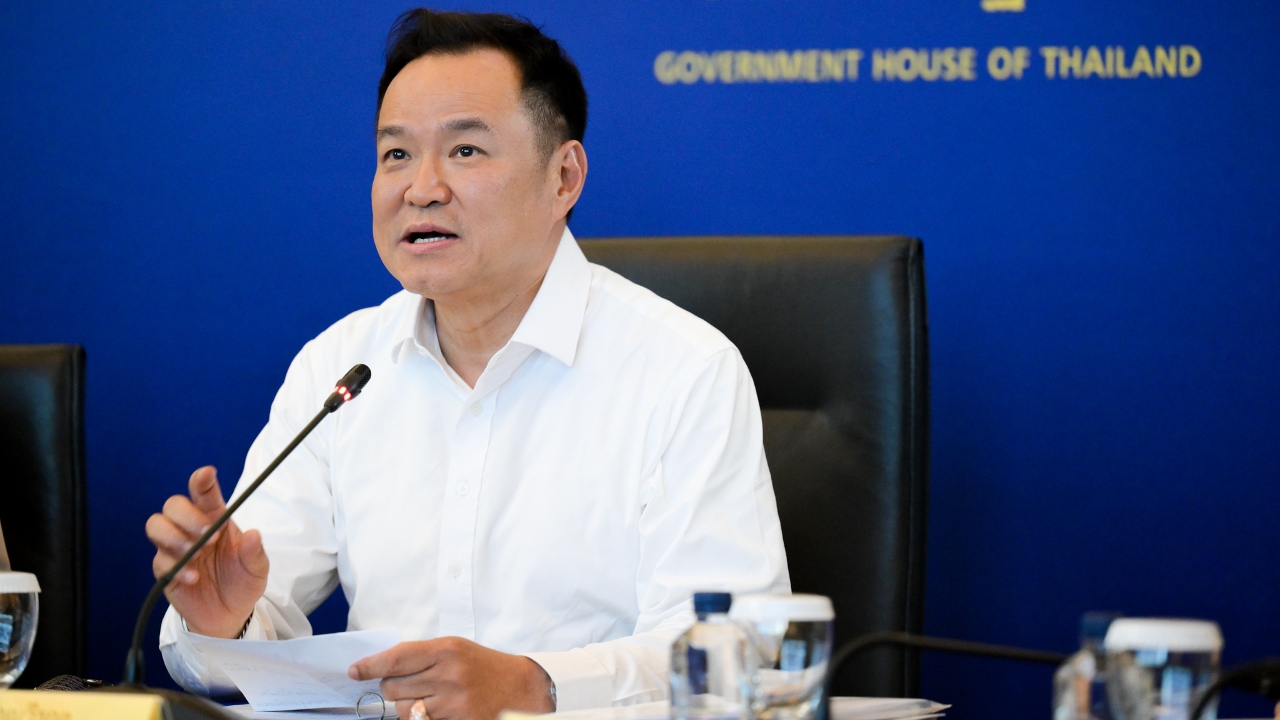
The "Anutin 2" government policy statement, spanning 19 pages, highlights 23 urgent policies. It acknowledges the current period of high global uncertainty and commits to advancing Thailand as the "Global Food Security Hub." "Global Food Security Hub"
On 5 April 2026 GMT+7, reporters stated that the Anutin Charnvirakul government has completed drafting a 19-page policy statement to present to the House of Representatives for the official policy address scheduled for 9-10 April. The summary states that the government will adhere to three key principles:
1. To protect and preserve the nation’s institutions: the nation, religion, and monarchy.
2. To firmly uphold governance under a constitutional monarchy with the King as Head of State.
3. To adhere to the rule of law, ensuring fair law enforcement and public administration based on good governance for the benefit of the people.
Emphasizing the encounter with widespread uncertainty
The Prime Minister’s policy document also states that the government has managed the country amid widespread uncertainty in economic, social, political, international relations, and global geopolitical conditions by implementing urgent key policies. Quick Big Win Key initiatives include stimulating the economy through the Khon La Khrueng Plus program, measures to reduce public expenses, addressing informal debt issues and monopoly threats while protecting national interests, intensifying anti-drug and influential figure crackdowns, enhancing safety and proactive communication to build tourist confidence, resolving investment bottlenecks to attract domestic and foreign private investment, accelerating trade and investment negotiations with promising new markets, adding value to agricultural products, repealing redundant laws that hinder imports to ensure fairness for foreign investors. These efforts have restored public confidence and revitalized Thailand’s economy, which had been stagnant, resulting in higher growth forecasts for Q4 2025, achieving short-term stimulus with long-lasting and broad effects.
Mitigating impacts during caretaker government period
However, the world is currently experiencing high uncertainty due to intense conflicts in the Middle East, disrupting crude oil and natural gas production and transportation globally. Reduced supply amid steady demand has caused fuel and energy prices to fluctuate sharply, with a rapid upward trend. This affects economies, international trade, and energy procurement worldwide, including Thailand. The duration and direction of this situation remain unpredictable.
The government has worked to mitigate impacts on the Thai people through existing state mechanisms under the caretaker government's authority and duties. These include upgrading consular services to protect Thai nationals abroad, securing sufficient fuel supplies for domestic demand, managing key production factors in the industry and agriculture sectors affected by conflict, especially raw materials and inputs linked to energy prices such as chemical fertilizers, industrial chemicals, and petrochemical raw materials, to prevent increased costs from undermining producers' and farmers' productivity and competitiveness. Fuel and energy price management is combined with increasing biofuel proportions to reduce oil imports, while boosting demand for agricultural by-products, supporting Thai farmers' incomes. Energy-saving measures are also implemented in government agencies.
Accelerating preparation of the 2027 budget
Once fully in office, the government will expedite implementing its policies by maximizing resource use within fiscal discipline to increase flexibility in managing potential emergencies ahead. It will accelerate budget disbursement efficiency and promptly finalize the 2026 annual budget transfer act to utilize resources continuously for resolving problems and mitigating disasters for the Thai people. The government will also speed up relief measures for vulnerable groups affected by rising fuel prices impacting livelihoods and employment. Discussions with Thai business associations will plan imports and exports to alleviate impacts on domestic enterprises affected by supply chain disruptions. Concurrently, the government aims to turn global crises into economic opportunities by incentivizing foreign companies to establish regional headquarters in Thailand and negotiating with trade partners to expand markets for agricultural and processed food exports, reinforcing Thailand’s role as the "Global Food Security Hub." At the same time, the government will expedite the 2027 annual budget enactment in line with the normal budget calendar and reduce unnecessary expenditures by state agencies that do not address national problems.
Proposing 23 major urgent policies
Alongside this, 23 urgent policies are proposed to create opportunities and enhance the country's competitiveness, including:
1. Creating equal opportunities for all groups to start and grow, generating jobs and careers for Thai people.
2. Restructuring Thailand’s economy for sustainable growth and competitiveness.
3. Connecting Thailand to the global economy and building trade alliances.
4. Transitioning from traditional agriculture to precise, secure, and sustainable agriculture.
5. Establishing Thailand as a key regional travel destination, upgrading tourism from quantity-focused to high-value creation.
6. Strengthening Thailand's status and credibility on the global stage.
7. Enhancing stability.
8. Driving economic diplomacy to expand opportunities for people and Thai businesses through integrated "Team Thailand" efforts.
9. Promoting border security free of all threats and resolving cross-border issues jointly with neighbors and regional countries.
10. Ensuring security and safety of citizens' lives and property.
11. Developing national defense systems and military capabilities that are prepared, appropriate, and aligned with current and future security contexts.
12. Developing volunteer military systems and reforming conscription.
13. Guaranteeing free education with real access, job opportunities, and learning anytime, anywhere.
14. Improving the Thai health insurance system to provide immediate treatment nationwide.
15. Strengthening the family institution as the fundamental social unit and building strong communities to adapt to Thailand’s demographic changes.
16. Managing water and disaster prevention systematically.
17. Developing a national disaster insurance system.
18. Driving the country to achieve net-zero greenhouse gas emissions by 2050.
19. Conserving and using natural resources valuably and sustainably.
20. Transforming bureaucracy into a fair, intelligent digital system.
21. Reforming government systems and strengthening state financial discipline systematically.
22. Developing laws to improve people's quality of life.
23. Seriously addressing structural corruption.