

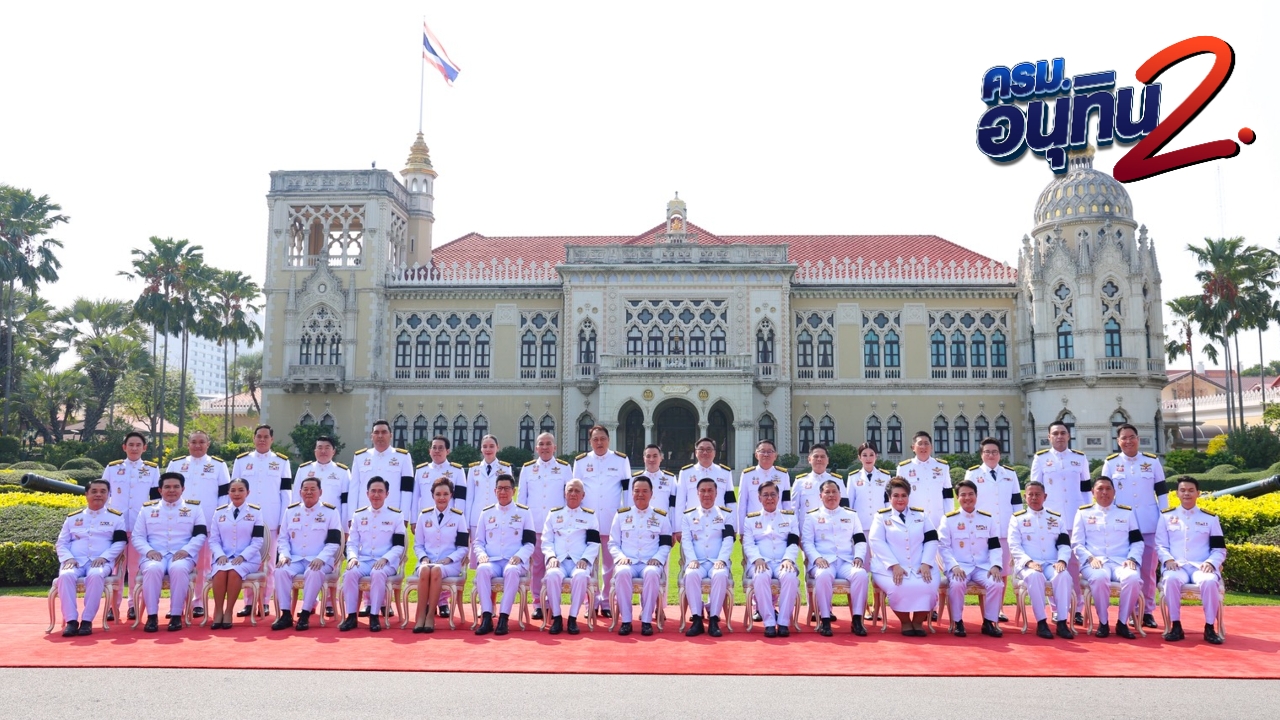
Joyful... the "Anutin 2 Cabinet" gathered for a group photo in front of the Thai Khu Fah Building at the Government House. Prime Minister Anutin led the new ministers in paying respects to the replica of the Narisinha deity to bring good fortune before leading the cabinet to the oath-taking ceremony.
On 6 April 2026, after the cabinet completed preparations for the oath-taking ceremony, Prime Minister and Minister of Interior Anutin Charnvirakul led all 35 ministers to join together for the Anutin 2 Cabinet group photo in front of the Thai Khu Fah Building at the Government House. They wore formal white uniforms despite the nearly 40 degrees Celsius temperature. Along the walkway, Anutin spoke with Deputy Prime Minister and Minister of Higher Education, Science, Research and Innovation Yossanan Wongsawat. The atmosphere was orderly.
Then, Anutin led the cabinet to take another group photo at the foot of the Thai Khu Fah Building stairs before some new ministers went to pay respects to the Narisinha replica atop the building. The entire cabinet then took some rest as they wished. Later, at 17:10, the cabinet boarded cars arranged by the Secretariat of the Cabinet and departed from the Government House to Amphorn Sathan Throne Hall at Dusit Palace to take the oath at 19:00.


At 20:00, the Prime Minister will chair a special cabinet meeting at Santi Maitri Building, Government House. The agenda includes approving the government policy statement draft for Parliament, scheduled for 9-10 April, officially declaring the administration’s direction. The meeting will also consider establishing a new management center to monitor the Middle East conflict (CBK), and appoint three prime ministerial advisors: Wan Muhamad Nor Mata, Police General Permpoon Chidchob, and Attapol Rerkpiboon, former Minister of Energy.


The key highlight is Deputy Prime Minister and Finance Minister Ekniti Nitithanprapas, who chairs the Fuel Price Structure Review Committee (KCT), presenting conclusions on the fuel price structure to the meeting with a two-phase problem-solving approach.
1. Past period covering March: Since the law cannot be applied retroactively, the government will have the Ministry of Energy negotiate with refineries to recover excess profits to help reduce the burden on the public, similar to the model used during the Russia-Ukraine war.
2. Future period starting April: The government will invoke the Emergency Decree on Fuel Shortage Prevention and Mitigation, B.E. 2516 (1973), granting the Prime Minister authority to delegate the Energy Policy Committee (EPC) to set future prices and refining fees directly.
Using the Emergency Decree will empower the Prime Minister to delegate the EPC to determine future prices and refining fees. This will lead Energy Minister Eknat Promphan to convene a meeting on 7 April to set refining fees, using actual costs, real selling prices, and historical average profits as standards for calculation.


