

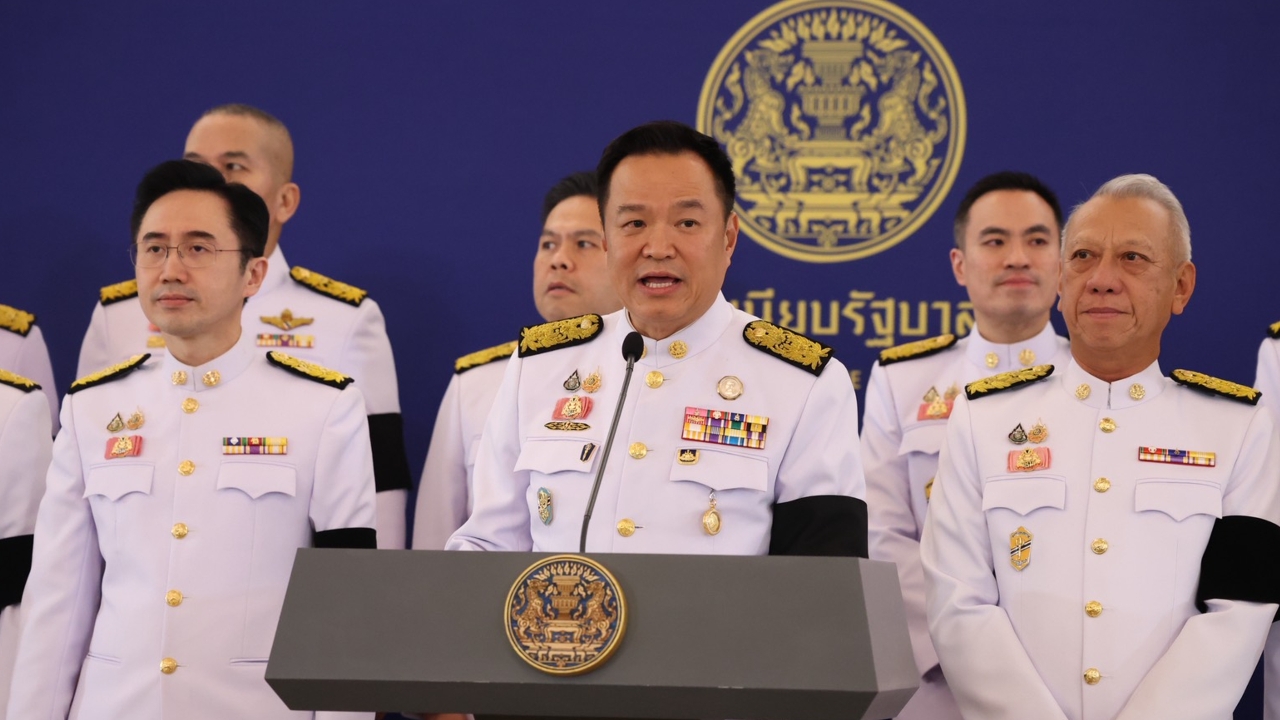
Anutin announced the reduction of the government budget to tackle problems and ease public hardship during the energy crisis, alongside restructuring energy and electricity tariffs. No decision has been made yet to reduce refining fees or oil excise taxes, pending policy announcements. Tags: [government budget, energy crisis, energy restructuring, electricity tariffs, oil excise tax, refining fees]
At 21:54 on 6 April 2026 GMT+7.Tags: [timestamp, date, event timing] Mr. Anutin Charnvirakul, Prime Minister and Minister of Interior.Tags: [Anutin Charnvirakul, Prime Minister, Minister of Interior] He made the announcement following a special Cabinet meeting regarding measures to resolve and prevent fuel oil shortages caused by the Middle East conflict, along with measures to assist the public amid the situation.Tags: [Cabinet meeting, fuel shortage, Middle East conflict, government measures, public assistance]
The Prime Minister stated that today he wishes to announce the government's commitment to alleviating the burden and hardship faced by citizens due to the conflict in the Middle East, a critical global oil and natural gas production region. This has caused rapid increases in prices of oil, natural gas, and related products such as fertilizers and plastic pellets on the world market, impacting countries worldwide including Thailand, which imports energy from the Middle East and other regions—especially the Middle East, from which it imports about 50% of its oil.Tags: [Prime Minister statement, Middle East conflict, global energy prices, Thailand energy imports, oil and gas prices]


The conflict situation continues to escalate, with intensified attacks on production sites, oil refineries, and transportation systems for oil and natural gas across the region. Even if the conflict ends in the future, restoring the damaged oil and gas production infrastructure will take time. Therefore, high energy prices and shortages of petrochemical products are expected to persist for some time.Tags: [conflict escalation, oil infrastructure damage, energy shortage, petrochemical products, energy prices]
A key fact the government must honestly inform the public is that despite all efforts to secure natural fuel oil, the loss of oil and gas from Middle Eastern sources makes it increasingly difficult to find alternative supplies. The government chooses to disclose this fact to the public to foster understanding and readiness to adjust lifestyles to cope with the ongoing situation.Tags: [government transparency, fuel supply challenges, public awareness, energy crisis management]
Anutin further revealed that he and the new Cabinet reaffirm their commitment to work hard to solve problems, find solutions, and protect the interests of all citizens to collectively overcome this difficult period. He urged the public to have confidence in this government, which stands alongside the people and works for everyone, emphasizing that they originate from the people.Tags: [government commitment, Cabinet statement, public reassurance, leadership dedication]


Tags: [] The government's actions include reducing the public sector budget to redirect funds for immediate assistance to citizens affected, restructuring energy prices—both oil and electricity—to lower energy costs promptly, and implementing relief measures to alleviate public hardship.Tags: [budget reduction, energy price restructuring, public assistance, government relief measures] Examples of such measures include projects likeTags: [government projects, relief programs] Khon La Khrueng Plus (Half-Half Plus) program.Tags: [Khon La Khrueng Plus, government subsidy program] Provision of low-interest loans to farmers, industrial entrepreneurs across all sectors, and SME operators.Tags: [low-interest loans, farmers, industry, SMEs, financial assistance]
Meanwhile, the Prime Minister also emphasized thatTags: [Prime Minister emphasis] “We are facing a global-impact crisis. We must accept reality and work together to overcome this crisis. National unity is our most important social capital at this time. I believe that cooperation among all citizens will help us get through this crisis and adapt to future changes. Currently, oil and industrial products may be scarce and expensive. The government will manage the situation to minimize the impact on the public and will implement measures to reduce hardship. Relevant ministers will inform the public accordingly.”Tags: [crisis management, national unity, government relief, public communication]
When asked whether refinery taxes and excise taxes have been reduced, the Prime Minister stated that Deputy Prime Minister and Minister of Finance Ekniti Nitithanprapas is handling the matter, emphasizing thatTags: [tax reduction inquiry, Deputy Prime Minister, Minister of Finance, policy process] everything will be concrete and resolved promptly once the government presents its policy to Parliament.Tags: [policy announcement, government plan, parliamentary process]
Regarding whether the Prime Minister has invoked powers under the 1973 Fuel Oil Shortage Prevention Act, he replied that some parts may be applied as necessary. He confirmed that the Ministry of Energy and the Minister of Finance have explained the necessity of such use. If needed, he is ready to take responsibility and act within his authority if it benefits and alleviates the hardship of the people.Tags: [legal authority, Fuel Oil Shortage Prevention Act, government responsibility, energy crisis management]


