

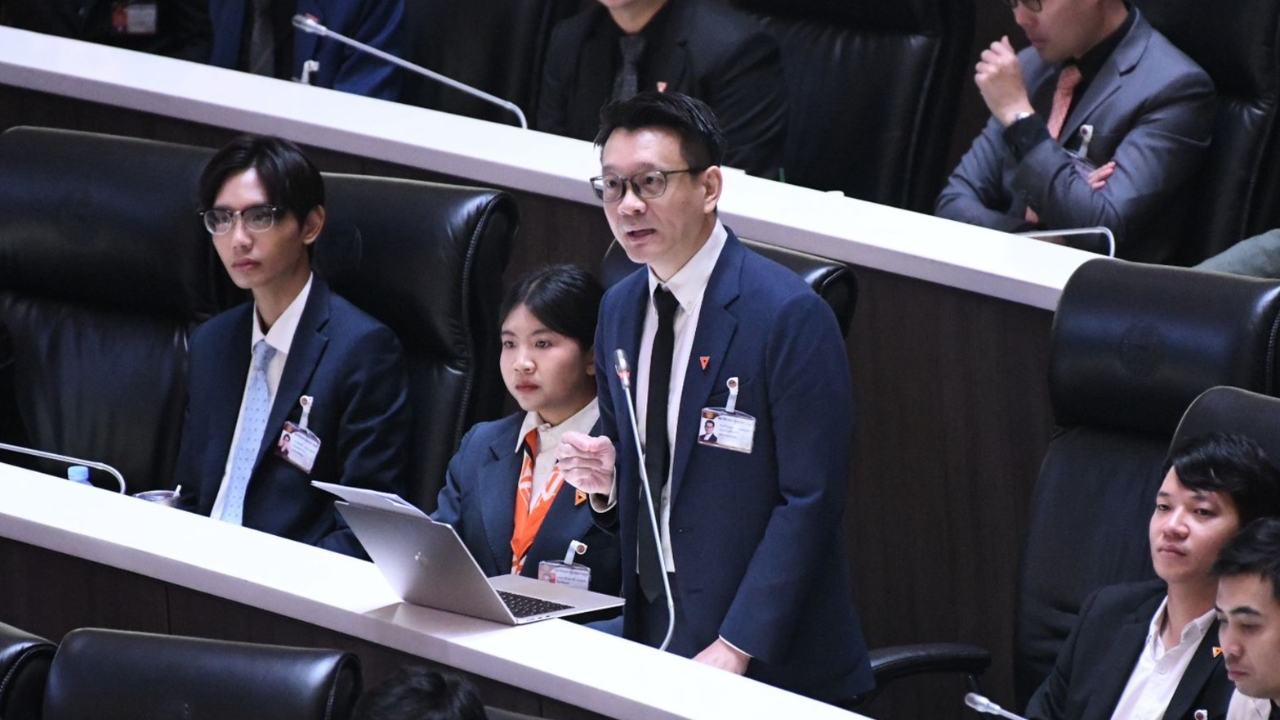
Veerayuth, a party-list MP and deputy leader of the Prachachon Party, proposed four urgent measures the government must immediately implement: subsidize public transport, update fuel data, stimulate the grassroots economy, and accelerate aid for vulnerable groups.
On 7 April 2026, Veerayuth Kanchuchat, party-list MP and deputy leader of the Prachachon Party, commented on a special Cabinet meeting. Despite Prime Minister Anutin Charnvirakul calling a special Cabinet session immediately after the oath-taking ceremony to signal a prompt start, there was no mention of measures or preparations for the upcoming Songkran festival.
Many issues have left some citizens hesitant about traveling back to their hometowns, while business operators remain concerned about sustaining their operations. Veerayuth stated that the public expects the government to announce clear measures to assist citizens and alleviate hardships for businesses amid the energy crisis. He proposed four key issues on which the public seeks clarity to plan their lives during this important festival:
1. Announce subsidies for public transport "the capillaries" nationwide.
Veerayuth pointed out that soaring fuel prices have made people reluctant to travel long distances, but many still wish to visit home during Songkran. A major transit route involves public transport stations like Mo Chit and others to provincial centers, then minivans and vans, which act as the "capillaries," carrying passengers onward to districts and local hometowns.
The Land Transport Control Committee has fixed fares only for large tour buses and major joint service buses (until 20 April 2026), but set fixed fares for 3,000 vans and minivans starting 6 April, based on diesel prices previously at 38.99 baht per liter. Now, with diesel costs exceeding 50 baht per liter, operators risk reducing routes or suspending services on some lines. Allowing operators to freely adjust fares would further burden citizens.
The Prachachon Party proposes the government choose a solution other than fare caps or free-floating fares by providing a "per passenger subsidy" calculated from routes, days, and passenger numbers. This approach avoids risks of hoarding and encourages people to use public transport instead of private cars.
2. Fully update fuel data to increase drivers' confidence.
Veerayuth urged the government to take the management of fuel station data on the Fuel Now website more seriously. Although there are about 25,000 fuel stations nationwide, the latest Fuel Now page reports data from only around 7,200 stations—less than one-third—making it difficult for travelers to plan trips confidently.
3. Set up local product sales points to stimulate the grassroots economy.
Veerayuth suggested the government use the Songkran festival to create economic circulation by setting up "local souvenir sales points" from farmers in each province to sell surplus or low-priced produce. Coordinating among the Ministry of Commerce, Ministry of Agriculture, and provincial authorities, these points would serve travelers going from the city to home (such as aromatic coconuts and mangoes) and from home back to the city (local products). The locations should be convenient for both private vehicle users and public transport travelers.
4. Immediate aid for farmers, fishermen, transport workers, and plastics sector.
Regarding Deputy Prime Minister and Finance Minister Aekniti Nitithanprapas's announcement of a Cabinet meeting on 11 April to focus aid on vulnerable groups, Veerayuth opined that many daily wage earners cannot wait until then. The government should promptly provide targeted assistance to at least four key groups: farmers, fishermen, transport workers, and those facing plastic shortages due to the fuel crisis, which impacts many sectors including over 9,000 commercial fishing vessels and more than 100,000 coastal fishing families.
He proposed the government secure additional fuel supplies for fishermen. Meanwhile, the shortage of plastic pellets and petrochemical products derived from crude oil is worsening, directly affecting over 2,500 plastic factory workers and operators. Urgent measures on both supply volume and cost are necessary; otherwise, this will trigger a chain reaction affecting other goods.